Featured Post
Review: Southern Pines Golf Club (Part 1)
For our final golf course on this North Carolina getaway, we turn to Southern Pines, which would appear on a surface level to be the third m...

Showing posts with label ice. Show all posts
Showing posts with label ice. Show all posts
Thursday, June 15, 2017
Today in Irony
An icebreaker was scheduled to make a trip to the Arctic to measure and survey the effects global warming was having on the Canadian Arctic. It will not be able to make this trip because Arctic sea ice is unusually active, making the trip too dangerous. So yes, the climate change study was cancelled because of climate change. Whoops.

Sunday, July 19, 2015
Pluto: The Story so Far

One of the most unusual features is actually a lack of a particular feature, namely craters. There just aren't any there. Charon, Pluto's most significant moon, has a few craters, but not nearly as many as one would expect. These are two cold, small bits of ice and rock 3 billion miles from the sun. There's no gas giant to exert any sort of tidal flexing as is the case with some moons orbiting Jupiter and Saturn. Based on what we know, Pluto and Charon should both be dead worlds. But they're not. Pluto's surface seems to be less than 100 million years old, very young when it comes to geology.

Not to be completely outshone, Pluto has its fair share of interesting geography. Of course, there's the heart, which I believe has officially been termed Tombaugh Regio after Pluto's discoverer. Then there's the mountains. Now at the cold temperatures we're familiar with, water ice is pretty soft and not really capable of getting very high. Pluto is an entirely different sort of cold, cold enough for

It's going to take a long time for New Horizons to send back all the data it collected during its brief visit, more than a year. Right now, we still barely know anything. I'm sure I'll be writing more posts about Pluto in the future as the data slowly trickles in. To wrap things up today, I just want to say that Pluto is not a planet, it just isn't big enough. That said, that doesn't make this achievement any less spectacular.
Monday, October 13, 2014
Expanding Ice in a Warming World
The planet is getting warmer. This is a fact, backed by data. This year is looking to be the warmest on record, even if the year doesn't end all that warm. However, it is important to note that despite this fact, the world has not gotten warmer overall, and that some regions may not behave how you might expect.
This year, Antarctic sea ice covered 7.72 million square miles, the biggest area since the 1970's, when accurate measurements began. It's theorized that changing wind conditions from global warming have caused cold air to move across the Ross Sea, allowing for large scale ice expansion, since there's no land to stop anything. Warm air has instead started moving across the Antarctic Peninsula, and it's worth noting that ice coverage in that area has shrunk from past years.
 Another area that is not behaving as expected is half a world away, in the Himalayas. Glaciers in the Karakorum region are not shrinking like other glaciers in the area, and if anything, are expanding. As the planet warms, the Himalayas receive more moisture, and for most mountains, this moisture comes in the summer, as rain. Because of geography, the Karakorum receives most of its moisture in the winter, so it falls as snow, feeding the glaciers in the area. So again, even though the area is warming, not everywhere behaves the same way. It is important to note that while some glaciers are expanding, many are not, and that some inconsistency does not mean global warming is not an issue. It would be more remarkable if every place on the planet was warming in the same way.
This year, Antarctic sea ice covered 7.72 million square miles, the biggest area since the 1970's, when accurate measurements began. It's theorized that changing wind conditions from global warming have caused cold air to move across the Ross Sea, allowing for large scale ice expansion, since there's no land to stop anything. Warm air has instead started moving across the Antarctic Peninsula, and it's worth noting that ice coverage in that area has shrunk from past years.
 Another area that is not behaving as expected is half a world away, in the Himalayas. Glaciers in the Karakorum region are not shrinking like other glaciers in the area, and if anything, are expanding. As the planet warms, the Himalayas receive more moisture, and for most mountains, this moisture comes in the summer, as rain. Because of geography, the Karakorum receives most of its moisture in the winter, so it falls as snow, feeding the glaciers in the area. So again, even though the area is warming, not everywhere behaves the same way. It is important to note that while some glaciers are expanding, many are not, and that some inconsistency does not mean global warming is not an issue. It would be more remarkable if every place on the planet was warming in the same way.
Tuesday, September 9, 2014
Plate Tectonics on Europa
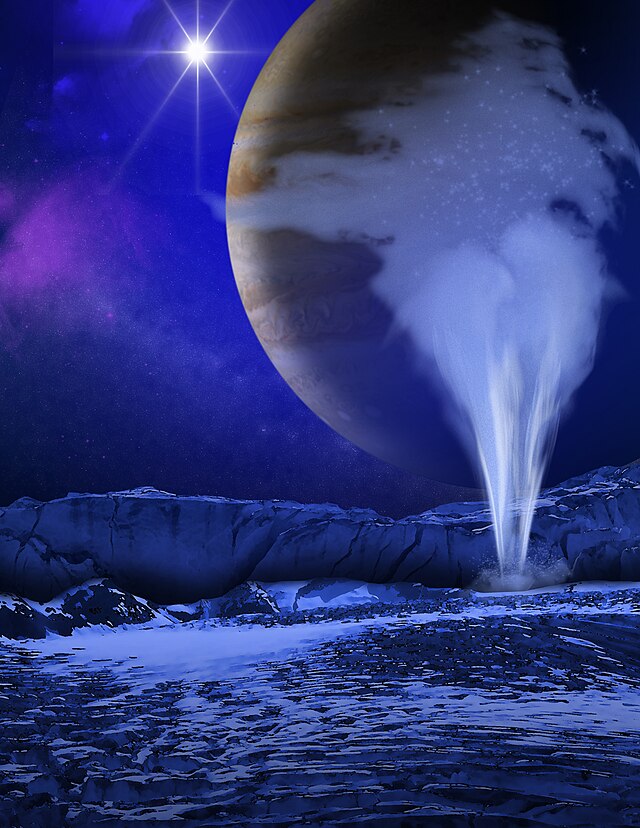
Europa is certainly getting interesting, with the recent suspected discovery of plumes of water jetting out from the surface, similar to Enceladus. While the plates, really large chunks of ice, probably don't go down all the way to the subsurface ocean, material probably gets down there somehow. It doesn't guarantee life exists on Europa, but it makes sending a spacecraft there to find some answers even more important. Seriously, when is that happening?
Subscribe to:
Posts (Atom)