In terms of overall elevation change, no body in the solar system has less than Europa. No feature extends more than a few hundred feet above "sea" level. You've probably heard the saying that if you made a billiard ball Europa sized, it would have more elevation change. All that is true, but just because Europa is flat doesn't mean it's smooth. As a matter of fact, much of the equatorial region could consist of thin ice towers that would wreak havoc on any space probe attempting to land.
These towers, called penitentes, form through sublimation in cold, dry environments at tropical latitudes. We have them on Earth, where they are especially common in the Chilean Andes. Here, they are about 5-15 feet tall, but on Europa, where it could hardly be colder or drier, they could be 50 feet tall and each peak would be about 25 feet apart.
So, what do we do about this? Well, the solution is quite obvious -- don't land at the equator. We'll just have to hope the most interesting stuff isn't there. Luckily, it's going to be quite a long time before we attempt a landing on Europa, so we have time to sort this out.
Featured Post
Review: Southern Pines Golf Club (Part 1)
For our final golf course on this North Carolina getaway, we turn to Southern Pines, which would appear on a surface level to be the third m...

Showing posts with label europa. Show all posts
Showing posts with label europa. Show all posts
Wednesday, October 10, 2018

Wednesday, August 9, 2017
Ice Planets Moving Within Their Star's Habitable Zone Will Skip Habitability
It's bad news for Arthur C. Clarke today. Computer models now suggest that moons or planets composed mainly of ice that warm up as their star becomes more luminous with age will not become nice places to live.
It made a lot of sense, really. Oh, warm up the giant ice cube, then you've got a bunch of water. Unfortunately, it takes more energy to melt a planet covered in ice than what the Earth receives, and by the time the ice does melt, the combo of reduced surface albedo (how reflective the surface is), increased solar radiation, and water vapor's status as a potent greenhouse gas would lead to a very quick runaway greenhouse effect. You'd go from Europa to Venus in no time at all.
So for any monoliths hanging around, don't go transforming Jupiter into a star to help out that native Europan life. Turns out, they're better off as they are.
In completely unrelated news, my review for Atlantic City Country Club is coming along nicely, and it'll be done before the end of the month. Here's a little teaser of the sort of course we're dealing with.

Even if I hadn't been playing from the back tees, I would have on that hole.
Anyway, I'm going to make a commitment to doing a golf course review once a month from now on. I enjoy playing new golf courses, I enjoy taking pictures of golf courses, and I enjoy writing about them. Maintaining that schedule might get dicey over the winter, so hopefully I can build up a backlog so I don't have to go roaming for warm weather on the last weekend in January.
It made a lot of sense, really. Oh, warm up the giant ice cube, then you've got a bunch of water. Unfortunately, it takes more energy to melt a planet covered in ice than what the Earth receives, and by the time the ice does melt, the combo of reduced surface albedo (how reflective the surface is), increased solar radiation, and water vapor's status as a potent greenhouse gas would lead to a very quick runaway greenhouse effect. You'd go from Europa to Venus in no time at all.
So for any monoliths hanging around, don't go transforming Jupiter into a star to help out that native Europan life. Turns out, they're better off as they are.
In completely unrelated news, my review for Atlantic City Country Club is coming along nicely, and it'll be done before the end of the month. Here's a little teaser of the sort of course we're dealing with.

Even if I hadn't been playing from the back tees, I would have on that hole.
Anyway, I'm going to make a commitment to doing a golf course review once a month from now on. I enjoy playing new golf courses, I enjoy taking pictures of golf courses, and I enjoy writing about them. Maintaining that schedule might get dicey over the winter, so hopefully I can build up a backlog so I don't have to go roaming for warm weather on the last weekend in January.
Tuesday, September 9, 2014
Plate Tectonics on Europa
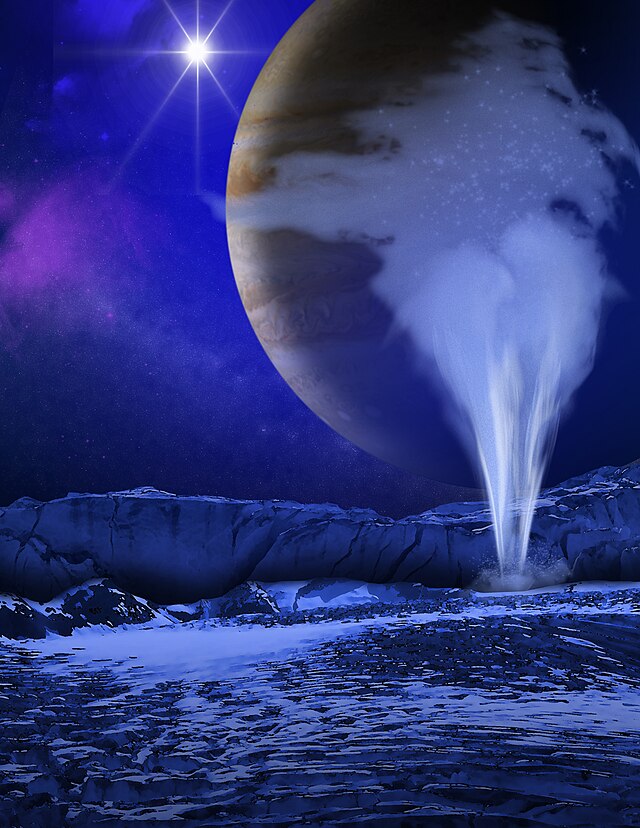
Europa is certainly getting interesting, with the recent suspected discovery of plumes of water jetting out from the surface, similar to Enceladus. While the plates, really large chunks of ice, probably don't go down all the way to the subsurface ocean, material probably gets down there somehow. It doesn't guarantee life exists on Europa, but it makes sending a spacecraft there to find some answers even more important. Seriously, when is that happening?
Subscribe to:
Posts (Atom)