Naturally, all of these new moons are tiny, irregular rocks, just a few kilometers across. There are no undiscovered Titans lurking around Saturn. And of course, similar observations of Jupiter could reveal just as many similar moons, if not more. Jupiter may end up taking the title of Moon Champion back. But for now, Saturn is very, very far ahead.
Featured Post
Review: Southern Pines Golf Club (Part 1)
For our final golf course on this North Carolina getaway, we turn to Southern Pines, which would appear on a surface level to be the third m...

Showing posts with label jupiter. Show all posts
Showing posts with label jupiter. Show all posts
Thursday, June 8, 2023
Saturn Becomes Moon Champion Of The Solar System
Jupiter and Saturn have a lot of moons. Many, many moons. Earlier this year, Jupiter edged ahead of Saturn in the official total, with scientists announcing 12 new moons, bringing its total up to 92, compared with 83 for Saturn. But Jupiter didn't hold onto the crown for long, as scientists have now announced 62 new moons around Saturn. This means Saturn now has 145 official moons, making it the first planet to have more than 100. That is a lot of moons. I distinctly remember growing up learning that Saturn only had 18 moons. And I'm not that old. Naturally, Cassini helped boost the total, but most of the new moons were discovered here on Earth. This batch of 62 came from observations out of an observatory in Hawaii.

Wednesday, November 27, 2019
Reports Of The Great Red Spot's Death May Be Greatly Exaggerated
The Great Red Spot isn't as big as it used to be. Naturally, the conclusions many scientists (and me) came to is that the famed storm was dying. But according to new research, Jupiter may not be getting rid of the Great Red Spot any time soon.
We can only see the top of the storm. Duh. We haven't installed a weather station in the middle of the Great Red Spot. But because we can only get a visual assessment, when the Great Red Spot shrinks, it sure looks like its dissipating. But when scientists took a closer look at its behavior, it turns out that whatever is driving the storm is still going strong. In that regard, nothing has changed, and so long as the Great Red Spot's driving forces still exist, it isn't going anywhere.
Wednesday, February 28, 2018
The Great Red Spot Is Disappearing

No storm lasts forever, even on Jupiter, and the Great Red Spot has been shrinking for decades. When Voyager 2 passed by in 1979, the storm was more than twice the size of Earth, a far cry from observations during the 19th century, when the Great Red Spot was at least four times the size of Earth, but still pretty big. But now the Great Red Spot is only slightly bigger than the Earth, and it may be gone entirely in 20 years.
Is it going to be a difficult time when the Great Red Spot finally disappears? Given how much trouble people have accepting Pluto isn't a planet anymore, I'd say yes. I'm going to say the memory of the Great Red Spot will outlive the storm's demise, though whether it will live longer than the storm is another question entirely. Can we keep up the Great Red Spot mythos for hundreds of years? That may be tricky.
Friday, May 26, 2017
Jupiter is Stranger Than We Thought
On the one hand, it's hardly surprising that an enormous gas giant doesn't work the way we first thought it did. It's space. Conventional logic is usually wrong. On the other hand, it's still surprising. It's not like Jupiter is a complete unknown to us, with Galileo fulfilling the same role Cassini is currently (though not for much longer) performing around Saturn. It was a big flagship space probe that orbited Jupiter for nearly 8 years, and in doing so vastly expanded our knowledge of Jupiter and the Jovian system.
 (Brief aside: Cassini and Galileo may be very similar space probes, but I don't think there's a question that Cassini was by far the more successful of the two. Galileo suffered several technical issues that hindered its abilities and orbited for 8 years, whereas Cassini has suffered no such problems and has orbited for 13 years.)
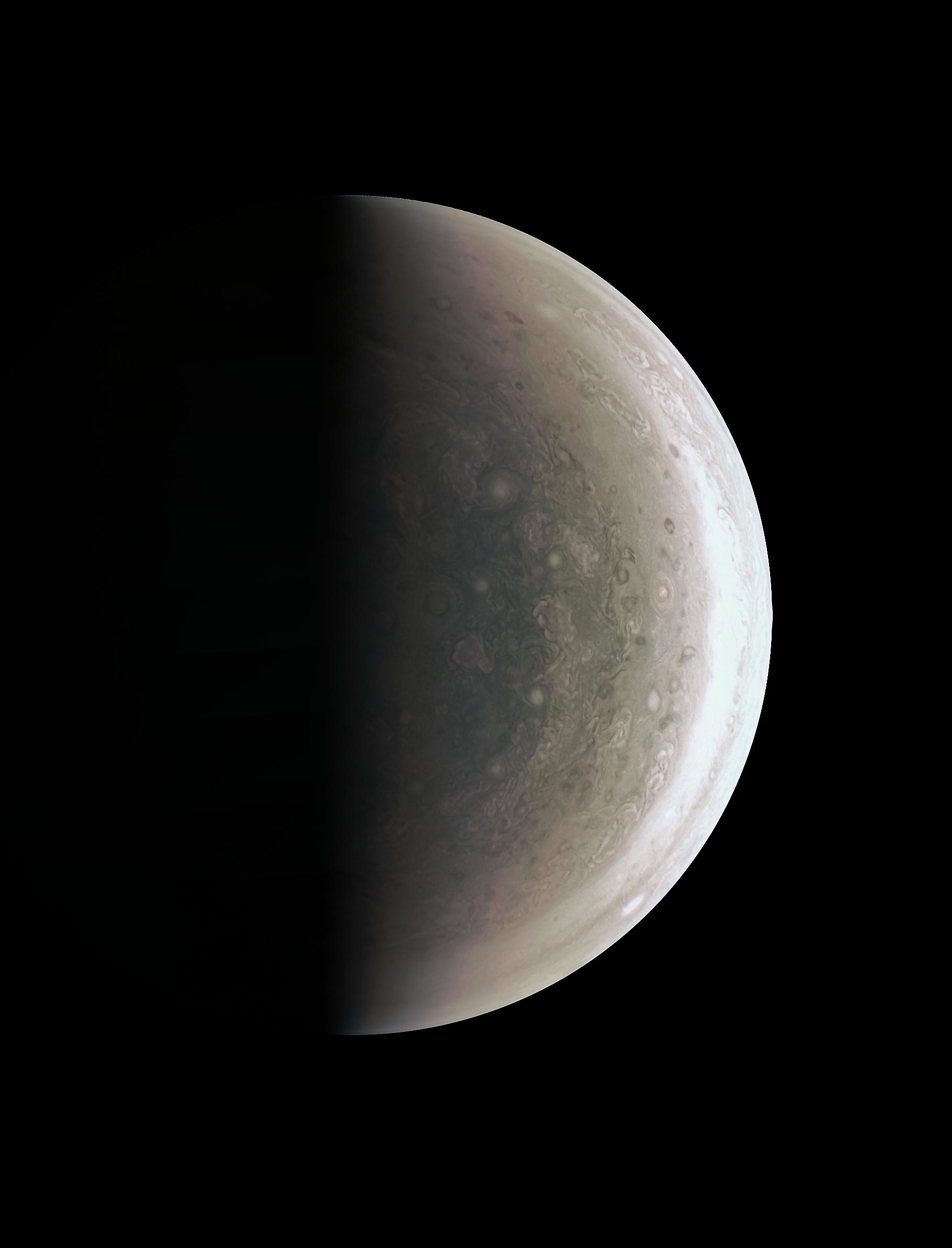
It's been nearly 14 years since Galileo took its final dive into Jupiter, and once again, a space probe orbits Jupiter. Juno is a space probe designed to learn more about Jupiter itself rather than its moons, and from polar orbit it has done a very good job of this. For one thing, the Jovian polar regions don't match the rest of the planet. You think of Jupiter, you see the red, brown, and white stripes, but in fact, the poles are mostly blue. And that's just an obvious thing we learned because we finally got a chance to look at Jupiter's poles (Jupiter has almost no tilt, so it was impossible to get an image of them without sending a probe into polar orbit).
Suffice to say, a gas giant that bears almost no resemblance to Earth has an atmosphere that operates in ways entirely different to our own. For one, the enormous Jovian auroras work in reverse, caused by electrons leaving the polar regions, rather than entering them as they do on Earth. It also appears that the sun is not the primary driver of weather on Jupiter, and once you drop below the upper atmosphere, things don't quiet down. The lower parts of the atmosphere are just as diverse as the upper parts. A big band of ammonia orbiting the equator was particularly interesting, as there is no good reason why it should be there at all.
Things don't get quieter even further down in Jupiter's central regions. There are noticeable fluctuations in Jupiter's gravitational and magnetic fields, indicating a non-uniform interior and deep convection within the planet. The article concludes with a quote that I find rather appropriate, both to this current situation and to astronomical science in general: "In hindsight, it’s hard to imagine why would we have ever thought it would be simple and boring." Indeed.
It's been nearly 14 years since Galileo took its final dive into Jupiter, and once again, a space probe orbits Jupiter. Juno is a space probe designed to learn more about Jupiter itself rather than its moons, and from polar orbit it has done a very good job of this. For one thing, the Jovian polar regions don't match the rest of the planet. You think of Jupiter, you see the red, brown, and white stripes, but in fact, the poles are mostly blue. And that's just an obvious thing we learned because we finally got a chance to look at Jupiter's poles (Jupiter has almost no tilt, so it was impossible to get an image of them without sending a probe into polar orbit).
Suffice to say, a gas giant that bears almost no resemblance to Earth has an atmosphere that operates in ways entirely different to our own. For one, the enormous Jovian auroras work in reverse, caused by electrons leaving the polar regions, rather than entering them as they do on Earth. It also appears that the sun is not the primary driver of weather on Jupiter, and once you drop below the upper atmosphere, things don't quiet down. The lower parts of the atmosphere are just as diverse as the upper parts. A big band of ammonia orbiting the equator was particularly interesting, as there is no good reason why it should be there at all.
Things don't get quieter even further down in Jupiter's central regions. There are noticeable fluctuations in Jupiter's gravitational and magnetic fields, indicating a non-uniform interior and deep convection within the planet. The article concludes with a quote that I find rather appropriate, both to this current situation and to astronomical science in general: "In hindsight, it’s hard to imagine why would we have ever thought it would be simple and boring." Indeed.
Thursday, October 9, 2014
Exoplanet Mapping

Hubble was also able to find water vapor in the planet's atmosphere, which doesn't do the planet much good, seeing as it's hot enough to melt quite a lot of metals, let alone water, but it does mean that we can detect water vapor in the atmospheres of exoplanets, which will come in handy whenever we start peering at smaller, cooler worlds. You know, ones that might have life.
My Twitter
Tuesday, September 9, 2014
Plate Tectonics on Europa
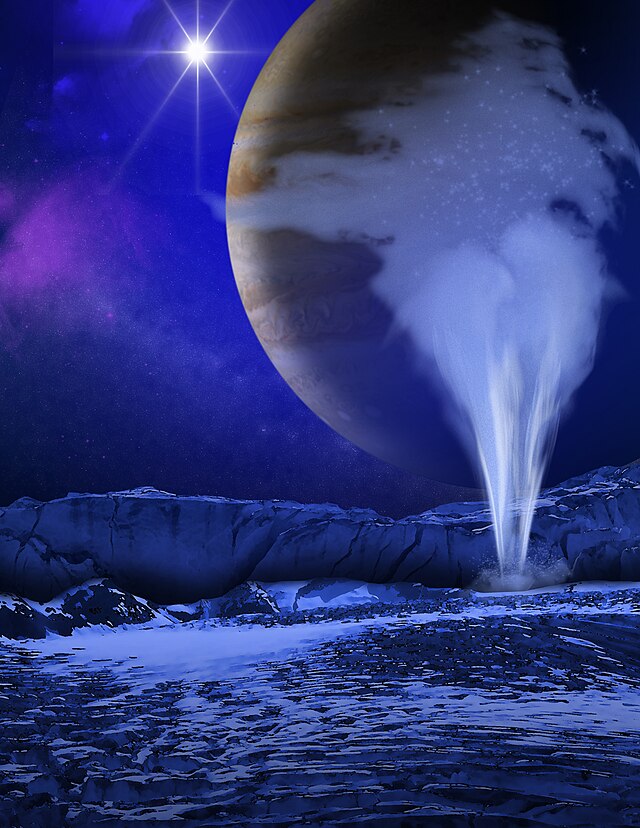
Europa is certainly getting interesting, with the recent suspected discovery of plumes of water jetting out from the surface, similar to Enceladus. While the plates, really large chunks of ice, probably don't go down all the way to the subsurface ocean, material probably gets down there somehow. It doesn't guarantee life exists on Europa, but it makes sending a spacecraft there to find some answers even more important. Seriously, when is that happening?
Subscribe to:
Posts (Atom)