Naturally, all of these new moons are tiny, irregular rocks, just a few kilometers across. There are no undiscovered Titans lurking around Saturn. And of course, similar observations of Jupiter could reveal just as many similar moons, if not more. Jupiter may end up taking the title of Moon Champion back. But for now, Saturn is very, very far ahead.
Featured Post
Review: Southern Pines Golf Club (Part 1)
For our final golf course on this North Carolina getaway, we turn to Southern Pines, which would appear on a surface level to be the third m...

Showing posts with label Saturn. Show all posts
Showing posts with label Saturn. Show all posts
Thursday, June 8, 2023
Saturn Becomes Moon Champion Of The Solar System
Jupiter and Saturn have a lot of moons. Many, many moons. Earlier this year, Jupiter edged ahead of Saturn in the official total, with scientists announcing 12 new moons, bringing its total up to 92, compared with 83 for Saturn. But Jupiter didn't hold onto the crown for long, as scientists have now announced 62 new moons around Saturn. This means Saturn now has 145 official moons, making it the first planet to have more than 100. That is a lot of moons. I distinctly remember growing up learning that Saturn only had 18 moons. And I'm not that old. Naturally, Cassini helped boost the total, but most of the new moons were discovered here on Earth. This batch of 62 came from observations out of an observatory in Hawaii.

Thursday, February 2, 2023
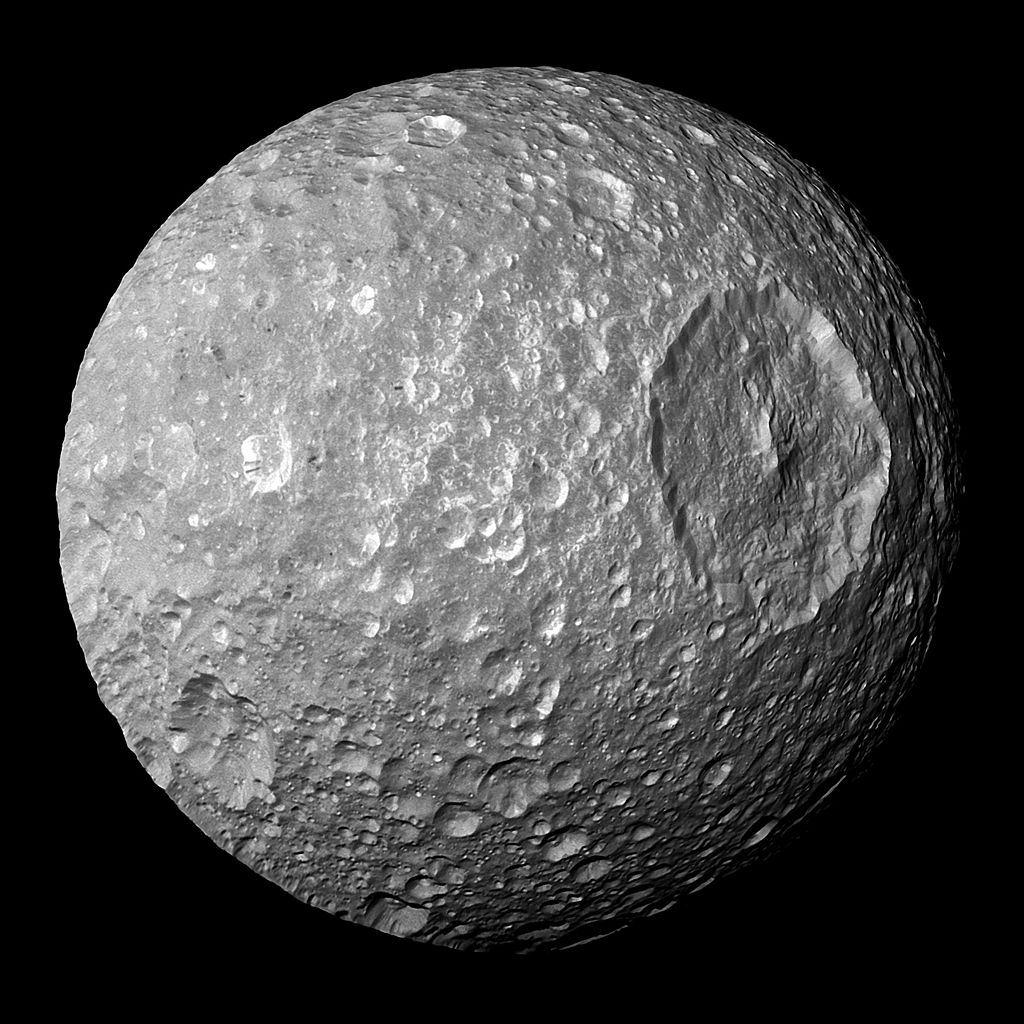
Could the Death Star Moon Have an Ocean?
 |
| NASA/Jet Propulsion Laboratory |
However, there is evidence that Mimas also harbors a subsurface ocean, despite all appearances to the contrary. It all comes back to that massive crater, Herschel. If Mimas had a completely icy shell around its core, an impact of that size would have completely shattered the crust. Obviously, that's not the case. However, the physics do work out if Mimas had a subsurface ocean when the impact occurred. Not only that, but the icy shell around the ocean may be thinning, shrinking from 34 miles thick during the Herschel impact to 19 miles today.
If we are able to confirm a subsurface ocean on Mimas, that would excellent news for the prospects of finding life in our solar system. Beyond the obvious of "hey, here's one more place we could look," there are a lot of moons like Mimas floating around, especially around Neptune. If Mimas has an ocean, there's no reason not to believe other moons like it wouldn't have them as well. There could be a dozen moons with secret oceans in the solar system, which is just that many more places we could find life. Let's just hope that, if Mimas does have life floating around, they don't convert the moon into a fully operational battle station.
Thursday, July 9, 2020
Titan Is Escaping Saturn's Grip Far Faster Than We Thought
As a result of the complex gravitational forces at work between a planet and its moon(s), all moons slowly drift away from their host planet. Our own moon is moving away at a rate of 1.5 inches a year. Titan however is a bit of a speed demon. I'm not sure what transpired between it and Saturn in the past, but Titan is in an awful hurry to get away. Every year, it gets 4.3 inches further away. Yeah, that's not very much, but honestly, what were you expecting? That 4.3 inches is actually 100 times what scientists were predicting, so in that regard, we're talking blazing speed here.
Friday, September 15, 2017
Farewell to Cassini
Today, after 13 years orbiting Saturn, Cassini will burn up in the planet's atmosphere. This is being done to prevent Cassini from crashing into one of Saturn's moons, most notably Titan or Enceladus, to prevent any alien organisms from being exposed to any foreign objects from Earth, living or otherwise.
It's no secret that Cassini has had an incredibly rich and successful mission. It's done more than even the people behind it would have thought possible when they started. And with its demise, there's not a whole lot of representation in the outer solar system. There's Juno orbiting Jupiter, New Horizons somewhere out beyond Pluto, and that's it. And there are no immediate plans to send anything beyond Jupiter either. But there is certainly plenty of reason to go back to Saturn. Cassini has discovered so much. And so, to memorialize Cassini, let's take a look back at just what Cassini has added to the halls of science.
Discovered 7 new moons: Methone, Pallene, Polydeuces, Daphnis, Anthe, Aegaeon, S/2009 S 1 (Hey, it takes a while to name these things)
Landed the Huygens probe on the surface of Titan. This remains the only time we have landed anything in the outer solar system.
 The confirmation of methane lakes on the surface of Titan. We were pretty sure they were there, it made sense, but now, thanks to Cassini, we know for sure. They're not quite big wide oceans like what we have on Earth, and Titan's lakes are confined to the polar regions, but they're there, and the biggest, Kraken Mare, is even bigger than the Caspian Sea on Earth.
The discovery of a subsurface ocean on Enceladus. Of all the things Cassini has done, and it's a lot, I haven't mentioned quite a bit, this is the biggest. I don't think anyone saw this coming. When the Voyagers passed by, they saw an icy little moon, surprisingly smooth and very bright (Enceladus is the most reflective body in the Solar System), but otherwise it was assumed that this was just another dead ball of ice, like most of Saturn's moons. Understandably, it was Titan that captured the imagination.
But when Cassini arrived, things began to change. First, Cassini found the "tiger stripes", a series of fractures in the southern polar region that could be less than a thousand years old. The entire region seemed to be less than a million years old. Then, geysers were discovered erupting from the same place. These geysers are actually the source of material for Saturn's E Ring. This is a dead giveaway, there was definitely a liquid water ocean underneath the surface, and while it was initially believed to be limited to the southern polar region, it's now accepted that the ocean covers the entire moon, and is likely a couple dozen kilometers deep. It's a miniature Europa, and without Cassini, we never would have known about it. It might even be easier to explore Enceladus than Europa, despite being twice as far away, because unlike Europa, Enceladus isn't bathed in lethal amounts of radiation.
Like I said, Cassini has done far more than what I've mentioned, but I think those are the big highlights. It's hard to argue with the accomplishments of Voyager, Hubble, or Spirit and Opportunity, but Cassini certainly isn't far behind in the annals of NASA's most successful missions. It's lived a good life, and a spectacular death dive into Saturn's atmosphere is a pretty good way to go out.

 |
| Credit: NASA/JPL |
Discovered 7 new moons: Methone, Pallene, Polydeuces, Daphnis, Anthe, Aegaeon, S/2009 S 1 (Hey, it takes a while to name these things)
Landed the Huygens probe on the surface of Titan. This remains the only time we have landed anything in the outer solar system.
The confirmation of methane lakes on the surface of Titan. We were pretty sure they were there, it made sense, but now, thanks to Cassini, we know for sure. They're not quite big wide oceans like what we have on Earth, and Titan's lakes are confined to the polar regions, but they're there, and the biggest, Kraken Mare, is even bigger than the Caspian Sea on Earth.The discovery of a subsurface ocean on Enceladus. Of all the things Cassini has done, and it's a lot, I haven't mentioned quite a bit, this is the biggest. I don't think anyone saw this coming. When the Voyagers passed by, they saw an icy little moon, surprisingly smooth and very bright (Enceladus is the most reflective body in the Solar System), but otherwise it was assumed that this was just another dead ball of ice, like most of Saturn's moons. Understandably, it was Titan that captured the imagination.
But when Cassini arrived, things began to change. First, Cassini found the "tiger stripes", a series of fractures in the southern polar region that could be less than a thousand years old. The entire region seemed to be less than a million years old. Then, geysers were discovered erupting from the same place. These geysers are actually the source of material for Saturn's E Ring. This is a dead giveaway, there was definitely a liquid water ocean underneath the surface, and while it was initially believed to be limited to the southern polar region, it's now accepted that the ocean covers the entire moon, and is likely a couple dozen kilometers deep. It's a miniature Europa, and without Cassini, we never would have known about it. It might even be easier to explore Enceladus than Europa, despite being twice as far away, because unlike Europa, Enceladus isn't bathed in lethal amounts of radiation.
Like I said, Cassini has done far more than what I've mentioned, but I think those are the big highlights. It's hard to argue with the accomplishments of Voyager, Hubble, or Spirit and Opportunity, but Cassini certainly isn't far behind in the annals of NASA's most successful missions. It's lived a good life, and a spectacular death dive into Saturn's atmosphere is a pretty good way to go out.
Monday, May 15, 2017
Cassini Has Been Good for Astrobiologists
As you may (or may not) be aware, Cassini's mission around Saturn will be coming to an end this year. For 13 years, Cassini has orbited Saturn, and has discovered a lot. I think that I'll make a more comprehensive post about Cassini closer to October, when Cassini performs its death dive into Saturn, but for now, I want to highlight this. It is interesting how a planet a billion miles away from the sun possesses two moons with the potential of hosting life. Enceladus especially has been a huge surprise. I don't think anyone was expecting Enceladus to be anything more than a ball of ice. But here we are today, with photo evidence of massive geysers spewing organic material out into space. Cassini doesn't have the capability to detect life, but the ingredients are there.
Then, of course, there's Titan. Titan is a fascinating place. A thick atmosphere, a methane cycle that mirrors Earth's water cycle, large methane seas hundreds of feet deep, even rivers of methane, Titan really does resemble an Earth in deep freeze. No one knows if life can use methane instead of water, there are pros and there are cons. But it would be very interesting to find out. Life on Enceladus would be, well, different to life on Earth, but not that different. It would be recognizable to us, and would probably resemble deep-sea life on Earth. But life on Titan? It would be a truly alien biochemistry.
Basically, we need to go back to Saturn. And soon. Enceladus and Titan are just too inviting as targets to resist. Mars is closer, and Europa is basically just a bigger Enceladus, but for my money, if there's life in the solar system, it'll be around Saturn.
Then, of course, there's Titan. Titan is a fascinating place. A thick atmosphere, a methane cycle that mirrors Earth's water cycle, large methane seas hundreds of feet deep, even rivers of methane, Titan really does resemble an Earth in deep freeze. No one knows if life can use methane instead of water, there are pros and there are cons. But it would be very interesting to find out. Life on Enceladus would be, well, different to life on Earth, but not that different. It would be recognizable to us, and would probably resemble deep-sea life on Earth. But life on Titan? It would be a truly alien biochemistry.
Basically, we need to go back to Saturn. And soon. Enceladus and Titan are just too inviting as targets to resist. Mars is closer, and Europa is basically just a bigger Enceladus, but for my money, if there's life in the solar system, it'll be around Saturn.
Thursday, April 7, 2016
Saturn's Moons May Be Younger Then They Look
Here's a story to file under "Unlikely but interesting to think about". Research has been published showing that many of the moons of Saturn are not actually 4 billion years old, but only about 100 million years old. The study suggests that the tidal forces governing the Saturnian moon system and gravitational interactions between moons should very quickly force out inner moons into longer orbits. Models were run to predict how far out the inner moons should have moved out, and were compared to where the moons actually are. Of course, they don't match up. According to the model, the inner moons such as Tethys, Dione, and Rhea are much closer than they should be to Saturn if they are in fact 4 billion years old, and actually haven't moved much at all.
To get a more exact date, the researchers looked at Enceladus. Assuming that the amount of tidal flexing and thus the level of geothermal activity was constant, the scientists were able to estimate just how strong the tidal forces around Saturn are. Using this information and computer models, they estimated that Enceladus had moved from its original orbit to its current one in only 100 million years, making the moon very, very young. The researchers guess that something drastic happened 100 million years ago, reshaping the moons that were present into what we see today while also creating Saturn's dramatic ring system. Now, if Enceladus really is that young, that's bad news for finding any life there. 100 million years, while long on a human scale, is really not enough time for life to develop. But I'm just a bit doubtful about this particular theory. It's interesting, yes, but I think there are too many holes for it to be correct.
To get a more exact date, the researchers looked at Enceladus. Assuming that the amount of tidal flexing and thus the level of geothermal activity was constant, the scientists were able to estimate just how strong the tidal forces around Saturn are. Using this information and computer models, they estimated that Enceladus had moved from its original orbit to its current one in only 100 million years, making the moon very, very young. The researchers guess that something drastic happened 100 million years ago, reshaping the moons that were present into what we see today while also creating Saturn's dramatic ring system. Now, if Enceladus really is that young, that's bad news for finding any life there. 100 million years, while long on a human scale, is really not enough time for life to develop. But I'm just a bit doubtful about this particular theory. It's interesting, yes, but I think there are too many holes for it to be correct.
Thursday, February 5, 2015
Exoplanet with Rings Discovered
What? It most certainly hasn't been two months since the last post, what are you talking about?
Anyway, scientists found an exoplanet orbiting the star 1SWASP J140747.93-394542.6 (what a catchy name) a few years back. Nothing unusual about that, but after a closer look, things got a bit baffling. Ordinarily, when a planet transits in front of a star, the star dims once, and then brightens again. Old J1407, as I am henceforth calling, was not dimming like that. It would dim and brighten many times in succession. They figured out it was a ring system orbiting the planet, J1407b, back in 2012, but at the time, they thought there were only 4 rings.
As it turned out, they slightly underestimated. Apparently this planet has 37 rings, with a radius of 0.6 AU. That means Earth's entire orbit would fit with this ring system. They have an estimated mass of 100 times the mass of the moon, and a gap 0.4 AU out is big enough that a Mars or even Earth-sized object could be orbiting inside. It should be noted that this planet is very young, less than 20 million years, and these rings are not going to last long. Astronomically long, that is. Eventually, those rings will disappear as moons appear, but with that much mass contained in the rings, there could be some pretty big moons. The planet's a bit too far out for any Earth-sized moon to be potentially habitable, which is too bad, but the idea of seeing a ring system that ridiculously oversized would probably make J1407b quite the tourist destination. Now, all we need is interstellar travel...
.jpg/1280px-Saturn_from_Cassini_Orbiter_(2004-10-06).jpg) |
| And you thought these rings were impressive. |
As it turned out, they slightly underestimated. Apparently this planet has 37 rings, with a radius of 0.6 AU. That means Earth's entire orbit would fit with this ring system. They have an estimated mass of 100 times the mass of the moon, and a gap 0.4 AU out is big enough that a Mars or even Earth-sized object could be orbiting inside. It should be noted that this planet is very young, less than 20 million years, and these rings are not going to last long. Astronomically long, that is. Eventually, those rings will disappear as moons appear, but with that much mass contained in the rings, there could be some pretty big moons. The planet's a bit too far out for any Earth-sized moon to be potentially habitable, which is too bad, but the idea of seeing a ring system that ridiculously oversized would probably make J1407b quite the tourist destination. Now, all we need is interstellar travel...
Friday, January 17, 2014
Space and My Childhood
So, I went to a little lecture this evening about Saturn and the Cassini space probe, and while I didn't learn all that much, I do love the subject. Astronomy is just so fascinating to me. It really makes me disappointed when I hear about how NASA's getting its budget cut, and cutting-edge missions to far-off places are getting cancelled because there's not enough money. I dream of flying to space one day, of all the things I want to do in my life, that is the one I want to happen the most. I remember way back in the 90's, watching that little Sojourner rover trundle across Mars, it was amazing just how much it captured my imagination. And at about that same time, I remember watching Comet Hale-Bopp in the night sky. Now that was a sight, I remember it being brighter and bigger than the moon. Space is a place for dreams and ambition, and losing that excitement from our lives would be a big loss.
Subscribe to:
Posts (Atom)