Yes, it's time for another installment of big Pluto news. New Horizons is still sending back data, and will be for several months. As that data comes in, we learn more and more about this surprisingly complex little world. A group of five studies was recently published in the journal
Science about Pluto, so let's take a look at what scientists have
learned.
The first piece of news is that Pluto's surface has a lot of variation in which type of ice is dominant. There are areas which are mostly methane ice, areas which are mostly nitrogen ice, and areas which are mostly water ice. Nitrogen ice is dominant in the flat, craterless plains, while water ice is dominant in the mountainous regions, reflecting their characteristics at the very cold temperature Pluto sits at. Water ice is very rigid and behaves almost like rock does on Earth, while nitrogen ice is much less tough and is able to flow, much like our glaciers on Earth. Indeed, this sort of distinct differentiation in material most closely resembles Earth, where the surface is separated by areas dominated by water and by rock.
Another study focuses on the geology of Pluto, especially Sputnik Planum, the vast, nitrogen ice dominated region in the southern hemisphere. The plain is located on an ancient impact crater, and its smooth, craterless surface contrasts sharply to areas with a heavy crater density scientists were likely expecting all over Pluto, and to areas with an intermediate crater density. Small bodies like Pluto should have frozen solid all the way through billions of years ago, but something is causing Sputnik Planum and much of the surface to refresh itself, though what that mechanism is remains unknown. The same study also demonstrates that Cthulhu Regio is covered in tholins, an organic molecule that has turned the area a deep red. The tholins likely drifted down from the atmosphere and the mountains Wright Mons and Piccard Mons. These are big mountains, Wright Mons is 2.5 miles high and Piccard Mons is 3.7 miles high, and likely formed through cryovolcanism.

Pluto's atmosphere was the focus of a third study. It's a bit less interesting, but it turns out that the Plutonian atmosphere is significantly colder than what was predicted before New Horizons' visit. Because of this, the particles of the upper atmosphere are much less energetic, which in turn means the atmosphere is losing gas at a much slower rate than what was anticipated. Initial estimates were off by about a factor of 5,000.
Don't worry, Pluto's five moons weren't forgotten in all this new research. Pluto's biggest moon Charon is actually quite a bit different from Pluto, and closer in line to what scientists were expecting. There is some very dramatic topography, but on the whole, Charon is a dead world, and has been for about 4 billion years. Its surface is mostly water ice, and is lacking significant amounts of methane and nitrogen ice like Pluto has. Why this is the case is unclear. An additional study examined the 4 smaller moons, which are much more reflective than more typical Kuiper Belt objects, and move very chaotically. This bolsters the theory that the moons are bits of debris that were thrown off in an enormous collision early on in Pluto's history, and the 4 moons are survivors that have managed to escape being sucked up by either Pluto or Charon.
 |
Credit: NASA/John Hopkins University Applied Physics
Laboratory/Southwest Research Institute |
In news unrelated to the
Science studies, scientists recently
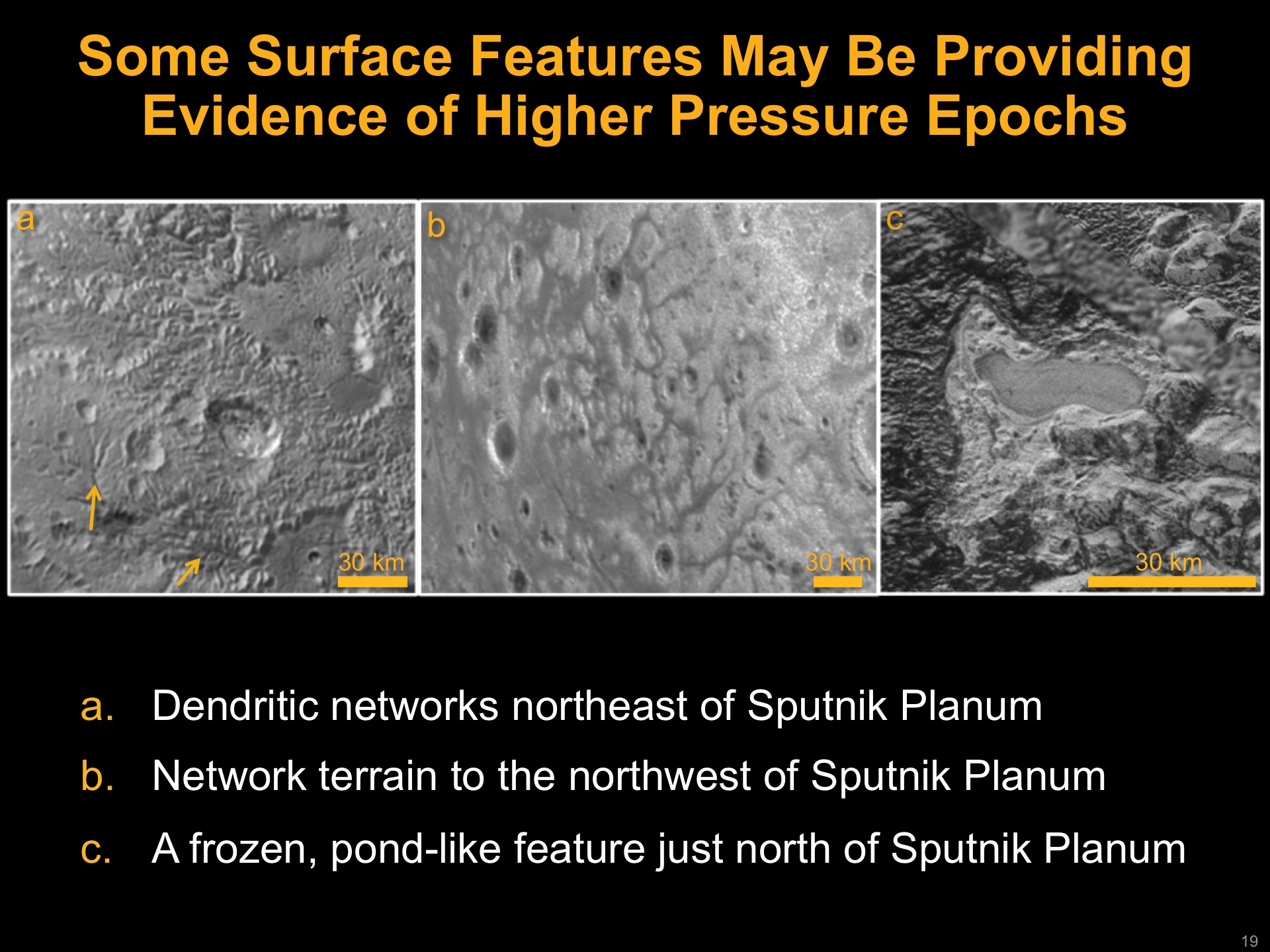
announced that as recently as 800,000 years ago, Pluto likely had a much thicker atmosphere, more substantial than even Mars. Right now, the Plutonian atmosphere has a pressure about 1/100,000 that of Earth's, and this is likely what it usually is. However, Pluto has a axial tilt of about 120 degrees, and as the planet's tilt slowly undergoes procession, there are certain times when the amount of solar radiation in areas with lots of volatile ices goes up dramatically. The resulting outgassing would thicken the atmosphere so that the pressure would increase to about a tenth of Earth's. This is significantly thicker than the Martian atmosphere, and potentially thick enough to allow liquid nitrogen to flow freely on the surface. A thicker atmosphere with liquid nitrogen streams and ponds would explain a series of unusual surface features, such as empty channels similar to those seen on Mars, and a flat, icy area that resembles a frozen pond. The possibility of a thick atmosphere and the existence of a nitrogen cycle similar to Earth's water cycle, even if temporary and limited, on such a tiny, cold world seems pretty far-fetched, but ever since New Horizons flew by, Pluto has surprised us. This batch of new science has made Pluto that much more interesting.
It's still not a planet though.