Featured Post

Review: Southern Pines Golf Club (Part 1)

For our final golf course on this North Carolina getaway, we turn to Southern Pines, which would appear on a surface level to be the third m...

Showing posts with label new horizons. Show all posts

Friday, June 14, 2024

The Sweetest Real Estate In The Solar System

Way back in 2019, the New Horizons space probe passed by the Kuiper Belt object Arrokoth, a 20-mile-wide chunk of ice that bears an uncanny resemblance to a snowman. Arrokoth is thus officially the farthest object ever closely observed and explored, and unless a new target for New Horizons to be pointed at is found in the next few years (an unlikely scenario, considering how little fuel New Horizons has left), Arrokoth will hold that record for a very long time.

 NASA/Johns Hopkins University Applied Physics Laboratory
While the snowman resemblance is kind of neat, there really isn't much to Arrokoth to excite the average person. It's a chunk of ice floating around billions of miles away. However, scientists were intrigued by the object's color; Arrokoth is a rusty red, which isn't generally a color that ice becomes. The theory at the time was that the solar wind had converted Arrokoth's various ices into organic molecules, and that these organic molecules were responsible for the object's unusual color.

Unfortunately, New Horizons couldn't turn around for a second look to answer this very important question, but it didn't need to, courtesy of a new study. The experiment the researchers undertook was shockingly simple: Build a miniature Kuiper Belt object, bombard it with high-energy electrons to simulate billions of years worth of solar wind, and observe the results.

The first thing they noticed after irradiating their chunk of ice was the presence of polycyclic aromatic hydrocarbons, which are actually quite common throughout the universe. But beyond that, they found a couple surprises, namely a sugar you're familiar with: glucose. The very same glucose, in fact, that your body depends on. So, if you went out there, dug up a little chunk, and licked it, the ice would actually taste sweet. It's those various sugars, the researchers said, that give Arrokoth its unusual color.

But before you suit up for the longest trip to the candy store ever undertaken, there's a catch to Arrokoth's sweetness. During their test, the researchers also detected glycerol, which is an important ingredient in soap. And that's not such a nice thing to eat. Unless, of course, you've just dropped the F-dash-dash-dash. Ralphie would probably appreciate a sweet-tasting soap ... so long as he doesn't get his tongue stuck to it.

Thursday, January 3, 2019

New Horizons Completes Fly-by of Ultima Thule

What I really want to know is if the timing was purposeful or not. Having New Horizons complete this historic fly-by on New Year's Day just seems a little too convenient.

Anyway, we have our first actual image of a Kuiper Belt object! And it's ... a red snowman!
Credit: NASA/Johns Hopkins University Applied Physics Laboratory/Southwest Research Institute
Obviously, this isn't the greatest picture of all time, and more will be coming. New Horizons is beaming back data at a very low power, so it's going to take more than a year to get everything back from the encounter. Hey, New Horizons is 4 billion miles away, you gotta be patient with these things.

But I'm sure we'll be getting more and better pictures in the days to come. I doubt this will be the last time I write about little Ultima Thule.

Wednesday, March 23, 2016

Pluto: The Saga Continues

Yes, it's time for another installment of big Pluto news. New Horizons is still sending back data, and will be for several months. As that data comes in, we learn more and more about this surprisingly complex little world. A group of five studies was recently published in the journal Science about Pluto, so let's take a look at what scientists have learned.

The first piece of news is that Pluto's surface has a lot of variation in which type of ice is dominant. There are areas which are mostly methane ice, areas which are mostly nitrogen ice, and areas which are mostly water ice. Nitrogen ice is dominant in the flat, craterless plains, while water ice is dominant in the mountainous regions, reflecting their characteristics at the very cold temperature Pluto sits at. Water ice is very rigid and behaves almost like rock does on Earth, while nitrogen ice is much less tough and is able to flow, much like our glaciers on Earth. Indeed, this sort of distinct differentiation in material most closely resembles Earth, where the surface is separated by areas dominated by water and by rock.

Another study focuses on the geology of Pluto, especially Sputnik Planum, the vast, nitrogen ice dominated region in the southern hemisphere. The plain is located on an ancient impact crater, and its smooth, craterless surface contrasts sharply to areas with a heavy crater density scientists were likely expecting all over Pluto, and to areas with an intermediate crater density. Small bodies like Pluto should have frozen solid all the way through billions of years ago, but something is causing Sputnik Planum and much of the surface to refresh itself, though what that mechanism is remains unknown. The same study also demonstrates that Cthulhu Regio is covered in tholins, an organic molecule that has turned the area a deep red. The tholins likely drifted down from the atmosphere and the mountains Wright Mons and Piccard Mons. These are big mountains, Wright Mons is 2.5 miles high and Piccard Mons is 3.7 miles high, and likely formed through cryovolcanism.

Pluto's atmosphere was the focus of a third study. It's a bit less interesting, but it turns out that the Plutonian atmosphere is significantly colder than what was predicted before New Horizons' visit. Because of this, the particles of the upper atmosphere are much less energetic, which in turn means the atmosphere is losing gas at a much slower rate than what was anticipated. Initial estimates were off by about a factor of 5,000.

Don't worry, Pluto's five moons weren't forgotten in all this new research. Pluto's biggest moon Charon is actually quite a bit different from Pluto, and closer in line to what scientists were expecting. There is some very dramatic topography, but on the whole, Charon is a dead world, and has been for about 4 billion years. Its surface is mostly water ice, and is lacking significant amounts of methane and nitrogen ice like Pluto has. Why this is the case is unclear. An additional study examined the 4 smaller moons, which are much more reflective than more typical Kuiper Belt objects, and move very chaotically. This bolsters the theory that the moons are bits of debris that were thrown off in an enormous collision early on in Pluto's history, and the 4 moons are survivors that have managed to escape being sucked up by either Pluto or Charon.

Credit: NASA/John Hopkins University Applied Physics
 Laboratory/Southwest Research Institute
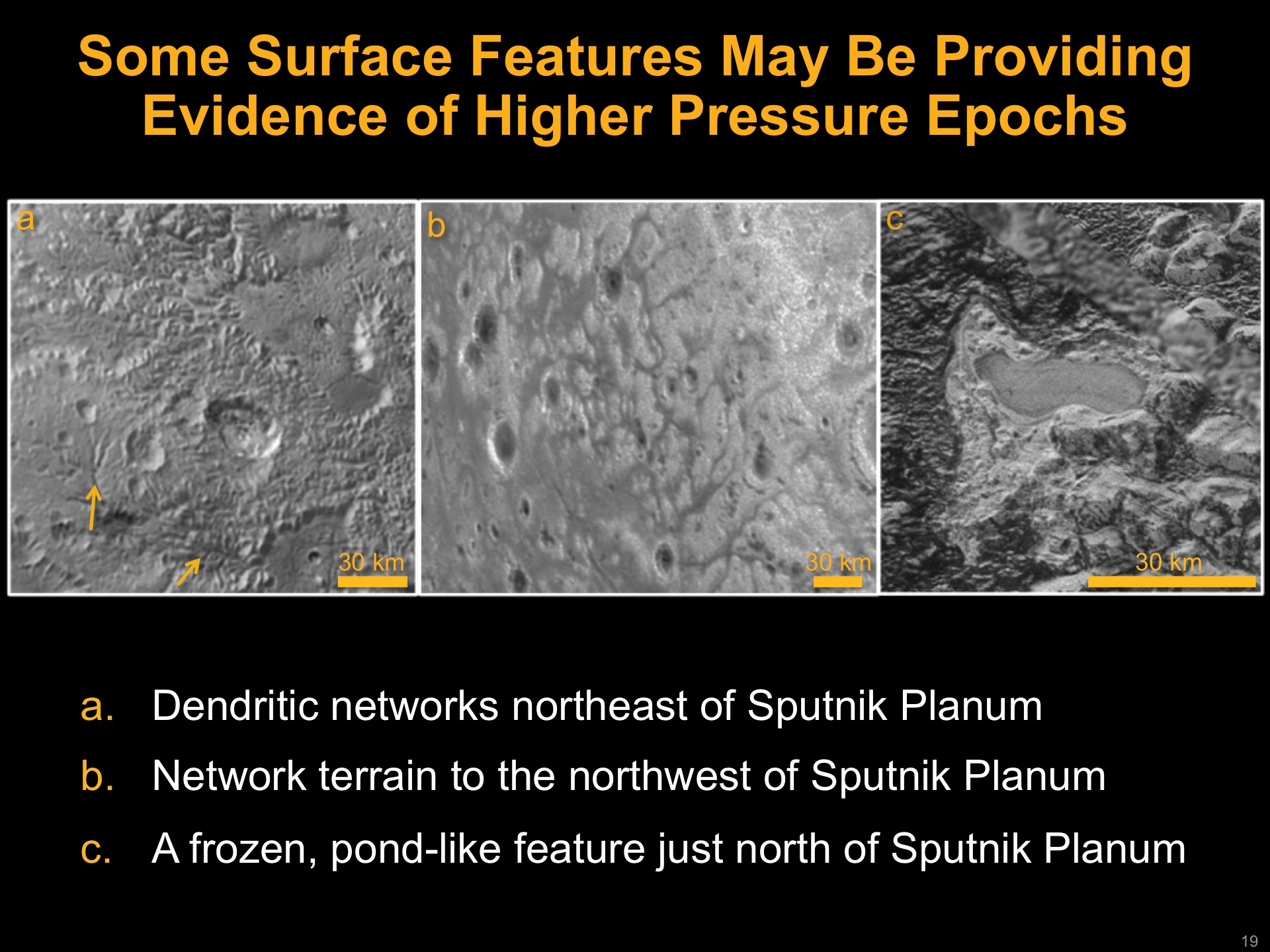
In news unrelated to the Science studies, scientists recently announced that as recently as 800,000 years ago, Pluto likely had a much thicker atmosphere, more substantial than even Mars. Right now, the Plutonian atmosphere has a pressure about 1/100,000 that of Earth's, and this is likely what it usually is. However, Pluto has a axial tilt of about 120 degrees, and as the planet's tilt slowly undergoes procession, there are certain times when the amount of solar radiation in areas with lots of volatile ices goes up dramatically. The resulting outgassing would thicken the atmosphere so that the pressure would increase to about a tenth of Earth's. This is significantly thicker than the Martian atmosphere, and potentially thick enough to allow liquid nitrogen to flow freely on the surface. A thicker atmosphere with liquid nitrogen streams and ponds would explain a series of unusual surface features, such as empty channels similar to those seen on Mars, and a flat, icy area that resembles a frozen pond. The possibility of a thick atmosphere and the existence of a nitrogen cycle similar to Earth's water cycle, even if temporary and limited, on such a tiny, cold world seems pretty far-fetched, but ever since New Horizons flew by, Pluto has surprised us. This batch of new science has made Pluto that much more interesting.

It's still not a planet though.

Wednesday, December 9, 2015

So, What's The News From Pluto?

It's been a while since I've mentioned Pluto. New Horizons has been slowly but surely sending back data and some absolutely spectacular images, revealing a world way more complicated than anyone could have predicted.

First off, there's the pictures. The most recent ones show a 50 mile wide strip of Pluto's surface extending on for hundreds of miles. The resolution is about 300 feet. Somehow, geology has crafted great mountains of ice thousands of feet high, as well as rugged badlands extending for miles.
Credit: NASA/JHUA/SwRI
This image is a particular favorite of mine. It's a picture from the other side of Pluto, and I don't know. There's just something about it that appeals to me. The way the haze fades away, the contrast between the mountains and the plain, it's a great image. I have it as my wallpaper on my work computer.
Credit: NASA/JHUA/SwRI
Oh, in case you were curious, if you were standing on the surface of Pluto and looked up, you'd see a blue sky, courtesy of reactions between methane, nitrogen, and sunlight.
Credit: NASA/JHUA/SwRI
In the picture below, the mountains imaged have a very odd texture, almost like tree bark. There was a guess hazarded as to their origin, but basically, we have no idea how they formed. Looks cool, though.
Credit: NASA/JHUA/SwRI
Oh, here's some actual science now. Scientists believe that based on the lack of cratering and the replenishing of nitrogen in the atmosphere, Pluto was almost certainly recently geologically active. It may even still be active today, courtesy of liquid water laced with ammonia. New Horizons even has images of potential cryovolcanoes.

I think that's all for now. Hopefully my next Pluto update won't take so long.


Sunday, July 19, 2015

Pluto: The Story so Far

On July 14, the New Horizons space probe flew past the dwarf planet Pluto, more than 50 years after Mariner 2 successfully completed a Venus flyby, the first time a space probe visited another world. It's been a long time coming for Pluto. Voyager 1 was nearly sent to Pluto after its Saturn visit, but instead it performed a close flyby of Titan. Honestly, considering how little Voyager was able to learn about Titan given the presence of its thick, inscrutable atmosphere, Titan may not have been the best choice for Voyager. But finally, Pluto has gotten its first visit, and as is tradition with cutting edge science such as this, Pluto gave us quite a few surprises.

One of the most unusual features is actually a lack of a particular feature, namely craters. There just aren't any there. Charon, Pluto's most significant moon, has a few craters, but not nearly as many as one would expect. These are two cold, small bits of ice and rock 3 billion miles from the sun. There's no gas giant to exert any sort of tidal flexing as is the case with some moons orbiting Jupiter and Saturn. Based on what we know, Pluto and Charon should both be dead worlds. But they're not. Pluto's surface seems to be less than 100 million years old, very young when it comes to geology.

Typically, worlds made up primarily of ice don't have big elevation changes. Look at Europa, the surface there is so smooth that a cue ball, expanded to Europa's size, would have greater elevation changes. So, it would make sense then for Pluto and Charon to be pretty much flat, right? Well, apparently not, because both have some pretty impressive topography. Charon has a canyon that could be up to 6 miles deep, just one of many canyons in a vast network that span for hundreds of miles. Charon also has a plain near the northern pole that scientists have been informally calling Mordor. I hope that name sticks.

Not to be completely outshone, Pluto has its fair share of interesting geography. Of course, there's the heart, which I believe has officially been termed Tombaugh Regio after Pluto's discoverer. Then there's the mountains. Now at the cold temperatures we're familiar with, water ice is pretty soft and not really capable of getting very high. Pluto is an entirely different sort of cold, cold enough for
strange and unusual ices like methane ice and nitrogen ice. At those temperatures, water ice because solid enough to build mountains. These are real mountains too, with the highest peaks soaring up over 10,000 feet. Sure, we've got higher here, but for a little chunk of basically ice, Pluto didn't do too badly for itself.

It's going to take a long time for New Horizons to send back all the data it collected during its brief visit, more than a year. Right now, we still barely know anything. I'm sure I'll be writing more posts about Pluto in the future as the data slowly trickles in. To wrap things up today, I just want to say that Pluto is not a planet, it just isn't big enough. That said, that doesn't make this achievement any less spectacular.

Sunday, December 7, 2014

New Horizons and Orion

On their own, I'm not sure either of these stories are worth a post, so I'll go ahead and combine them.

The New Horizons space probe woke up from a long hibernation this weekend. It's on it's way to Pluto, and will fly by on July 14, 2015. It will be, of course, the first spacecraft to visit Pluto, and the first to obtain any sort of detailed image. Even the most advanced telescopes on Earth or in orbit can barely make out any detail. That's definitely something to look forward to this summer.

In a follow-up to my last post, the Orion spacecraft, NASA's new manned crew capsule, underwent a successful first test launch a couple of days ago. I have to confess, given how many rockets have exploded during launch recently, I was a little worried about Orion. I'm not sure the manned space program could take a setback like that. Orion needs to work, and it needs to work well. At least it's gotten through it's first test just fine.

My Twitter


Monday, September 1, 2014

NASA's New Rocket Coming Soon

Well, in three and a half years or so.  The Space Launch System is the first really heavy duty rocket we've had since the Saturns, and the SLS will have even more deep space capability.  At over 400 feet tall, the SLS will be able to send astronauts outside Earth's influence altogether, on to nearby asteroids or to Mars.  It's about time we regained the capability to send people beyond the International Space Station.  Sure, the shuttle was interesting, and the ISS is quite an achievement, but they're not very far away.  We've sent probes far afield, Rosetta is now in orbit around a comet, and New Horizons just passed Neptune's orbit, but they don't have quite the same impact that sending astronauts to those places would have.  So yes, this is good news.  A new, ambitious manned space program is a good thing.