Featured Post

Review: Southern Pines Golf Club (Part 1)

For our final golf course on this North Carolina getaway, we turn to Southern Pines, which would appear on a surface level to be the third m...

Showing posts with label physics. Show all posts

Thursday, April 8, 2021

Big Physics News: Fifth Fundamental Force Likely Found

It's not an absolutely definite, but researchers in Illinois have probably identified a fifth fundamental force of nature, adding onto the four we know today: gravity, electromagnetism (the two we can actually see and experience), and the strong and weak nuclear forces. The strong nuclear force acts like a sort of glue, keeping protons and neutrons in the nucleus of an atom from flying apart; the weak nuclear force is a bit harder to pin down, but it's basically responsible for nuclear decay and radiation.

The new fifth force is perhaps unsurprisingly one that also acts on the subatomic level, and as of right now all it seems to do is influence the behavior of muons, a fundamental particle (not made of anything else) similar to an electron but many times heavier. In an experiment, the Illinois scientists sent muons around a 14-meter ring and then applied a magnetic field, expecting the muons to wobble at a certain rate as predicted by our current model of physics. But they wobbled faster than expected. Yes, that's enough to make a fifth fundamental force likely. There's just a 1 in 40,000 chance the discovery is a statistical fluke, although a chance of 1 in 3.5 million is necessary to make things official.

To be fair, this fifth force may do more than make some obscure particle dance a bit faster. There may be a new, undiscovered particle associated with it, and it may have something to do with the whole "universe expansion is speeding up for no good reason" thing. Stay tuned, there may be more very exciting subatomic particle news coming up in the future.

Wednesday, June 5, 2019

We Can Save Schrodinger's Cat

Now nothing can keep Schrodinger's cat out of the box.
It's perhaps the most well-known thought experiment in the world. You stick a cat in a box beyond direct observation with a bit of poison that will kill the cat should the radioactive isotope on the trigger decay. Until you open the box, you don't know if the cat is alive or dead, and so it's both at the same time. This is the basic extent of the average person's knowledge of quantum mechanics, even though Schrodinger was intentionally being ridiculous, setting up an absurd thought experiment to criticize the idea of quantum blurriness.

Anyway, the whole issue is now a moot point, because scientists have found a way to predict whether or not that radioactive atom will decay. And that's not all; they can stop it too. Their process involves observing a superconducting atom through doubly indirect means, giving them a view with unprecedented accuracy. Using microwave radiation, the atom can be monitored in real time, and the scientists noticed that, when the atom stopped emitting detection photons, it made a quantum jump. This quantum jump is what would cause the atom to decay. And not only can we detect the jump, we can reverse it, so the atom would not decay. This prediction isn't possible in the long term, but we can catch the atom just before it decays, thus saving our cat. Which is good, I quite like cats, and this thought experiment always made me feel a bit sad.

Wednesday, November 7, 2018

The Physics Of The Perfect Pizza

Yes, I said physics of the perfect pizza. Actual people have published an actual study about how to back the perfect margherita pizza. And yes, one of the study authors is Italian.

The secret to pizza, based on much sampling of pizza throughout Rome, is all in the way it's cooked. Also, I want to write a study that involves sampling a bunch of pizza. But anyway, the perfect margherita pizza can be baked in 2 minutes in a brick oven at 625 degrees Fahrenheit. If there are additional toppings, the pizza should be lifted off the bottom of the oven for 30 more seconds to prevent the bottom from burning.

Now, most people don't have a brick oven, and this is where the physics comes in. Using a complex thermodynamic equation, the scientists found that these conditions could be reasonably replicated in an electric oven. What you do is put your pizza on a metal tray, turn the oven to 450 degrees, and cook for 170 seconds, adding a bit more time if your toppings have a high water content.

One more thing, the study authors actually took the time to note that the perfect pizza basically requires you to wash it down with a pitcher of good beer. And that is a beautiful sentiment.

Wednesday, September 5, 2018

Apparently We're Looking For Dark Photons Now

I am not a theoretical physicist. Shocking, right? But I like to think I have a greater knowledge and appreciation for the subject than the average person. I've read some books, I occasionally peruse science news websites. But I had never heard of dark photons until today. Sure, they're still theoretical, but the fact that we're confident enough in their existence to actually spend money searching for them... I'm skeptical.

But anyway, yes, we're searching for dark photons. And we're doing it by shooting antimatter at a diamond. Science is weird, but it's also pretty cool. 

I guess the better question is why are we looking for something called a dark photon anyway? Well, if you follow astrophysics at all, you'll know that most of the universe is not actually visible. The matter we see? Only about 10% of the universe's mass. The rest is so-called dark matter/energy. And you'll also know that we've had absolutely no luck in figuring out what either of those things actually are. If dark photons are a thing, and that's a big if, they could help us detect dark matter and help us figure out what it is. In addition, the existence of dark photons would mean the existence of a fifth fundamental force beyond gravity, electromagnetism, and the weak and strong nuclear forces. That's right, the fifth fundamental force would be... dark electromagnetism. 

I don't want to downplay the work these people are doing, and obviously, if they're successful, that would be really cool and would change our viewpoint of the universe, but these names are terrible.

Wednesday, May 9, 2018

Alternate Theories to Relativity Have Not Had a Good Time Lately

It's a conundrum at the very heart of theoretical physics. We know quantum mechanics to be correct. It's how nature works at very small scales. We know that the theory of general relativity is completely incompatible with quantum mechanics. The two just don't go together. Therefore general relativity must be wrong, or at minimum, incomplete. Yet general relativity has been proven to work time and time again. But general relativity also means that dark matter and dark energy must be a thing. And despite our best efforts, we're no closer to discovering either than when we first started looking for them. Not really. And I think you get the idea at this point. It's a mess.

So, what are physicists to do? If you guessed make wild theories that somehow work in what we know about gravity AND what we know about quantum mechanics, and hope the two go together, then congratulations! You've got what it takes to be a theoretical physicist. Turns out there are lots of alternate theories of gravity out. Well, there were. The discovery of gravitational waves by LIGO killed most of them. Okay, it wasn't just that, it was that and the simultaneous observation of a gamma-ray burst from the same neutron star collision.

I think the biggest takeaway from this story is that science is always in motion. General relativity's been around for a century now, and it's been observationally validated many, many times. But it isn't perfect. And so, rather than shrug our shoulders and say "close enough", we keep going, and we try to find something that does work. There is always more science to do, always more questions to answer.

Wednesday, May 17, 2017

Is Cosmic Inflation Theory Wrong?

Sometimes, even fairly basic scientific concepts get questioned. This is a good thing. If there's enough room in a theory for questioning, there's a good chance the theory is either wrong or incomplete. Take the Big Bang. It's a fairly uncontroversial theory in the scientific community. All the matter in the universe started from one single point, it explodes, and we get the universe. But there was a problem with that concept. The universe is flat, as in, the matter is spread out incredibly thin and space is basically empty. That's fine as far as it goes, but there was no way the Big Bang could have been powerful enough on its own to spread the matter of universe so thin. There must have been another factor, and into the breach came inflation. This inflationary energy is what cause the universe to become what we see today.
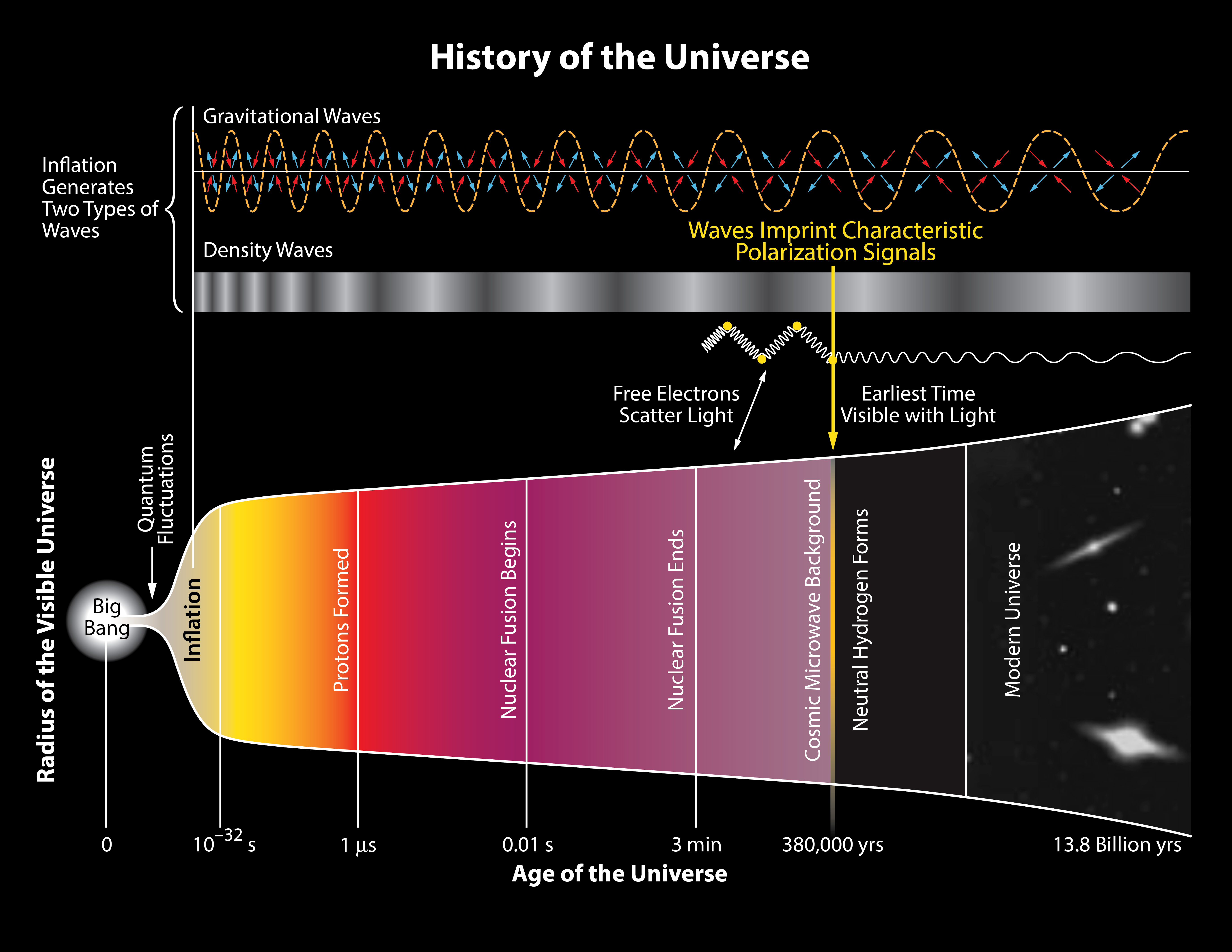
Of course, a theory is nothing without evidence, and we have significant evidence of inflation. There are the ripples in the cosmic background radiation, the existence of dark matter (though we still don't know what dark matter is), as well as another type of gravitational radiation called B-Mode polarization, found in 2013 using data collected from the Planck satellite. Case closed, right?

You know where this is going. Three scientists took issue with the Planck data, saying that it fit the most convenient theory of inflation, not the simplest one. And that leads into one of inflation's biggest problem. It is so broad a theory, with so many hypotheses contained within it, that all new data can be made to fit. Nothing can disprove it. And that's a problem. If it can't be disproved, it's not science, it's philosophy. And we're not dealing with a bunch of philosophers here, we're dealing with physicists. And pro-inflation physicists (the vast majority, let's remember) are not happy with this suggestion. They say they need more time and more data, that it's just taking a very long time to eliminate hypotheses. The anti-inflation physicists say that more than enough time has been spent on inflation, nothing will prove it, and new data will just cause the theory to stretch even further.

Inflation has another big problem, and that is inflation seems to require a multiverse. And once again, the existence of multiple universes would be impossible to prove and is therefore not science.

That begs a question, though. If inflation is wrong, how did the universe get the way it is today? The anti-inflation physicists suggest something called "the Big Bounce", a process wherein the universe grows out of a point, reaches a certain point, then collapses back on itself, only to repeat the process again and again. This is also not a new idea, and like inflation, it has a big problem. The Big Bounce has always required the existence of naked singularities. And once a theory requires naked singularities, it's done. Nobody likes naked singularities. Our intrepid trio anti-inflation physicists claim they've managed to figure out a Big Bounce theory without a singularity, but that claim's been made before, and has always been disproved.

So where does that leave us, the non-physicist audience? Well, if you want to be democratic about it, inflation has the support of almost everyone, while anti-inflation is thought of as being pretty fringe science. I'd say if you're ever at a party, and someone asks about your opinion on the formation of the early universe, just say inflation. It would require less explanation.

Tuesday, August 26, 2014

Multiverse Theory Could Be Wrong

The universe might not recognize the size difference between this...
The field of particle physics is at a standstill.  The problem, in a nutshell, is this: the particles we all know are very light, but physicists predict that there are unknown particles associated with gravity that are much heavier.  About a billion billion times heavier.  This isn't right, especially in this field.  The Higgs Boson, the particle that is surmised to give all other particles mass, should be heavier because of these Planck mass particles, and should also drag the weight of standard particles up as well.  But this isn't the case. 

To get around this problem, scientists came up with supersymmetry, the idea being that every particle has a slightly heavier twin, and when a Higgs boson meets a pair, the masses cancel out, and the Higgs stays light.  Supersymmetry isn't working either, unfortunately.  Scientists have yet to find a partner particle, and it's been decades since they were first theorized.  Because supersymmetry seems to be a dead end, scientists have all but given up on it, which has given credence to the multiverse theory.  Why?  Because the observed properties of the Higgs are so improbable that the universe we observe must not be the only one.  There must be other universes with Higgs bosons with different properties, properties that don't give atoms the ability to form.  Not the multiverse idea most people have, but a bleak, empty multiverse that seems to elude understanding.  This isn't what scientists want to hear.

...and this.
There are new theories in the works, but they are still in the early stages.  Most of them focus around scale symmetry, which, if anything, is even weirder than everything I've just talked about.  The idea is that the universe fundamentally lacks scale, and that the universe doesn't know the concept of mass or length.  This article was a challenge to read, and this part is where it really gets tough to understand.  I guess all the average person needs to know is that it could fix the Higgs problem, and it gets rid of the multiverse theory.  We'll have to see where that takes us, but really, there doesn't seem to be any other direction for physicists to take.

Monday, August 11, 2014

Propulsion From Nothing Probably Nothing

You may have heard recently about how researchers have found a way to move an object without exerting any actual force on it.  The experiment was simple.  Place a radio transmitter inside a specially designed container, play the radio, and the container moves, breaking some very important laws of nature.  Why is this such a big deal?  You might think it's because photons have no mass, but that's not it.  If that was the case, solar sails wouldn't work, but they do.  The problem is that the radio waves are not reacting against anything.  The transmitter is inside the container, and the waves are pushing against all sides.  There is no reaction.  Newton's third law is not being satisfied.  The container is moving forward, but nothing is moving backwards.

This all sounds like fantastic news.  But science, especially science at the cutting edge, can be thrown by the simplest things.  A couple years back, people were going crazy about neutrinos moving faster than the speed of light.  It was even discussed in one of my English classes back in college, and not the science fiction one either.  People were talking about how it changed everything, but I was never convinced.  I knew there was no way that research was correct, I knew that they had made some error in calculation, or their observation was off slightly, I knew that the physics just weren't there.  And guess what?  They weren't.  I don't remember what it was exactly that they did wrong, but a few months later the scientists retracted their claim, and everything was right with the world.

Obviously, I'm not a physicist, I'm not even a scientist.  But I will say this with certainty.  There is no way the experiment is correct.  Something went wrong somewhere.  Just like last time, I wish they would be true.  I wished neutrinos moved faster than light, I wish radio waves propelled in all directions inside a fancy can could move the can, but it just won't happen.  A claim like this requires some impressive evidence to back it up, and so far, it just isn't there.  It may take months, maybe even years, but there will be another explanation.  Just watch.