Featured Post

Review: Southern Pines Golf Club (Part 1)

For our final golf course on this North Carolina getaway, we turn to Southern Pines, which would appear on a surface level to be the third m...

Showing posts with label big bang. Show all posts

Friday, April 8, 2022

New Star Discovered, Farther Away Than Any Other

It's tough to look back to the first stages of the universe. Shockingly enough, the distances involved are astronomical. Billions and billions of light years (and normal years) separate us from the first galaxies, but thanks to telescopes like Hubble, we can look back to something around 400 million years after the Big Bang. But the things we see are on the magnitude of galaxies. Vast cosmic structures, nothing on the order of stars themselves. Well, until now.

Meet Earendil. It's about 50 times bigger than the sun, and while the name is technically Old English, it's probably more familiar to fans of J.R.R. Tolkien. In the Silmarillion, Earendil was a seafarer who carried a silmaril across the sky; he was mentioned in song by Bilbo in Lord of the Rings. I'm going to guess the scientists who named the star were probably thinking Tolkien, not Old English.

Anyway, this star is 12.9 billion years old (roughly), meaning that it formed just 1 billion years after the Big Bang. The previous record for a single star was 4 billion years after the Big Bang, so we're not talking some small, piecemeal improvement; Earendil has absolutely destroyed the record for farthest star. But while this is a big star, it would absolutely not be possible without a bit of luck in the form of gravitational lensing. A massive galaxy cluster sits between us and Earendil, and its gravity has focused the light behind it; we almost literally have a magnifying class pointing at the star. 

Since the galaxy cluster will remain in place for years, Earendil will remain a focus for astronomers for quite a while, and the James Webb Telescope will surely participate in its observation as well. Earendil may represent the first known example of a Population III star, or the first stars formed after the Big Bang. We could learn a lot about the formation of those early stars from it. Plus, it's just really cool, spotting a specific star that far away.

Friday, July 5, 2019

Computer Simulates The Universe A Little Too Well

So I've been very busy this week but I wanted to make some sort of post. So here's an article about an AI simulating the universe so well that the scientists behind the simulation aren't actually sure how it works. Which is cool and a little disconcerting.

Wednesday, March 7, 2018

The Universe's First Stars Have Been Discovered

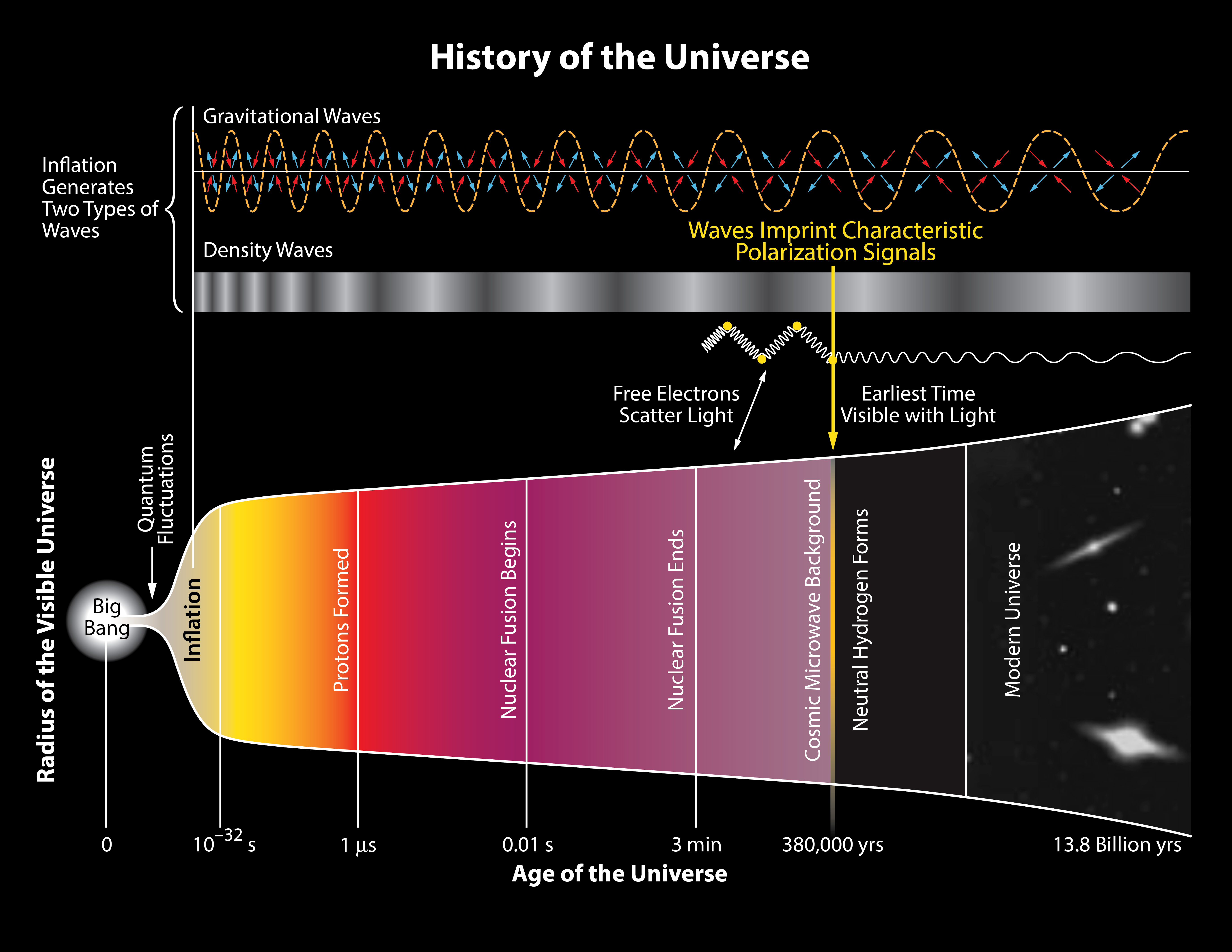
These are some pretty old stars we're talking about here. Previously, the oldest stars we knew about formed 400 million years after the Big Bang, but it was suspected that stars formed much earlier than that. We just couldn't see them yet. Well, now we have. And they did form much earlier, coming into existence a mere 180 million years after the Big Bang.

Credit: N.R. Fuller, National Science Foundation
Finding these old stars took some doing. Until 500 million years post-Big Bang, the universe was filled with loose, heated hydrogen, which is very good at blocking light. So instead of looking for the stars themselves, astronomers have to look for their impact on the cosmic background radiation. This is no easy task, the radio signals astronomers were searching for were something like 10,000 times dimmer than normal radio noise. But you know what? They did it.

Besides that, there's something interesting going on with the signals. They're twice as bright as expected, meaning the radio background was stronger than expected, or the hydrogen filling the young universe was cooler. The second option is more likely, but what would be cooling down the hydrogen is a mystery. A likely contender is dark matter. If that's the case, this discovery may accidently have given us our best look at what dark matter actually is. And that's news worth mentioning.

Wednesday, May 17, 2017

Is Cosmic Inflation Theory Wrong?

Sometimes, even fairly basic scientific concepts get questioned. This is a good thing. If there's enough room in a theory for questioning, there's a good chance the theory is either wrong or incomplete. Take the Big Bang. It's a fairly uncontroversial theory in the scientific community. All the matter in the universe started from one single point, it explodes, and we get the universe. But there was a problem with that concept. The universe is flat, as in, the matter is spread out incredibly thin and space is basically empty. That's fine as far as it goes, but there was no way the Big Bang could have been powerful enough on its own to spread the matter of universe so thin. There must have been another factor, and into the breach came inflation. This inflationary energy is what cause the universe to become what we see today.

Of course, a theory is nothing without evidence, and we have significant evidence of inflation. There are the ripples in the cosmic background radiation, the existence of dark matter (though we still don't know what dark matter is), as well as another type of gravitational radiation called B-Mode polarization, found in 2013 using data collected from the Planck satellite. Case closed, right?

You know where this is going. Three scientists took issue with the Planck data, saying that it fit the most convenient theory of inflation, not the simplest one. And that leads into one of inflation's biggest problem. It is so broad a theory, with so many hypotheses contained within it, that all new data can be made to fit. Nothing can disprove it. And that's a problem. If it can't be disproved, it's not science, it's philosophy. And we're not dealing with a bunch of philosophers here, we're dealing with physicists. And pro-inflation physicists (the vast majority, let's remember) are not happy with this suggestion. They say they need more time and more data, that it's just taking a very long time to eliminate hypotheses. The anti-inflation physicists say that more than enough time has been spent on inflation, nothing will prove it, and new data will just cause the theory to stretch even further.

Inflation has another big problem, and that is inflation seems to require a multiverse. And once again, the existence of multiple universes would be impossible to prove and is therefore not science.

That begs a question, though. If inflation is wrong, how did the universe get the way it is today? The anti-inflation physicists suggest something called "the Big Bounce", a process wherein the universe grows out of a point, reaches a certain point, then collapses back on itself, only to repeat the process again and again. This is also not a new idea, and like inflation, it has a big problem. The Big Bounce has always required the existence of naked singularities. And once a theory requires naked singularities, it's done. Nobody likes naked singularities. Our intrepid trio anti-inflation physicists claim they've managed to figure out a Big Bounce theory without a singularity, but that claim's been made before, and has always been disproved.

So where does that leave us, the non-physicist audience? Well, if you want to be democratic about it, inflation has the support of almost everyone, while anti-inflation is thought of as being pretty fringe science. I'd say if you're ever at a party, and someone asks about your opinion on the formation of the early universe, just say inflation. It would require less explanation.

Tuesday, September 23, 2014

Advanced Astrophysics is Kind of Difficult

A few months back, scientists announced they had found gravitational waves from the very beginning of the universe, lending credible evidence to the theory that the universe expanded at an enormous rate in the first few... what's the small prefix I can think of...picoseconds.  Anyway, in those first few instants, the universe expanded at much faster than the speed of light, or so the theory goes.

As I've mentioned before, science is hard, and this kind of science is really hard.  An extraordinary claim was made here, and you know what they say about those.  Of course, equally important is making sure you didn't make any silly mistakes, like not compensating for dust floating around the Milky Way.  Now, no one is saying the observation is wrong, or that the whole theory is wrong.  Unlike propulsion from nothing, this actually has a chance of working out.  I hope it does.

In an unrelated bit of news, I'm putting the link to my Twitter back on the bottom of each post.  I'm going to try and actually be an active Twitter user...er, even if I don't care for it.  Just don't expect too much.

My Twitter