Featured Post

Review: Southern Pines Golf Club (Part 1)

For our final golf course on this North Carolina getaway, we turn to Southern Pines, which would appear on a surface level to be the third m...

Showing posts with label inflation. Show all posts

Wednesday, May 17, 2017

Is Cosmic Inflation Theory Wrong?

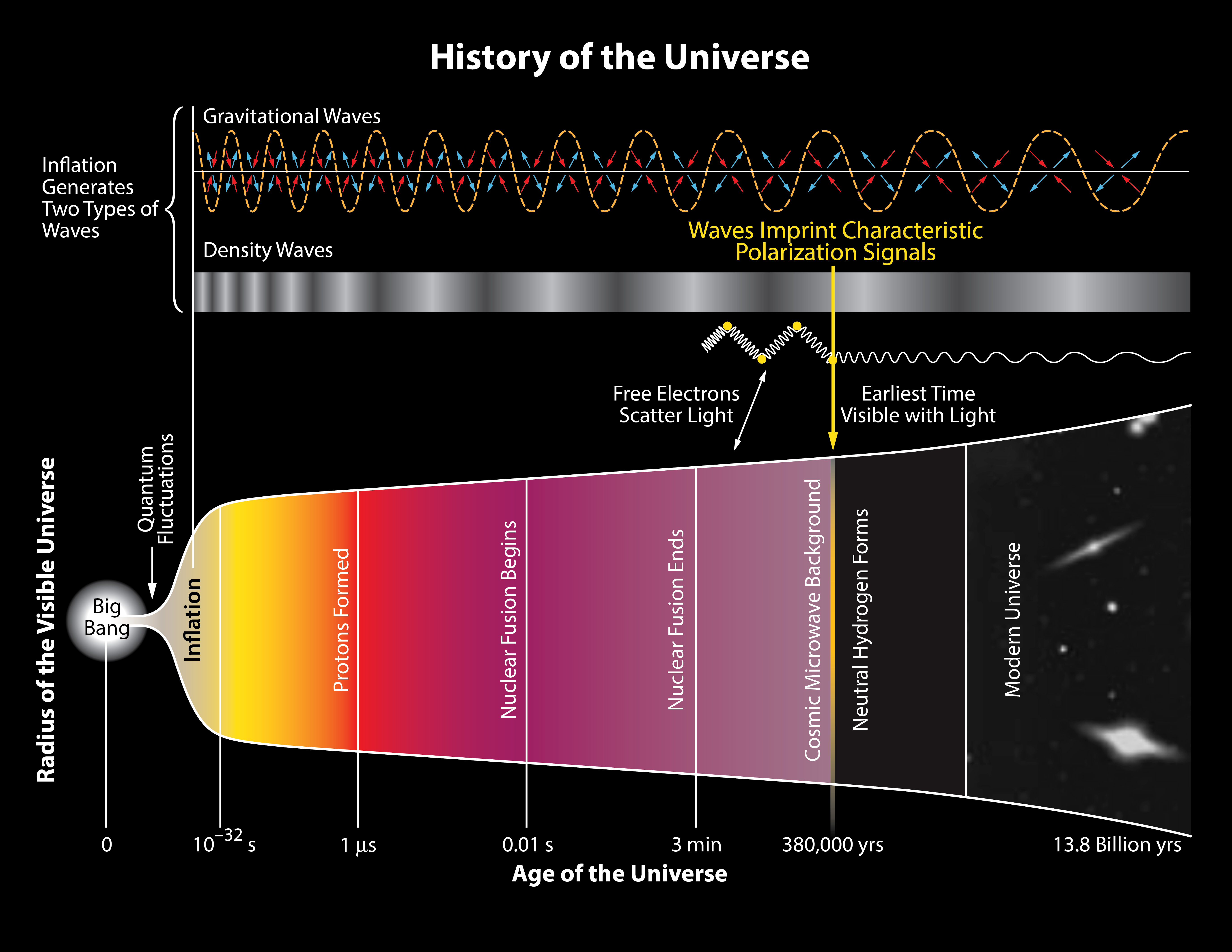
Sometimes, even fairly basic scientific concepts get questioned. This is a good thing. If there's enough room in a theory for questioning, there's a good chance the theory is either wrong or incomplete. Take the Big Bang. It's a fairly uncontroversial theory in the scientific community. All the matter in the universe started from one single point, it explodes, and we get the universe. But there was a problem with that concept. The universe is flat, as in, the matter is spread out incredibly thin and space is basically empty. That's fine as far as it goes, but there was no way the Big Bang could have been powerful enough on its own to spread the matter of universe so thin. There must have been another factor, and into the breach came inflation. This inflationary energy is what cause the universe to become what we see today.

Of course, a theory is nothing without evidence, and we have significant evidence of inflation. There are the ripples in the cosmic background radiation, the existence of dark matter (though we still don't know what dark matter is), as well as another type of gravitational radiation called B-Mode polarization, found in 2013 using data collected from the Planck satellite. Case closed, right?

You know where this is going. Three scientists took issue with the Planck data, saying that it fit the most convenient theory of inflation, not the simplest one. And that leads into one of inflation's biggest problem. It is so broad a theory, with so many hypotheses contained within it, that all new data can be made to fit. Nothing can disprove it. And that's a problem. If it can't be disproved, it's not science, it's philosophy. And we're not dealing with a bunch of philosophers here, we're dealing with physicists. And pro-inflation physicists (the vast majority, let's remember) are not happy with this suggestion. They say they need more time and more data, that it's just taking a very long time to eliminate hypotheses. The anti-inflation physicists say that more than enough time has been spent on inflation, nothing will prove it, and new data will just cause the theory to stretch even further.

Inflation has another big problem, and that is inflation seems to require a multiverse. And once again, the existence of multiple universes would be impossible to prove and is therefore not science.

That begs a question, though. If inflation is wrong, how did the universe get the way it is today? The anti-inflation physicists suggest something called "the Big Bounce", a process wherein the universe grows out of a point, reaches a certain point, then collapses back on itself, only to repeat the process again and again. This is also not a new idea, and like inflation, it has a big problem. The Big Bounce has always required the existence of naked singularities. And once a theory requires naked singularities, it's done. Nobody likes naked singularities. Our intrepid trio anti-inflation physicists claim they've managed to figure out a Big Bounce theory without a singularity, but that claim's been made before, and has always been disproved.

So where does that leave us, the non-physicist audience? Well, if you want to be democratic about it, inflation has the support of almost everyone, while anti-inflation is thought of as being pretty fringe science. I'd say if you're ever at a party, and someone asks about your opinion on the formation of the early universe, just say inflation. It would require less explanation.

Tuesday, September 23, 2014

Advanced Astrophysics is Kind of Difficult

A few months back, scientists announced they had found gravitational waves from the very beginning of the universe, lending credible evidence to the theory that the universe expanded at an enormous rate in the first few... what's the small prefix I can think of...picoseconds.  Anyway, in those first few instants, the universe expanded at much faster than the speed of light, or so the theory goes.

As I've mentioned before, science is hard, and this kind of science is really hard.  An extraordinary claim was made here, and you know what they say about those.  Of course, equally important is making sure you didn't make any silly mistakes, like not compensating for dust floating around the Milky Way.  Now, no one is saying the observation is wrong, or that the whole theory is wrong.  Unlike propulsion from nothing, this actually has a chance of working out.  I hope it does.

In an unrelated bit of news, I'm putting the link to my Twitter back on the bottom of each post.  I'm going to try and actually be an active Twitter user...er, even if I don't care for it.  Just don't expect too much.

My Twitter