Featured Post

Review: Southern Pines Golf Club (Part 1)

For our final golf course on this North Carolina getaway, we turn to Southern Pines, which would appear on a surface level to be the third m...

Showing posts with label macdonald. Show all posts

Wednesday, May 14, 2025

Review: The Architects Golf Club (Part 1)

Nearly 8 years ago, I did a review of McCullough's Emerald Golf Links, a collection of replica holes based on the best golf holes from across the pond in Great Britain. It was a solid enough golf course, if a bit underwhelming. Little did I know, though, that New Jersey was hiding a second tribute golf course, one with a concept equally as intriguing, at Architects Golf Club, located just across the border from Pennsylvania.

As the name implies, rather than each hole being a replica of another, more famous hole, each hole at Architects pays homage to the style of a famous Golden Age architect (mostly, there are a few exceptions). So, there's a hole in the style of C.B. Macdonald, a hole in the style of William Flynn, and so on. At least, that's the idea. Whether or not the execution is there is another story, as some of the selected architects have notoriously difficult styles to pin down. But hopefully Architects will provide some fun, since it at least has some ambition behind it.

The first hole is in the style of Old Tom Morris, which right off the bat represents a challenge. While Old Tom is considered one of the first true golf course architects, to say he had a design style is really pushing it. He had no complex tools and worked with what the land offered in the most sincere expression of that phrase. Also, you know, he only worked with British linksland, not an old farm in northern New Jersey. So, interpreting his design into a single hole could really take any form.

What we have is a shortish par 5, playing 510 yards gently downhill to a wide fairway with several bunkers scattered around the edges. I will give it this; there are plenty of points where the green is blind, which is honest to Old Tom's style. He had to work around blindness, and so does this hole. For those laying up, there's a left-side fairway bunker about 75 yards short of the green to think about, and for those going for the green in two, there a small pot bunker with sod walls (naturally) right in front with another more traditional bunker right. The green itself isn't too interesting, though it isn't dead flat either.
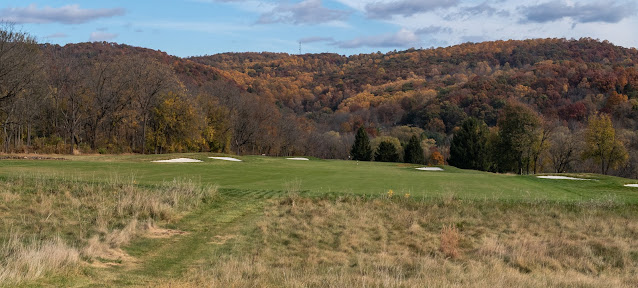
The first hole.

Approaching the first green.

The first green.

The second hole is a par 3 in the style of C.B. Macdonald, and the homage is a pretty obvious Eden. The hole is 195 yards but plays uphill, with deep bunkers left and front right, along with a hidden bunker behind. The green is sloped severely from back to front, making putts from above the hole very treacherous. Of course, the back of the green is the safe place to play, as the two bunkers in front make a more aggressive tee shot much more hazardous. No complaints about this hole, this is an honest and pretty solid interpretation of a Macdonald staple.
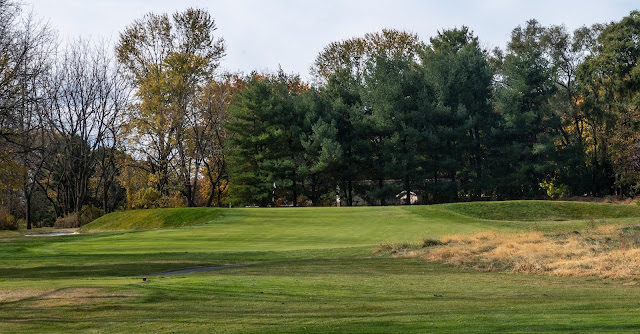
The second hole.

The third hole is another par 5, this one 520 yards and inspired by Hugh Wilson, who doesn't have many golf course credits to his name, but of those few, one obviously stands out: Merion. I've never played Merion (duh), so I'll just have to judge this hole on its own merits, and it's solid enough. To bring the green into reach on the second, a pair of bunkers must be cleared on the drive; bail out right and you'll have a terrible angle at the green, not to mention the small clump of trees guarding the right side of the fairway up in the lay-up zone. That isn't the only difficulty presented for those laying up, as there's another bunker left and two right extending from about 75 yards short most of the way to the green. The green isn't spectacular, but there's a greenside bunker left and a big falloff long and right, so accuracy is important.
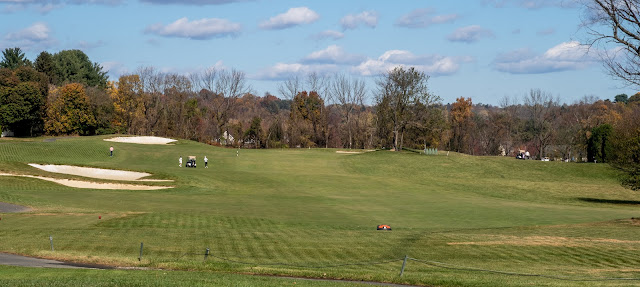
The third hole.

Approaching the third green.

The third green.

The fourth hole is a long par 4 at 440 yards, and it's in the style of Devereux Emmet, which of course got my brothers and I very interested. Of all the Golden Age architects, Emmet is the one we know best. So, does this feel like an Emmet? Sort of, I'll say. The big cross-bunker is reminiscent of hazards on other Emmet courses, particularly the 13th at Leatherstocking. The green is a different story. On the surface, yes, Emmet courses often did have mounding around their greens, and this green does have slightly interesting contours. But I just don't know, it isn't quite right to me. It's close, but not completely there.
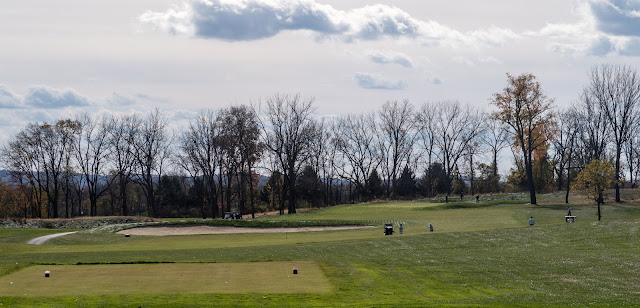
The fourth hole.

Approaching the fourth green.

The fourth green.

The fifth hole is an homage to Walter Travis, who did the Country Club of Troy and Cape Arundel. Not his most famous work (that would likely be Garden City, which of course was originally by Devereux Emmet), but two very well-respected golf courses, particularly Cape Arundel and its wild greens. That, more than the heavy bunker scheme, is what Travis was known for, and while the heavy bunkering and mounding around the fairway of this 355-yard par 4 is solid and fun, there are plenty of non-Travis examples of similar holes. In particular, this hole reminds me of the last hole at Bedford Springs. Same length, same preponderance of bunkers, roughly similar green. It's a solid hole, honestly, but without a wild green it has to fail as a tribute to Walter Travis.
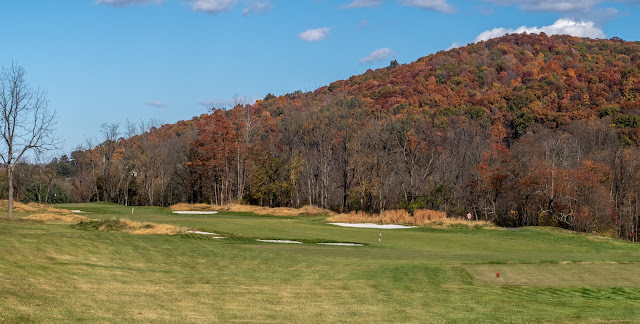
The fifth hole.

Approaching the fifth green.

The fifth green.

The sixth hole is a tiny little par 3, playing under 150 yards from the tips. It's downhill as well, so you really don't need much on the tee shot here. However, the green is small and surrounded by deep bunkers, with a steep falloff behind leading into forest. It's supposed to be a tribute to H.S. Colt and C.H. Alison, but since I'm completely unfamiliar with either of them (Colt never did work in the US, and unless Timber Point gets restored, Alison's surviving work in this country is pretty much all private), I can pretty much only judge this as a fun little short par 3. It's a likeable hole and honestly one of the best on the course.
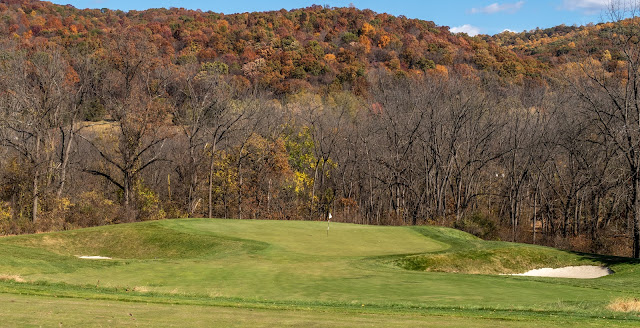
The sixth hole.

The sixth green.

The seventh hole is the A.W. Tillinghast tribute hole, and if you know anything about Tillinghast's work, you'll know that distilling him down to a single hole is an effort in futility. A Tillinghast course can look like pretty much anything; he had no distinct style or calling card. But Architects tried to copy him anyway.

What they came up with is a mid-length par 4 with a tee shot playing through a chute of trees to an initially wide fairway below. A 3 wood or long iron will find the wide part of the fairway, but if you're feeling aggressive, you can try to thread a faded driver into a narrow gap guarded by bunkers on both sides. Do that, and the second will be a wedge; the safe play on the tee shot will leave a short or mid iron into the green, which is elevated and protected by two bunkers. Each bunker on this hole is supposed to refer to the bunkers from a different Tillinghast course, but they kind of just look like bunkers to me. Not every replica can be a winner. 
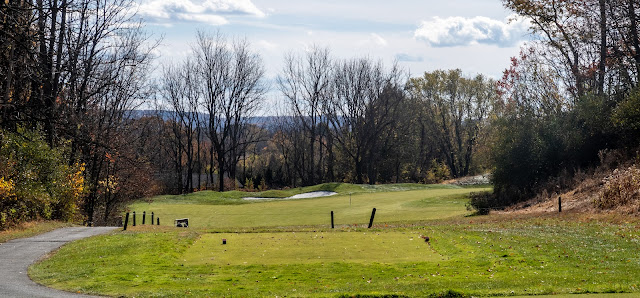
The seventh hole.

Approaching the seventh green.

The seventh green.

Speaking of not capturing the spirit of the architect, the eighth hole is pretty clearly the worst attempt Architects has to offer. This is supposed to be the homage to Seth Raynor, student of C.B. Macdonald and template hole extraordinaire. This would seem to be the easiest architect to copy for Architects' entire gimmick and yet, they screwed it up. 

The eighth hole is a mid-length par 3 playing uphill to a two-tiered green with several bunkers left. I suppose the bunkers are kind of geometric and hard-edged, but in no way does this resemble a hole Seth Raynor would have built. It just doesn't. A Redan would have worked; the tee shot approached the hillside in the appropriate diagonal fashion, and an uphill Redan would capture the traditional lower angle of approach that marked the original. That would have been a cool hole. Instead, we got something kind of boring and not related to Seth Raynor in any meaningful way.
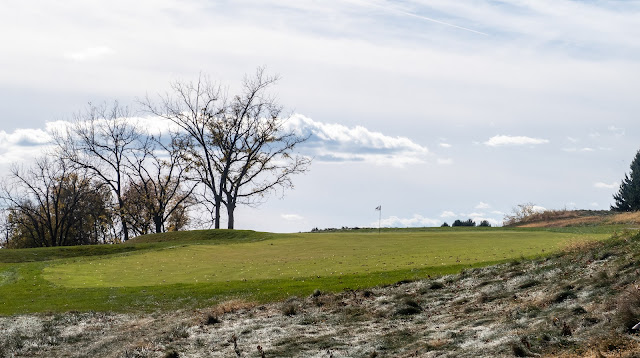
The eighth hole.

The eighth hole.

The ninth hole is a long par 4, playing an uphill 450 yards, and is an homage to Donald Ross. Ross is another tricky one to try and emulate; he certainly had a style, unlike Tillinghast, but it was generally subtle and conservative, fitting the land. Which makes sense, considering how many courses he's responsible for. So basically, as long as you don't do anything really flashy, you can make pretty much anything a tribute to Donald Ross.

The tee shot here has to go past a pair of top-shot bunkers (which is a very Ross feature, to be fair) and needs to be hit with driver to get to the top of the hill. From there, the second shot appeared to be quite difficult, with a bunker right of the green and a pond short and left. However, while left is pretty clearly dead, there is a bit of visual deception at play with the pond short of the green; there's actually 10-20 yards of space between the water of the green. Not a huge amount of space, but far from nothing. And the green itself is actually kind of interesting, with a trench sort of cutting across the green diagonally. The front left and back portions are elevated, making hole locations on those sections quite tricky. It's apparently based on drawing from Mr. Ross, which explains why it's so much more interesting than the greens we've seen before. Overall, I think this hole is a decent facsimile of a Ross design.

The ninth hole.

Approaching the ninth green.

The ninth green.

That's it for this week, next week we'll check out the back nine.

Wednesday, April 9, 2025

Review: Hendricks Field Golf Course (Part 2)

It's time to check out the back nine at Hendricks Field, go here to see the front.

The tenth hole is a shortish 365 yard par 4 that is apparently designed as a mirror image of the first hole at The Creek, a Macdonald original hole. Now, I haven't played The Creek, but looking at it on Google Maps (the hole in the center), I'm prepared to say with some confidence that this hole (also in the center) bears very little resemblance to anything at The Creek. That's not to say this is a bad hole, because it isn't. There's a fairway bunker right where a good driver will end up, forcing you to either squeeze it into a tight space or lay back, leaving a longer approach into a green protected front right by a fairly large bunker, which guards the direct line to the green very well. If you want the better angle, you have to play the hole to the outside of the fairway. I think it's a solid opening hole, which as you can tell from the amount of daylight in the pictures is exactly how we experienced Hendricks Field.

The tenth hole.

Approaching the tenth green.

The tenth green.

The eleventh hole is easily the longest on the course, being the only one over 500 yards at a beefy 575; plus, it was playing directly into a fairly fresh wind for our round, making it play even longer. Unfortunately, while it is extremely long, there isn't much to this hole until you get to the green. There's a single fairway bunker in play right, and the fairway, while not narrow, is squeezed by overhanging trees to the right. The second shot is a simple matter of advancing the ball, though ideally you do want to favor the right side, close to the tree line. This gives you the best angle into the green, which is a mild version of the Road hole, complete with Road bunker front left and an old disused railway line just beyond the shrubbery long and right. It's a solid green complex; it's just too bad the first 500 yards of this hole aren't particularly interesting.

The eleventh green.

Approaching the eleventh green.

The eleventh green.

The twelfth hole is the shortest hole on the course, playing more than 400 yards shorter than the last one at a listed 155. That yardage can vary significantly though, as this green is a classic (if moderated) Biarritz, long and complete with swale running through the middle. While this hole lacks the flanking bunkers, it does have a series of small bumps and hollows running along both sides, which does a reasonable job approximating the missing hazards. It is a little unfortunate that we got a front hole location for our round, which made the swale almost irrelevant; none of us reached it and so nobody had to putt through it. A back hole location would have made this green a lot more interesting. Still, the twelfth is a solid hole.

The twelfth hole.

The twelfth green.

The thirteenth hole is a short 345-yard par 4 that climbs up a hill for the first 225-250 yards or so, with a single bunker carved into the top that eats into the left side of the fairway. Challenge that bunker with a driver, and you'll have just a pitch for your second shot. Lay up safely short of it and the second shot will be blind. Of course, you can also skirt right of it, but that leaves a bad angle over a bunker and a group of pine trees come quite close to the fairway, giving you little wiggle room. The green here is an interesting one; it's definitely a punchbowl, the sides funneling golf balls toward the middle, but it's also distinctly elevated, making run-up shots (or pitches) tricky to get close. It's a fun little hole, and while I think using driver and leaving that tricky pitch is the best play, I can definitely see advantages to approaching this green with a full wedge. My brothers and I all played the hole differently to each other, and we all ended up with par.

The thirteenth hole.

The thirteenth green.

The fourteenth hole is obviously not Hendrick Field's official Redan, which we've already seen, but it does share more than a few of the Redan's playing characteristics; namely, the bunker short left, the angled green, and the green slope funneling drawn golf balls in toward the hole. But at 210 yards, it's quite a long hole, especially for the course's typical crowd, and it's not as dramatic or difficult a green as the eighth. I think this hole benefited from being seen first; if we'd played the actual Redan a few holes before this one instead of at the very end of the round, I think I would have a less favorable opinion on what feels like a cheap knock-off.

The fourteenth hole.

The fourteenth green.

The fifteenth hole is 370 yards, though it does play a bit shorter than that as the drive is significantly downhill. Although it isn't immediately obvious, this is a Principal's Nose hole, with a central bunker having fairway on all sides. I'm not entirely sure why they consolidated the three original bunkers into one larger one, since this one takes up the same exact space. Do golfers get more psyched out at higher numbers of bunkers? Is it maintenance related? Who knows. What I do know is that, while the left side is more inviting on the tee shot, squeezing a driver between the bunker and trees right gives you an ideal angle to attack this green. Obviously, when the hole is in front like it was for us, left isn't a bad place to be, but for those back left hole locations just behind the long greenside bunker, the right side is definitely the better place to be.

The fifteenth hole.

Approaching the fifteenth green.

The fifteenth green.

The sixteenth hole is 335 yards and generously described as a Cape hole, which I suppose is technically true in the absolute broadest definition of the word. There is a hazard in the corner of the slight dogleg right, and you do get an advantageous angle into the green if you carry it. That said, it's rather curiously placed, being about 275 yards out from the tee, which likely puts it out of range of 95% of Hendricks Field's clientele. And if you can't reach the bunker, that makes this hole considerably less interesting. Not completely, of course; the green is still narrow and protected by a bunker on the left, so the right side is always going to be the better place to be. But a second bunker along the right side of the fairway would go a long way toward making this drive more interesting for a wider range of people. 

The sixteenth hole.

The sixteenth green.

The seventeenth hole is Hendricks Field's homage to the Eden, which is definitely closer than its attempt at a Cape. At 160 yards and downhill, it's quite short, but the front right bunker is present. No left bunker, but seeing as the green is built up over its surrounding, a 3- to 4-foot dropoff around the left and back sides do a decent job approximating the left and back hazards. The green also isn't dramatically sloped from back to front like most Edens, but there is some slope and this green isn't easy to putt, especially in the evening with long shadows crossing it.

The seventeenth hole.

The seventeenth green.

The eighteenth hole is the longest par 4 on the course, playing 430 yards. The hole doglegs left around a sparse collection of large trees, with a bunker on the far side of the dogleg guarding the ideal line for the second shot. The green is quite large, but it's got some decent undulation to it and there's a large bunker front left, so the approach – hit with a mid iron – is far from easy. It isn't a terribly complicated hole, but it has a nice scale to it that I think is appropriate for a closing hole. I also like how connected it feels with the rest of the course; there are three greens on the front nine within 50 yards of this one. It's always kind of neat when courses have routings that interconnect and flow to common areas like this one does.

The eighteenth hole.

Approaching the eighteenth green.

The eighteenth green.

Hendricks Field is a beginner-friendly golf course through and through. It's also a good golf course. But that, unfortunately, is all it is. Don't get me wrong, I thoroughly enjoyed my round and I'd happily play here every day. This is a charming place, especially in the fall with the trees showing their full colors. But at virtually every turn, I couldn't help thinking that the course could have been better. More bunkers, more interesting greens, drives that required real thought behind them, Hendricks Field would benefit greatly from all those things. I was reminded of how I felt after playing Wilmington Municipal; both courses were very, very charming, but both constantly felt like they were coming in with one hand tied behind their back.

That's the tradeoff of public, friendly golf: You can only make the golf course so interesting before it starts getting too difficult for the below-average golfer. Hendricks Field is plenty of golf if you're the sort of golfer who struggles to break a hundred – a population that is the vast majority of golfers – but for someone like me, a lower-handicap player, this just isn't enough. It's a shame too, because at $50 or so for 18 holes, Hendricks Field is a real bargain, especially considering its proximity to New York City. The place is in solid shape too.

In the end, while I wish Hendricks Field was more interesting, it's good enough for what it aims to be, a nice, friendly place to play golf for the people who can't afford a membership at one of the many, many private clubs dotting the suburbs of New York City.

Wednesday, April 2, 2025

Review: Hendricks Field Golf Course (Part 1)

When you think vacation destinations, northern New Jersey is probably not the first place that pops into your head. Obviously, being in the greater New York City area we're not talking about a distant outpost of civilization here, but most people, when confronted with one of the greatest cities on Earth, don't stop 10 miles short and think, "eh, close enough." But when it comes to public golf, northern New Jersey is sneaky good, with multiple representatives on this recent list from Golf.com of the best golf courses that can always be played for $100 or less.

Unfortunately, we must start off with a bit of disappointment. You see, Essex County has three public golf courses in its municipal roster (all designed by Charles Banks, a representative of the MacRaynor school of design), two of which have undergone recent renovations: Hendricks Field and Francis Byrne (the third, Weequahic, was under the knife during our visit). Of the two, it was pretty clear from the various things I saw online that Francis Byrne had turned out very well, and I was eager to check it out. And so, as it turned out, was the rest of New Jersey, because I simply could not get a time there. Hendricks Field was gettable, however, and so to represent the Macdonald-Raynor flag in a region inundated with their best work, Hendricks Field must carry the flag (since I've already reviewed Rock Spring, which my brothers and I also played during this excursion.

Designed in 1929 by Mr. Banks, Hendricks Field is unique in that it was always meant for public play, a rarity among the MacRaynor oeuvre, as they worked pretty exclusively for the cream of NYC's crop. And it's pretty clear throughout, as the renovation definitely emphasized the public aspect of the course – as well as rearranging the layout, adding and subtracting holes in several places. Hendricks Field is a beginner-friendly Raynor-style course, and oftentimes, easy golf often means boring golf. Think about it: How many great golf courses would be classified as easy? How many top 100 courses could your average 15-handicapper stroll up to and break 90? Not many. So the question here is, can Hendricks Field manage to be both interesting and easy to play?

The first hole kicks things off in a quirky fashion; this is a 475-yard par 5 that doglegs hard left up a hill, with the fairway sloping significantly in the opposite direction. The ideal line is guarded by a bunker, which must be cleared to bring the green into play on the second shot. Bail out right and you can quickly run out of fairway and into a group of trees. For most people, the second shot will be blind, though long drivers can just about bring the flag into view if they play aggressively enough on the drive. This hole is inspired by the Alps hole, and while it lacks the front bunker, the blind aspect is fully present, as is the punchbowl green that so often accompanies Alps holes. While the green does funnel golf balls in toward the center, there is more to it than that. This is something Hendricks Field does throughout the round; on almost every green, there are one or two small but distinct mounds. These mounds are often very well placed to affect most putts, and while they aren't particularly big or tall (we're talking 3-5 feet across and 6-12 inches high), they do plenty to make putts up and around them very tricky. They don't feel like a Banks original feature (though of course I'm hardly an expert), but I like them. They add character to the greens without making them too difficult to play, and they help make this hole one of the best on the course.

The first green.

Approaching the first green.

The first green.

The second hole is a fairly long par 4 at 425 yards, though it does play pretty dramatically downhill as it heads right back alongside the first. The hole is blind from the tee, but aside from the obvious trees lining the fairway, there aren't any hazards to worry about. The second shot is tricky; while the green is quite large, there's a big greenside bunker short right and you'll have a tough hanging lie on your short to mid iron. 

The second hole.

Approaching the second green.

The second green.

The third hole is 185 yards and isn't modeled after any particular hole; it's basically just a mid-length par 3 with a bunker left of the green. That said, the green is tilted pretty significantly from right to left, so while the obvious bailout is right, missing the green on that side will leave a tricky little chip. This is one of those times where the bunker really isn't that bad a place to miss.

The third hole,

The fourth hole is a straightaway short par 5, playing just under 500 yards. The tee shot here is simple, though the playing area isn't particularly wide. Not narrow, of course, but not wide to the point where you may want to hit 3 wood. If you do that, though, not only do you preclude yourself from going for the green in two, it brings a cross bunker 50 yards short of the green directly into play. Either you need to carry that bunker or leave yourself a full wedge third. For those who did hit driver and can go for the green in two, a large bunker front right means a fade is definitely the play. This green is actually modeled after a reverse Redan, so figure in the usual Redan playing characteristics when approaching the green.

The fourth hole.

Approaching the fourth green.

The fourth green.

The fifth hole is also a short par 5, playing just 480 yards. Yes, we've got two short par 5s in a row, playing parallel to each other. The tee shot here is quite similar to the last one: bunkerless fairway, trees on both sides, although this fairway has some interesting little crumples to it that are impossible to capture on camera but do make approach shots slightly more complicated. In addition, a narrow ditch crosses the fairway about 325 yards out, but if you hit a good drive it doesn't come into play. The green is also bunkerless (as is the entire hole), but the surface is angled right to left with a noticeable dropoff left acting similarly to a bunker. This is honestly an very easy hole, and an excellent birdie or even eagle opportunity.

The fifth hole.

Approaching the fifth green.

The fifth green.

The sixth hole is 160 yards and is supposed to be a Short hole. This may be the biggest stretch on the course; Shorts are supposed to have large, wild greens surrounded by a ring of sand. This has neither of those things. The green is pretty much the same level of severity as the rest of the course, and the lone bunker only protects the front right portion of the green. It's not a bad hole, just nothing close to what the scorecard claims.

The sixth hole.

The sixth green.

The seventh hole is a 420-yard par 4 and presents an actual challenge on the tee shot in the form of the ditch from five slashing across the fairway at a 45-degree angle through the landing area. How much it comes into play depends on how bold you want to be with the tee shot. Obviously, you can lay well back of it with a long iron, but that means you'll have another long iron on the second shot. A 3 wood is safe so long as you avoid the left side, but longer hitters do have to worry about the ditch if they happen to hook one. If you're feeling especially bold and/or stupid, you could even hit driver so long as you hug the right trees; there is just enough space between them and the ditch to squeeze a driver. Of course, miss left at all and you're going in the ditch.

The green here is bunkerless and on the larger side, but it's also one of the most undulating and severe on the course, and it's also slightly elevated above its surroundings. It is not a simple matter hitting this green, especially if you've got a mid iron in hand. This is the No. 1 handicap hole, and I think it deserves it.

The seventh hole.

Approaching the seventh green.

The seventh green.

The eighth hole is Hendricks Field's true Redan, and happily it plays pretty authentically. It's got the front left bunker, the right-to-left green tilt (with a neat mini-punchbowl hole location back right), and at 190 yards it's just long enough that most golfers will be using a mid iron or more, taking the direct line at the hole out of the equation. Yeah, it's not as dramatically difficult as the Redans at Keney Park or Charleston Municipal, but it still provides the Redan experience, and I like it a lot.

The eighth hole.

The eighth green.

The ninth hole is a mild-mannered mid-length par 4 for most of its 375 yards. Yeah, the ditch from the fifth and seventh holes crosses this fairway as well, but it requires all of a 180-yard carry to clear, which is within the realm of most people, especially those playing from the back tees. The fairway does narrow slightly beyond 250 yards, squeezed between a native area left and trees (along with the parking lot) right, but there's still plenty of space to work with. 

Things get more interesting on the second shot, or more accurately, once you get to the green. This green is very large, likely the largest on the course, and it's also a Double Plateau, going from high in the front to low in the middle back to high in the back. The challenge is obvious; control the approach and you'll have an easy birdie attempt, fail to do so and risk three putting. As the scorecard summary states, this isn't the most extreme version of the Double Plateau in the world (certainly less so than the one at Rock Spring a few miles away), but honestly, it doesn't need to be. The challenge is there, and that's what matters.

The ninth hole.

Approaching the ninth green.

The ninth green.

That's it for this week, next week we'll take a look at the back nine.