Nearly 8 years ago, I did a review of McCullough's Emerald Golf Links, a collection of replica holes based on the best golf holes from across the pond in Great Britain. It was a solid enough golf course, if a bit underwhelming. Little did I know, though, that New Jersey was hiding a second tribute golf course, one with a concept equally as intriguing, at Architects Golf Club, located just across the border from Pennsylvania.
As the name implies, rather than each hole being a replica of another, more famous hole, each hole at Architects pays homage to the style of a famous Golden Age architect (mostly, there are a few exceptions). So, there's a hole in the style of C.B. Macdonald, a hole in the style of William Flynn, and so on. At least, that's the idea. Whether or not the execution is there is another story, as some of the selected architects have notoriously difficult styles to pin down. But hopefully Architects will provide some fun, since it at least has some ambition behind it.
The first hole is in the style of Old Tom Morris, which right off the bat represents a challenge. While Old Tom is considered one of the first true golf course architects, to say he had a design style is really pushing it. He had no complex tools and worked with what the land offered in the most sincere expression of that phrase. Also, you know, he only worked with British linksland, not an old farm in northern New Jersey. So, interpreting his design into a single hole could really take any form.
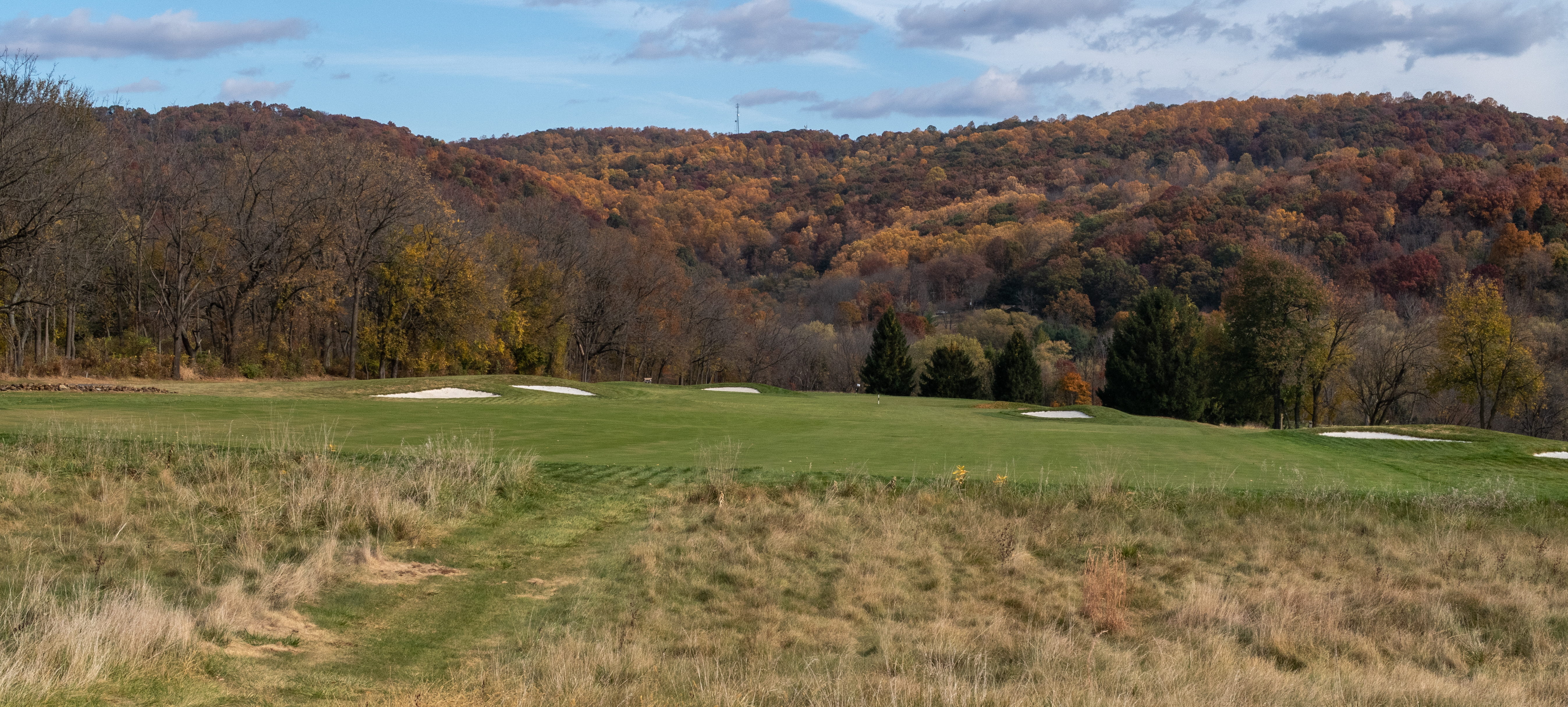
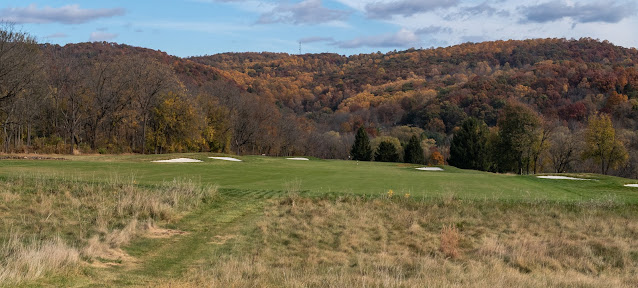
What we have is a shortish par 5, playing 510 yards gently downhill to a wide fairway with several bunkers scattered around the edges. I will give it this; there are plenty of points where the green is blind, which is honest to Old Tom's style. He had to work around blindness, and so does this hole. For those laying up, there's a left-side fairway bunker about 75 yards short of the green to think about, and for those going for the green in two, there a small pot bunker with sod walls (naturally) right in front with another more traditional bunker right. The green itself isn't too interesting, though it isn't dead flat either.
 |
| The first hole. |
 |
| Approaching the first green. |
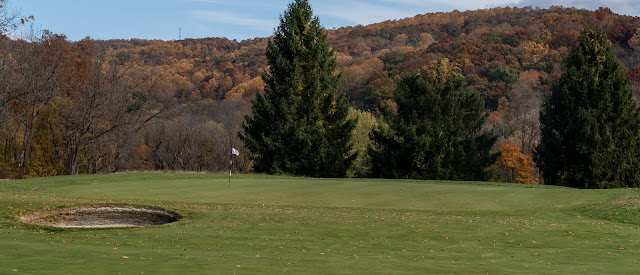 |
| The first green. |
The second hole is a par 3 in the style of C.B. Macdonald, and the homage is a pretty obvious Eden. The hole is 195 yards but plays uphill, with deep bunkers left and front right, along with a hidden bunker behind. The green is sloped severely from back to front, making putts from above the hole very treacherous. Of course, the back of the green is the safe place to play, as the two bunkers in front make a more aggressive tee shot much more hazardous. No complaints about this hole, this is an honest and pretty solid interpretation of a Macdonald staple.
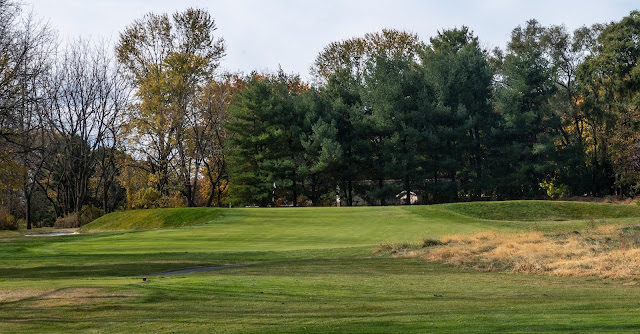 |
| The second hole. |
The third hole is another par 5, this one 520 yards and inspired by Hugh Wilson, who doesn't have many golf course credits to his name, but of those few, one obviously stands out: Merion. I've never played Merion (duh), so I'll just have to judge this hole on its own merits, and it's solid enough. To bring the green into reach on the second, a pair of bunkers must be cleared on the drive; bail out right and you'll have a terrible angle at the green, not to mention the small clump of trees guarding the right side of the fairway up in the lay-up zone. That isn't the only difficulty presented for those laying up, as there's another bunker left and two right extending from about 75 yards short most of the way to the green. The green isn't spectacular, but there's a greenside bunker left and a big falloff long and right, so accuracy is important.
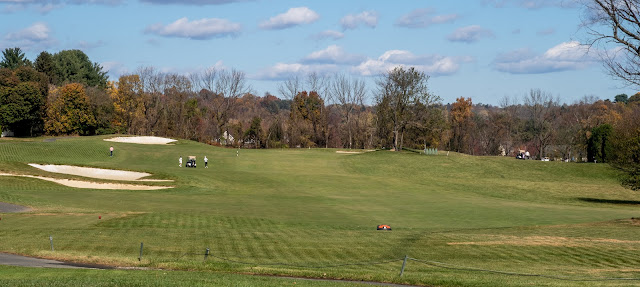 |
| The third hole. |
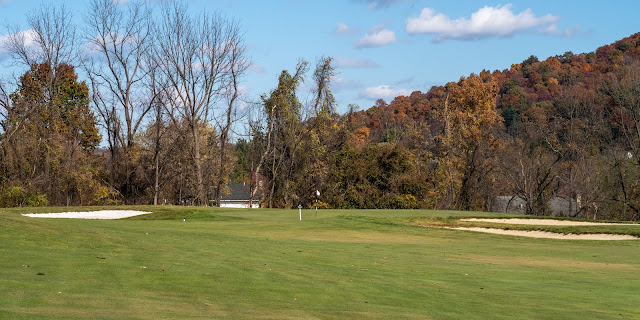 |
| Approaching the third green. |
 |
| The third green. |
The fourth hole is a long par 4 at 440 yards, and it's in the style of Devereux Emmet, which of course got my brothers and I very interested. Of all the Golden Age architects, Emmet is the one we know best. So, does this feel like an Emmet? Sort of, I'll say. The big cross-bunker is reminiscent of hazards on other Emmet courses, particularly the 13th at Leatherstocking. The green is a different story. On the surface, yes, Emmet courses often did have mounding around their greens, and this green does have slightly interesting contours. But I just don't know, it isn't quite right to me. It's close, but not completely there.
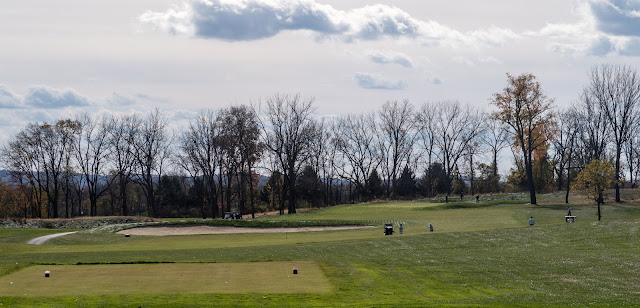 |
| The fourth hole. |
 |
| Approaching the fourth green. |
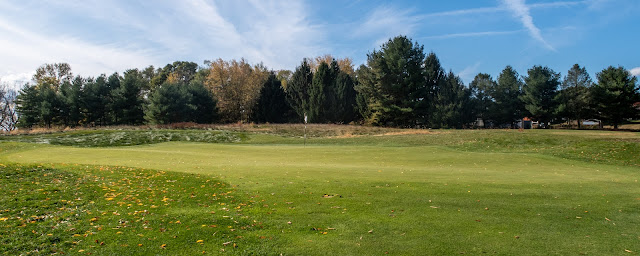 |
| The fourth green. |
The fifth hole is an homage to Walter Travis, who did the Country Club of Troy and Cape Arundel. Not his most famous work (that would likely be Garden City, which of course was originally by Devereux Emmet), but two very well-respected golf courses, particularly Cape Arundel and its wild greens. That, more than the heavy bunker scheme, is what Travis was known for, and while the heavy bunkering and mounding around the fairway of this 355-yard par 4 is solid and fun, there are plenty of non-Travis examples of similar holes. In particular, this hole reminds me of the last hole at Bedford Springs. Same length, same preponderance of bunkers, roughly similar green. It's a solid hole, honestly, but without a wild green it has to fail as a tribute to Walter Travis.
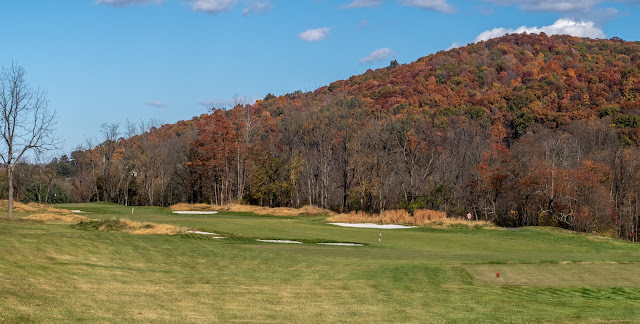 |
| The fifth hole. |
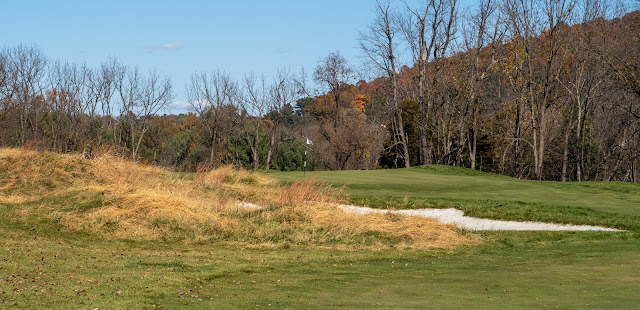 |
| Approaching the fifth green. |
 |
| The fifth green. |
The sixth hole is a tiny little par 3, playing under 150 yards from the tips. It's downhill as well, so you really don't need much on the tee shot here. However, the green is small and surrounded by deep bunkers, with a steep falloff behind leading into forest. It's supposed to be a tribute to H.S. Colt and C.H. Alison, but since I'm completely unfamiliar with either of them (Colt never did work in the US, and unless Timber Point gets restored, Alison's surviving work in this country is pretty much all private), I can pretty much only judge this as a fun little short par 3. It's a likeable hole and honestly one of the best on the course.
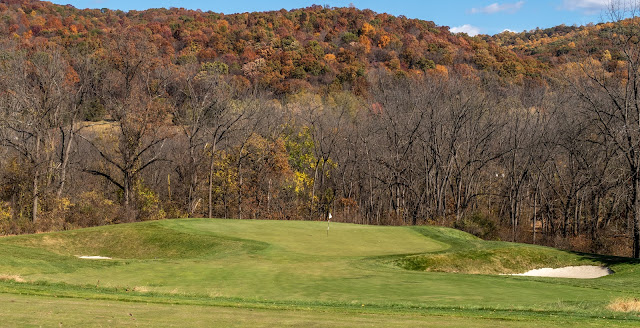 |
The sixth hole.
|
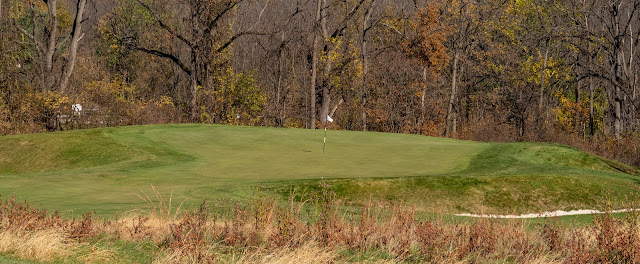 |
| The sixth green. |
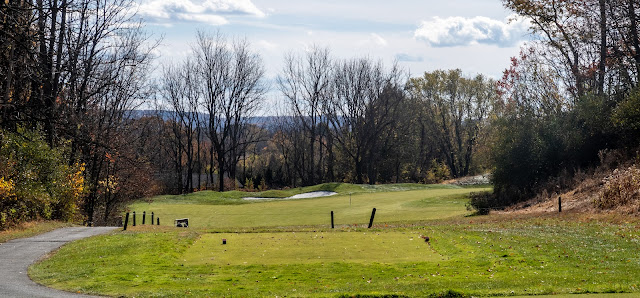
The seventh hole is the A.W. Tillinghast tribute hole, and if you know anything about Tillinghast's work, you'll know that distilling him down to a single hole is an effort in futility. A Tillinghast course can look like pretty much anything; he had no distinct style or calling card. But Architects tried to copy him anyway.
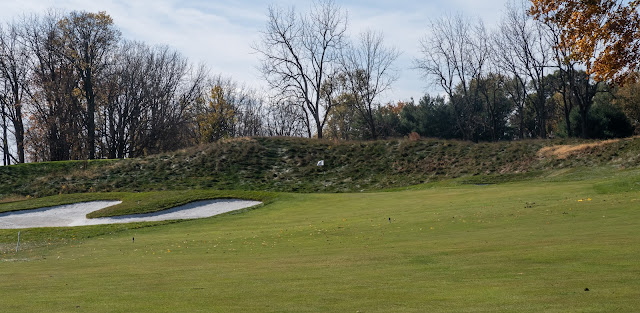
What they came up with is a mid-length par 4 with a tee shot playing through a chute of trees to an initially wide fairway below. A 3 wood or long iron will find the wide part of the fairway, but if you're feeling aggressive, you can try to thread a faded driver into a narrow gap guarded by bunkers on both sides. Do that, and the second will be a wedge; the safe play on the tee shot will leave a short or mid iron into the green, which is elevated and protected by two bunkers. Each bunker on this hole is supposed to refer to the bunkers from a different Tillinghast course, but they kind of just look like bunkers to me. Not every replica can be a winner.
 |
| The seventh hole. |
 |
| Approaching the seventh green. |
 |
| The seventh green. |
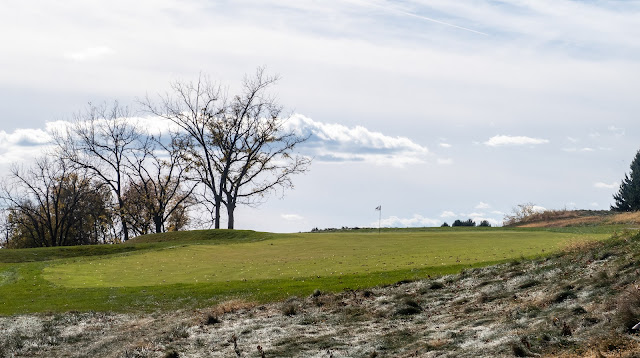
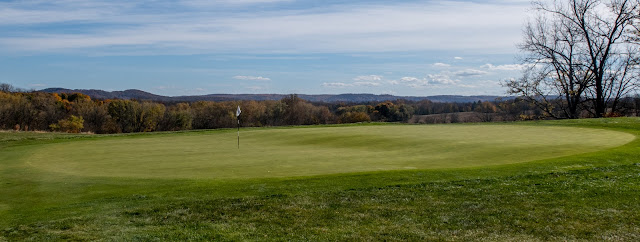
Speaking of not capturing the spirit of the architect, the eighth hole is pretty clearly the worst attempt Architects has to offer. This is supposed to be the homage to Seth Raynor, student of C.B. Macdonald and template hole extraordinaire. This would seem to be the easiest architect to copy for Architects' entire gimmick and yet, they screwed it up.
The eighth hole is a mid-length par 3 playing uphill to a two-tiered green with several bunkers left. I suppose the bunkers are kind of geometric and hard-edged, but in no way does this resemble a hole Seth Raynor would have built. It just doesn't. A Redan would have worked; the tee shot approached the hillside in the appropriate diagonal fashion, and an uphill Redan would capture the traditional lower angle of approach that marked the original. That would have been a cool hole. Instead, we got something kind of boring and not related to Seth Raynor in any meaningful way.
 |
| The eighth hole. |
 |
| The eighth hole. |
The ninth hole is a long par 4, playing an uphill 450 yards, and is an homage to Donald Ross. Ross is another tricky one to try and emulate; he certainly had a style, unlike Tillinghast, but it was generally subtle and conservative, fitting the land. Which makes sense, considering how many courses he's responsible for. So basically, as long as you don't do anything really flashy, you can make pretty much anything a tribute to Donald Ross.
The tee shot here has to go past a pair of top-shot bunkers (which is a very Ross feature, to be fair) and needs to be hit with driver to get to the top of the hill. From there, the second shot appeared to be quite difficult, with a bunker right of the green and a pond short and left. However, while left is pretty clearly dead, there is a bit of visual deception at play with the pond short of the green; there's actually 10-20 yards of space between the water of the green. Not a huge amount of space, but far from nothing. And the green itself is actually kind of interesting, with a trench sort of cutting across the green diagonally. The front left and back portions are elevated, making hole locations on those sections quite tricky. It's apparently based on drawing from Mr. Ross, which explains why it's so much more interesting than the greens we've seen before. Overall, I think this hole is a decent facsimile of a Ross design.
 |
| The ninth hole. |
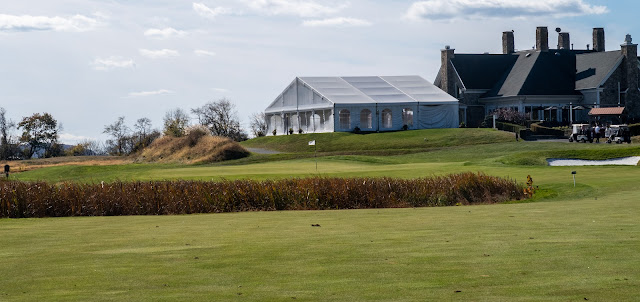 |
| Approaching the ninth green. |
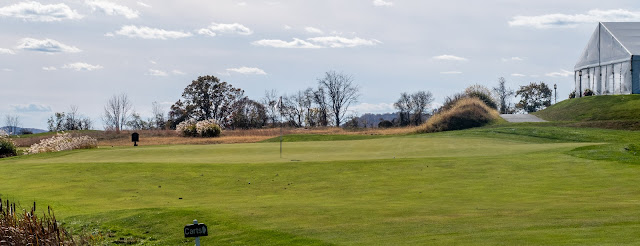 |
| The ninth green. |
That's it for this week, next week we'll check out the back nine.