When you think vacation destinations, northern New Jersey is probably not the first place that pops into your head. Obviously, being in the greater New York City area we're not talking about a distant outpost of civilization here, but most people, when confronted with one of the greatest cities on Earth, don't stop 10 miles short and think, "eh, close enough." But when it comes to public golf, northern New Jersey is sneaky good, with multiple representatives on this recent list from Golf.com of the best golf courses that can always be played for $100 or less.
Unfortunately, we must start off with a bit of disappointment. You see, Essex County has three public golf courses in its municipal roster (all designed by Charles Banks, a representative of the MacRaynor school of design), two of which have undergone recent renovations: Hendricks Field and Francis Byrne (the third, Weequahic, was under the knife during our visit). Of the two, it was pretty clear from the various things I saw online that Francis Byrne had turned out very well, and I was eager to check it out. And so, as it turned out, was the rest of New Jersey, because I simply could not get a time there. Hendricks Field was gettable, however, and so to represent the Macdonald-Raynor flag in a region inundated with their best work, Hendricks Field must carry the flag (since I've already reviewed Rock Spring, which my brothers and I also played during this excursion.
Designed in 1929 by Mr. Banks, Hendricks Field is unique in that it was always meant for public play, a rarity among the MacRaynor oeuvre, as they worked pretty exclusively for the cream of NYC's crop. And it's pretty clear throughout, as the renovation definitely emphasized the public aspect of the course – as well as rearranging the layout, adding and subtracting holes in several places. Hendricks Field is a beginner-friendly Raynor-style course, and oftentimes, easy golf often means boring golf. Think about it: How many great golf courses would be classified as easy? How many top 100 courses could your average 15-handicapper stroll up to and break 90? Not many. So the question here is, can Hendricks Field manage to be both interesting and easy to play?
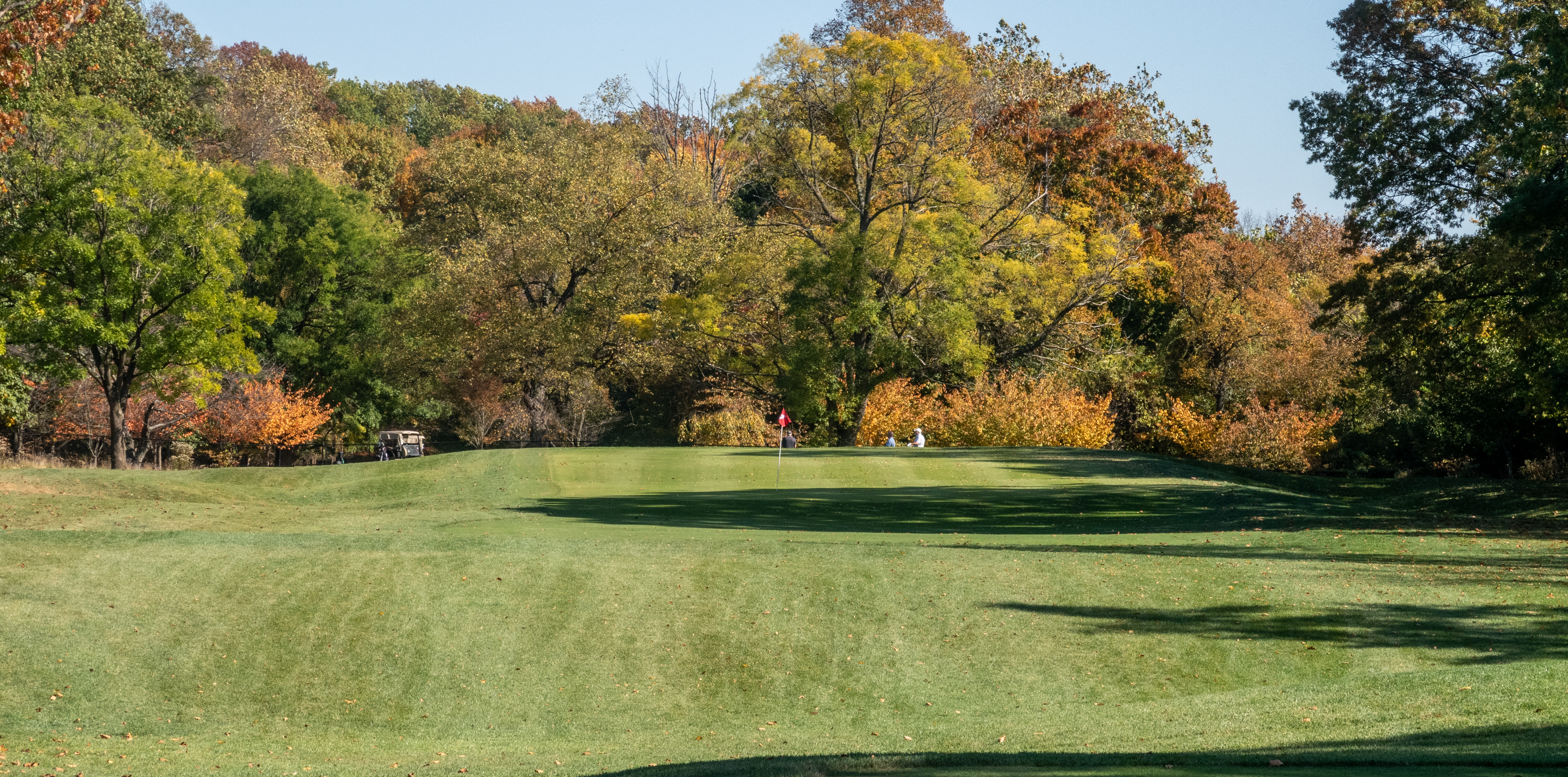
The first hole kicks things off in a quirky fashion; this is a 475-yard par 5 that doglegs hard left up a hill, with the fairway sloping significantly in the opposite direction. The ideal line is guarded by a bunker, which must be cleared to bring the green into play on the second shot. Bail out right and you can quickly run out of fairway and into a group of trees. For most people, the second shot will be blind, though long drivers can just about bring the flag into view if they play aggressively enough on the drive. This hole is inspired by the Alps hole, and while it lacks the front bunker, the blind aspect is fully present, as is the punchbowl green that so often accompanies Alps holes. While the green does funnel golf balls in toward the center, there is more to it than that. This is something Hendricks Field does throughout the round; on almost every green, there are one or two small but distinct mounds. These mounds are often very well placed to affect most putts, and while they aren't particularly big or tall (we're talking 3-5 feet across and 6-12 inches high), they do plenty to make putts up and around them very tricky. They don't feel like a Banks original feature (though of course I'm hardly an expert), but I like them. They add character to the greens without making them too difficult to play, and they help make this hole one of the best on the course.
 |
| The first green. |
 |
| Approaching the first green. |
 |
| The first green. |
The second hole is a fairly long par 4 at 425 yards, though it does play pretty dramatically downhill as it heads right back alongside the first. The hole is blind from the tee, but aside from the obvious trees lining the fairway, there aren't any hazards to worry about. The second shot is tricky; while the green is quite large, there's a big greenside bunker short right and you'll have a tough hanging lie on your short to mid iron.
 |
| The second hole. |
 |
| Approaching the second green. |
 |
| The second green. |
The third hole is 185 yards and isn't modeled after any particular hole; it's basically just a mid-length par 3 with a bunker left of the green. That said, the green is tilted pretty significantly from right to left, so while the obvious bailout is right, missing the green on that side will leave a tricky little chip. This is one of those times where the bunker really isn't that bad a place to miss.
 |
| The third hole, |
The fourth hole is a straightaway short par 5, playing just under 500 yards. The tee shot here is simple, though the playing area isn't particularly wide. Not narrow, of course, but not wide to the point where you may want to hit 3 wood. If you do that, though, not only do you preclude yourself from going for the green in two, it brings a cross bunker 50 yards short of the green directly into play. Either you need to carry that bunker or leave yourself a full wedge third. For those who did hit driver and can go for the green in two, a large bunker front right means a fade is definitely the play. This green is actually modeled after a reverse Redan, so figure in the usual Redan playing characteristics when approaching the green.
 |
| The fourth hole. |
 |
| Approaching the fourth green. |
 |
| The fourth green. |
The fifth hole is also a short par 5, playing just 480 yards. Yes, we've got two short par 5s in a row, playing parallel to each other. The tee shot here is quite similar to the last one: bunkerless fairway, trees on both sides, although this fairway has some interesting little crumples to it that are impossible to capture on camera but do make approach shots slightly more complicated. In addition, a narrow ditch crosses the fairway about 325 yards out, but if you hit a good drive it doesn't come into play. The green is also bunkerless (as is the entire hole), but the surface is angled right to left with a noticeable dropoff left acting similarly to a bunker. This is honestly an very easy hole, and an excellent birdie or even eagle opportunity.
 |
| The fifth hole. |
 |
| Approaching the fifth green. |
 |
| The fifth green. |
The sixth hole is 160 yards and is supposed to be a Short hole. This may be the biggest stretch on the course; Shorts are supposed to have large, wild greens surrounded by a ring of sand. This has neither of those things. The green is pretty much the same level of severity as the rest of the course, and the lone bunker only protects the front right portion of the green. It's not a bad hole, just nothing close to what the scorecard claims.
 |
| The sixth hole. |
 |
| The sixth green. |
The seventh hole is a 420-yard par 4 and presents an actual challenge on the tee shot in the form of the ditch from five slashing across the fairway at a 45-degree angle through the landing area. How much it comes into play depends on how bold you want to be with the tee shot. Obviously, you can lay well back of it with a long iron, but that means you'll have another long iron on the second shot. A 3 wood is safe so long as you avoid the left side, but longer hitters do have to worry about the ditch if they happen to hook one. If you're feeling especially bold and/or stupid, you could even hit driver so long as you hug the right trees; there is just enough space between them and the ditch to squeeze a driver. Of course, miss left at all and you're going in the ditch.
The green here is bunkerless and on the larger side, but it's also one of the most undulating and severe on the course, and it's also slightly elevated above its surroundings. It is not a simple matter hitting this green, especially if you've got a mid iron in hand. This is the No. 1 handicap hole, and I think it deserves it.
 |
| The seventh hole. |
 |
| Approaching the seventh green. |
 |
| The seventh green. |
The eighth hole is Hendricks Field's true Redan, and happily it plays pretty authentically. It's got the front left bunker, the right-to-left green tilt (with a neat mini-punchbowl hole location back right), and at 190 yards it's just long enough that most golfers will be using a mid iron or more, taking the direct line at the hole out of the equation. Yeah, it's not as dramatically difficult as the Redans at Keney Park or Charleston Municipal, but it still provides the Redan experience, and I like it a lot.
 |
| The eighth hole. |
 |
| The eighth green. |
The ninth hole is a mild-mannered mid-length par 4 for most of its 375 yards. Yeah, the ditch from the fifth and seventh holes crosses this fairway as well, but it requires all of a 180-yard carry to clear, which is within the realm of most people, especially those playing from the back tees. The fairway does narrow slightly beyond 250 yards, squeezed between a native area left and trees (along with the parking lot) right, but there's still plenty of space to work with.
Things get more interesting on the second shot, or more accurately, once you get to the green. This green is very large, likely the largest on the course, and it's also a Double Plateau, going from high in the front to low in the middle back to high in the back. The challenge is obvious; control the approach and you'll have an easy birdie attempt, fail to do so and risk three putting. As the scorecard summary states, this isn't the most extreme version of the Double Plateau in the world (certainly less so than the one at Rock Spring a few miles away), but honestly, it doesn't need to be. The challenge is there, and that's what matters.
 |
| The ninth hole. |
 |
| Approaching the ninth green. |
 |
| The ninth green. |
That's it for this week, next week we'll take a look at the back nine.