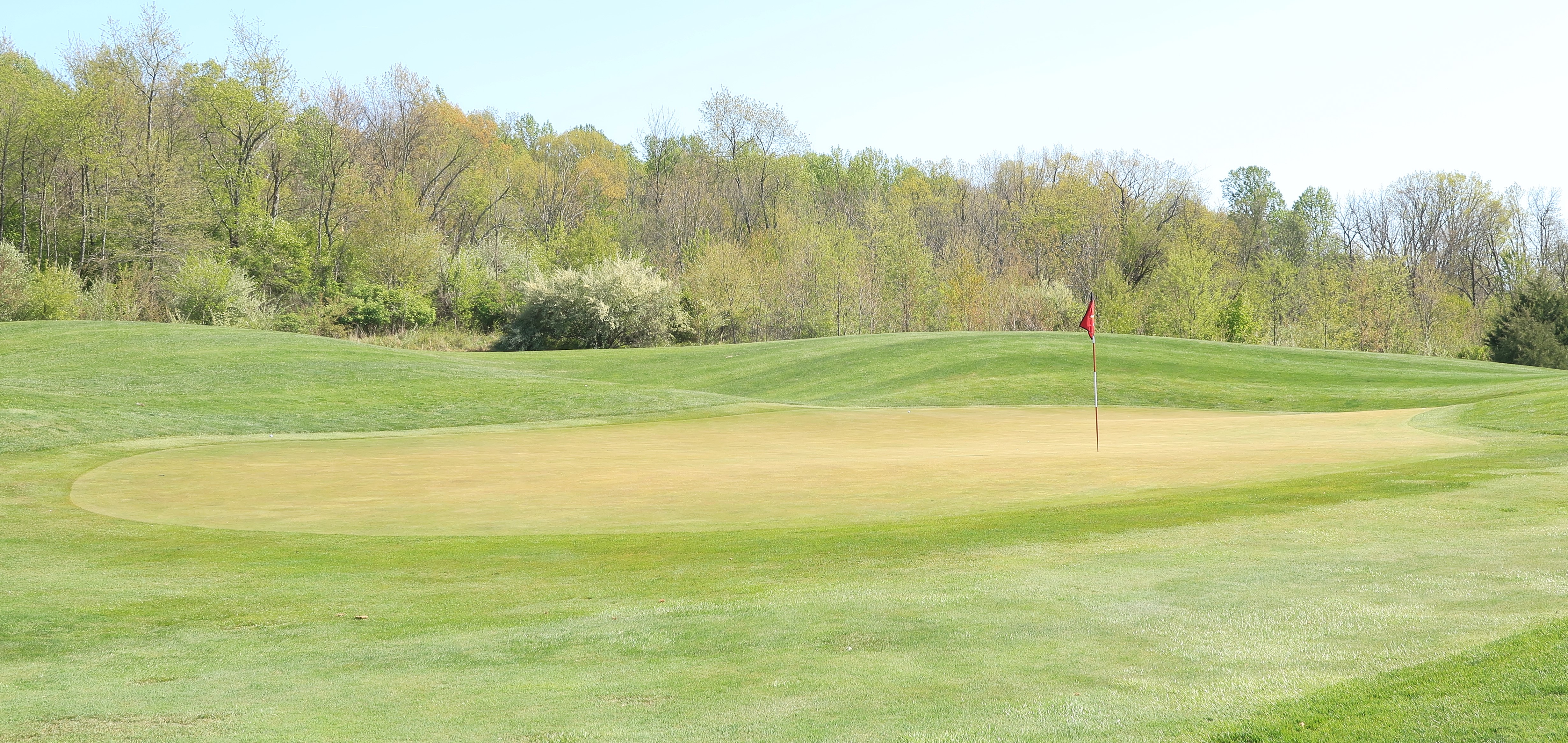
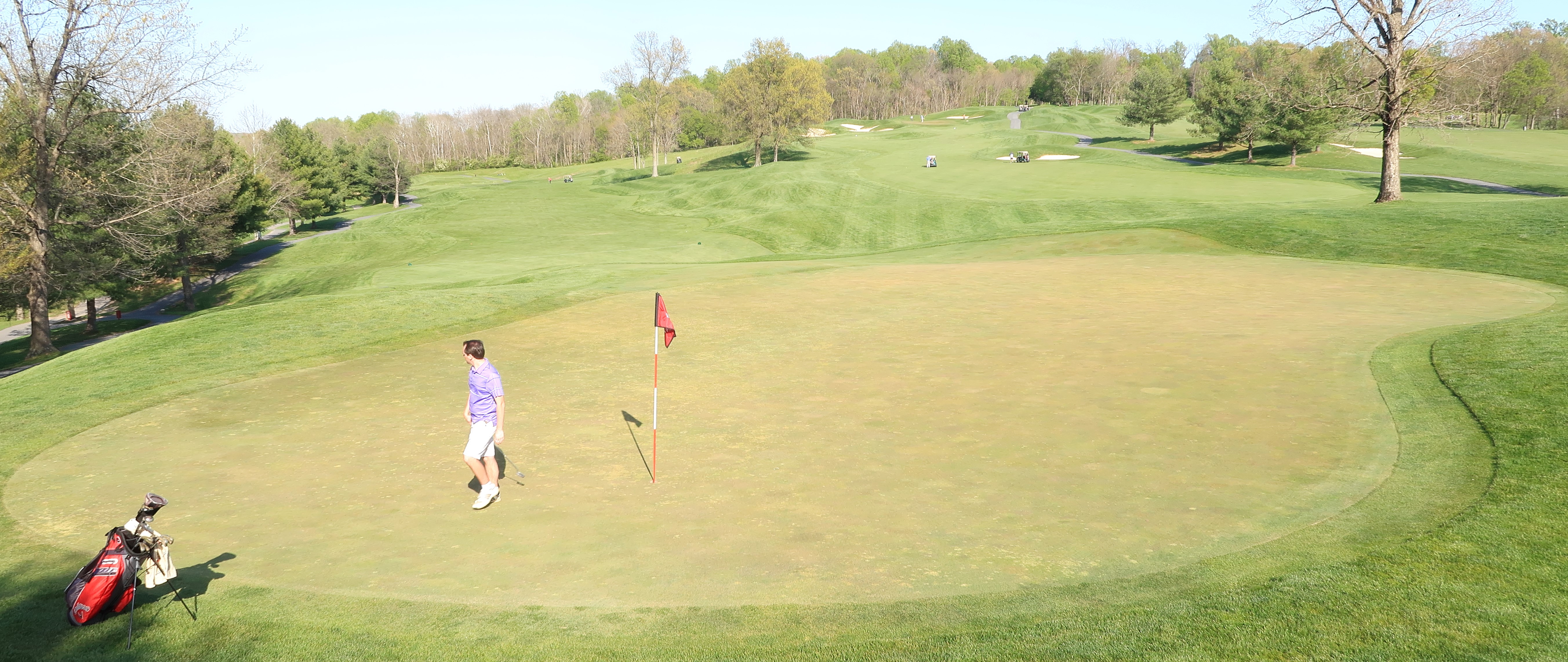
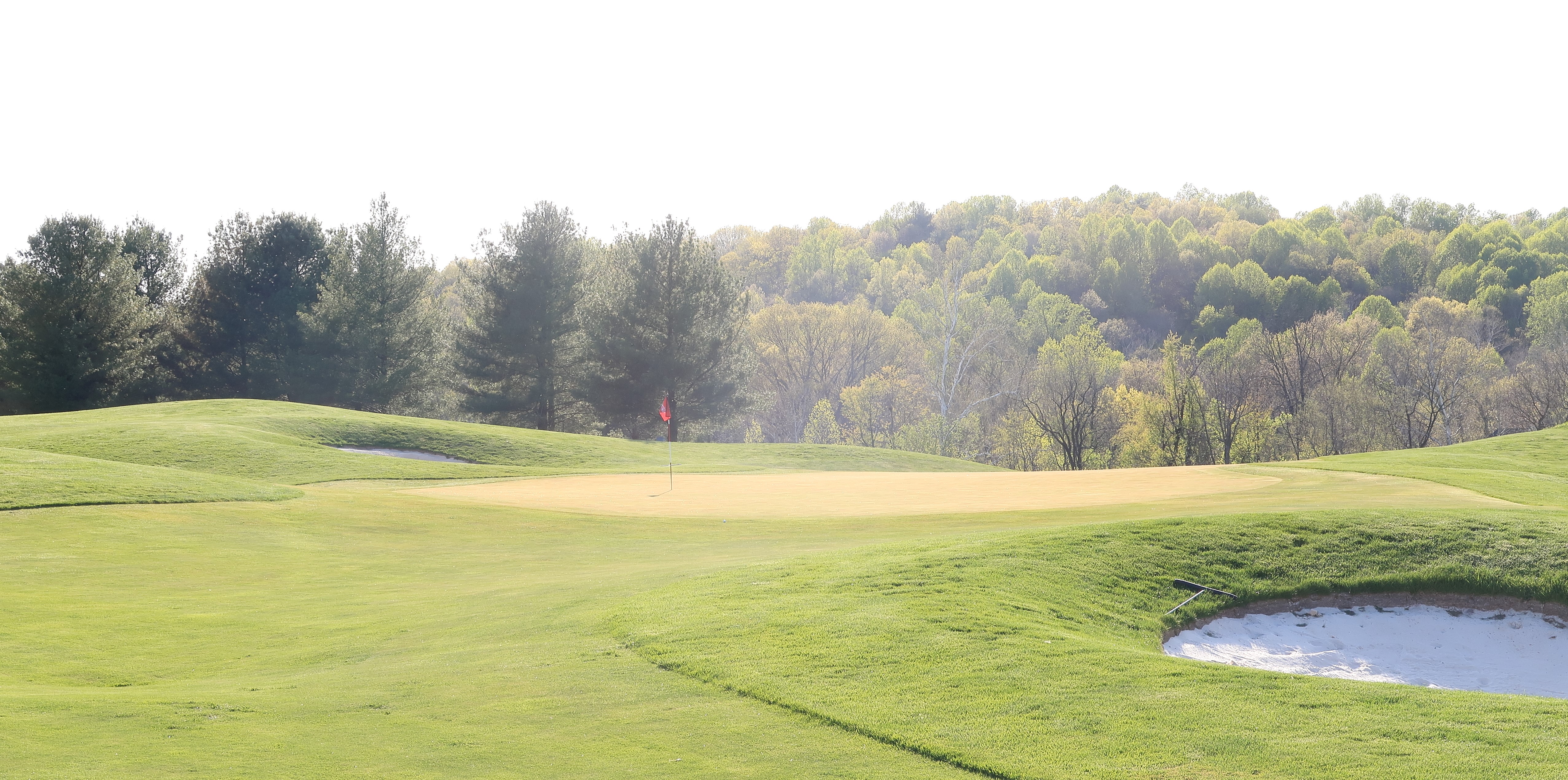
If there's one thing Frederick, Maryland is not lacking in, it's upscale public golf. There are five of these "country clubs for a day" within 20 minutes of downtown, which is a lot. Why we need so many (or any; needless to say I'm not a big fan of the concept) is unclear to me. But we're stuck with them, and of the five, Whiskey Creek is generally considered to be the best. It's ranked the highest out of the central Maryland golf courses on Golfweek's best public courses in Maryland list. It's definitely the highest profile, considering its well-advertised connection with Ernie Els, who served as a consultant as the course was being built back in the late 1990s/early 2000s. How involved he actually was during the height of his career is an excellent question, and the answer is probably not much. This is really not an Ernie Els–designed golf course.
As with the other upscale public golf courses in Frederick, Whiskey Creek occupies some very rolling terrain, which is strange to me. I don't think of Frederick County as being particularly hilly, but if the golf is to be believed, this is quite possibly the hilliest place in the world. An exaggeration of course, since the affordable local golf courses are much flatter, but Whiskey Creek is very much not an easy walk. You can, and my brother and I did, but it's tough (even tougher since this was our first official 18-hole round of 2022). So at the very least, Whiskey Creek has topography going for it. Does it have anything else though? Something substantive enough to justify a price tag that often tops $100? Let's find out.
The first hole is a classic gentle handshake opener. At just over 400 yards, it's not long, and there's plenty of space around, since there are no trees around. The hole doglegs right pretty significantly, and the fairway narrows at the turning point, squeezed between four fairway bunkers. You can bail out well left, but that will leave a pretty long second shot. Challenging the bunkers will leave a much shorter approach into the green, which is fairly long and narrow and protected by three bunkers. Whiskey Creek doesn't waste any time revealing its party trick: The ruins of an 18th century farmhouse. They don't come into play on this hole, but we'll be seeing them again.
 |
| The first hole. |
 |
| Approaching the first green. The old farmhouse is in view. |
 |
| The first green. |
The second hole is another mid-length par 4, this one playing 390 yards. It's uphill the whole way though, so it's effective 10 or 20 yards longer. The strategy is simple: A drive that favors the left side, challenging the fairway bunkers, will leave the golfer with an easier shot to the semiblind green. If you bail out right with the drive, you'll have to carry a pretty big greenside bunker, and you'll have a lot less green to work with. Not revolutionary, but there's a reason you see holes like this. The strategy works.
 |
| The second hole. |
 |
| Approaching the second green. |
 |
| The second green. |
The third hole is just under 200 yards, but plays significantly uphill to a fairly shallow green guarded by a big bunker short, as well as a smaller one behind the green, hidden from view. This is a hole where you really don't want to go straight for the flag when its tucked in the right corner, like it was for our round. An iron to the middle of the green is all you really want here.
 |
| The third hole. |
 |
| The third green. |
The fourth hole is the longest hole at Whiskey Creek at 560 yards, and it plays uphill too. I promise, not every hole on this course plays uphill. This is actually a pretty tight driving hole, with trees surrounding the fairway quite closely, not to mention a pair of bunkers pinching in right where a good drive would finish. If you've hit the fairway, the second shot is more about position, getting yourself into a good place for the third, though there is one small bunker about 100 yards from the green. The green is long and narrow, and has two tiers, with the back higher than the front. I don't imagine too many eagles are made on this hole; positioning and accuracy are much more important.
 |
| The fourth hole. |
 |
| Approaching the fourth green. |
 |
| The fourth green. |
At long last, the fifth heads down, and it does so very quickly. The fairway lays far below the tee, which makes the tee shot a tricky proposition. The hole is 400 yards and doglegs hard left at about 250 yards between a pair of bunkers. There's definitely something to be said for laying up with a wood or long iron, but even that can be difficult considering how much further the ball will go. The aggressive play is along the left tree line, flirting with the left bunker. And it's definitely advantageous to be closer to this green, considering how shallow it is. There's a bunker beyond, and the fairway slopes down short, so you can't really run a shot into the green. It's not an easy approach.
 |
| The fifth hole. |
 |
| The fifth green. |
The sixth hole is 344 yards and plays pretty steeply uphill. Not quite to the same extend that the fifth plays down, but you regain quite a bit of elevation on this hole. The hole doglegs slightly right, and while the first fairway bunker isn't really an issue, the second one definitely is, especially considering the right-to-left slope of the fairway. Using a 3 wood leaves you in the widest part of the fairway and leaves a full wedge on the second, which is just fine. The green is semiblind and fronted by two deep bunkers, so in all honesty a full wedge, which is easier to control, is preferable. You also don't want to miss long; that leaves a tricky chip from a downhill hanging lie to a green that slopes away.
 |
| The sixth hole. |
 |
| Approaching the sixth green. |
 |
| The sixth green. |
The seventh hole is the shortest hole on the course, playing a bit under 160 yards. That's not quite under the threshold for a true short par 3, but it's pretty close, and the next tee up is only 135. The green is pretty big, but so are two of the three bunkers protecting it. The one front left is especially nasty. Still, it's a very playable hole, and it gives shorter hitters a good chance at a birdie.
 |
| The seventh hole. |
The eighth hole is much like the second in the simplicity of its strategy, though I like this one more, since the advantages are much clearer. The fairway doglegs left around a big bunker, and if you challenge that bunker, or carry it with a big drive, you'll have an clear, easy wedge into the green. Bail out right, and you're left with a much tougher shot over a bunker to a shallow target. Plus, this hole doesn't play 50 feet uphill.
 |
| The eighth hole. |
 |
| Approaching the eighth green. |
 |
| The eighth green. |
The ninth hole is the front nine's second par 5, playing 545 yards to a sprawling fairway. If you want to go for the green in two, you'll have to clear a section of native area and a long fairway bunker off on the right side, otherwise the fairway ends too far back. If you can't clear that native area, the second shot will be complicated by a bunker about 100 yards from the green right in the middle of the fairway. This is the only hole with a true fairway bunker, so don't expect any more. But it is nice to see once. The green itself is sloped pretty severely from front to back, and has two bunkers alongside, one front left and one back left.
 |
| The ninth hole. |
 |
| Approaching the ninth green. |
 |
| The ninth green. |
That's it for this week, next week we'll look at the back nine.