Featured Post

Review: Leatherstocking Golf Course (Part 1)

Most people who visit Cooperstown, New York, are going to see the National Baseball Hall of Fame. It is the obvious reason to visit the town...

Showing posts with label planet. Show all posts

Thursday, September 2, 2021

Could Life Exist on Mini-Neptunes?

It would certainly make the search for life outside Earth a lot easier if life could exist on the class of planets astronomers have dubbed "Hycean" worlds. Hycean planets are otherwise known as mini-Neptunes because of their diameter (bigger than Earth, smaller than Neptune) and their make-up, having large hydrogen atmospheres. These mini-Neptunes don't actually have much more mass than the Earth.

According to a new study, scientists believe that Hycean planets may actually be a prime source for life. The reason is simple: These planets likely have oceans of liquid water underneath the hydrogen atmosphere, and we all know life loves liquid water. In addition, Hycean planets have proved to be quite common in the universe, and it is believed that detecting biosignatures in the atmospheres of these planets would actually be easier than on standard terrestrial worlds. The plan is to use the James Webb telescope (which is finally ready for launch) on a number of Hycean planets within 200 light-years of Earth, scanning them for molecules consistent with life. It wouldn't be definitive evidence, but it would be closer than we've come yet, and that would be big news.

Tuesday, February 6, 2018

A Pair of Exoplanet News Stories

February 5th was a good day for exoplanet enthusiasts. Two stories, both interesting in their own ways. Funny how it happens like this sometimes.

Let's start off with the less immediately useful news. For the very first time, we have detected planets...in another galaxy. Yes, you heard me, another galaxy. And we're not talking about one of Magellanic Clouds, or even Andromeda, we're talking about planets in the quasar galaxy RX J1131-1231, which is, um, 3.8 billion light-years away. Yeah, we're not getting there any time soon.
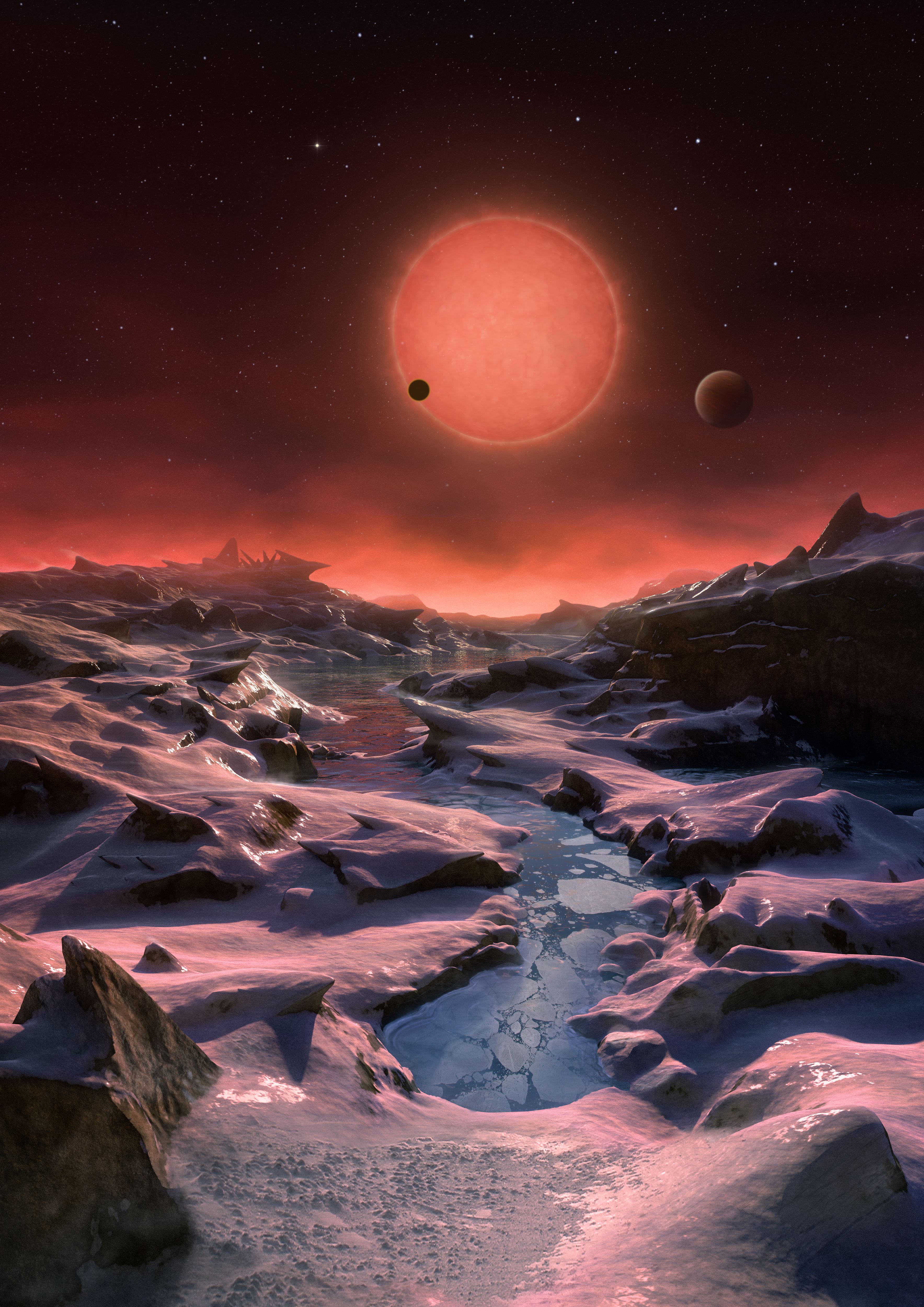
ESO/M. Kornmesser
How have we managed to ferret these planets out, when we have trouble finding planets orbiting stars right next door, and we're not even entirely convinced we've discovered every planet in our own solar system? We can thank gravitational microlensing for that. I won't explain how that works, but it involves general relativity, and a gravitational midpoint focusing far-off light in just the right way so we see it as if it were nearby. Okay, I explained it a little bit. We've discovered a few dozen planets in the Milky Way using this method, but we're not talking about a few dozen planets this time, we're talking a couple thousand, from objects as small as the moon to ones the size of Jupiter. Obviously, we have no chance of ever seeing these places directly, but it is very cool that we can even find them in the first place, and even learn a bit about them.

The second bit of exoplanet news is, well, not exactly practical, but certainly much more so that intergalactic exoplanets. TRAPPIST-1 is, after all, 100 million times closer to Earth that RX J1131-1231. If that name rings a bell, it should, I've written about it before. A seven planet system around a red dwarf, three of which are in the habitable zone? And at only 40 light-years away, TRAPPIST-1 is close, much closer than any of the other potentially habitable exoplanets we've found, which are almost all Kepler discoveries and are hundred or even thousands of light-years out. That makes it a very inviting place to study, and study it we have. TRAPPIST-1 (named for the Belgian beermakers, if you're curious), is likely now the most studied solar system outside our own, and the results we've gotten so far are very promising. We've found water, and lots of it. We've found these planets don't have thick hydrogen/helium atmospheres and are almost certainly terrestrial.

While nearly all the planets in the system are interesting, TRAPPIST-1e is particularly noteworthy. It's a bit smaller and a bit less massive than Earth, but it has a very similar density to Earth, meaning it most likely has an iron core, like Earth. And that means a magnetic field. It likely doesn't have a tremendously thick atmosphere or an enormous world-covering ocean. It receives nearly the same amount of light Earth does. Granted, 1e is tidally locked, but in every other way, it's exactly the sort of planet we've been looking for. I expect to hear a lot more about TRAPPIST-1e in the future.


Sunday, January 24, 2016

A Ninth Planet for Our Solar System?

Yes, that's right, after 10 years, the International Astronomical Society have realized their mistake and are reinstating Pluto as the ninth planet. It's a controversial decision in the astronomical world, but the IAU has recognized the public popularity of Pluto, especially after the New Horizons visit, and astronomers now feel that an exemption should be made for Pluto.

Uhhh, no. Did I have you going? Probably not.

So, yes, scientists have announced that there is likely a large body very far out in the solar system, hundreds of AU away. It obviously isn't official yet, but this is some very interesting news. The hypothetical planet would likely be about 10 times more massive than the Earth and would orbit about 20 times further away then Neptune. The evidence for the existence of this object, since we haven't actually seen anything, is that the orbits of 6 Kuiper Belt objects seem to be heavily influenced by something. The orbits all point in the same general direction, even though the objects, including the dwarf planet Sedna, are moving at very different speeds.

If you recall your astronomical history, you'll remember that the search for Neptune commenced because of perceived inconsistencies in Uranus' orbit, and that the search for Pluto occurred because of inconsistencies in Uranus' and Neptune's orbits. So, as with most extraordinary discoveries, it's important not to jump to any conclusions. But I do find it interesting that a few months back, scientists hypothesized the existence of a fifth gas giant in the early solar system which was cast out due to interactions from an early Jupiter or Saturn. This hypothetical planet would have been an ice giant, like Uranus and Neptune. The new "Ninth Planet" is also almost certainly an ice giant which probably did not form that far out in the solar system. Interesting how this works out, isn't it? I'm expecting to hear more about this in the future.