Featured Post

Review: Leatherstocking Golf Course (Part 1)

Most people who visit Cooperstown, New York, are going to see the National Baseball Hall of Fame. It is the obvious reason to visit the town...

Showing posts with label TRAPPIST-1. Show all posts

Tuesday, February 6, 2018

A Pair of Exoplanet News Stories

February 5th was a good day for exoplanet enthusiasts. Two stories, both interesting in their own ways. Funny how it happens like this sometimes.

Let's start off with the less immediately useful news. For the very first time, we have detected planets...in another galaxy. Yes, you heard me, another galaxy. And we're not talking about one of Magellanic Clouds, or even Andromeda, we're talking about planets in the quasar galaxy RX J1131-1231, which is, um, 3.8 billion light-years away. Yeah, we're not getting there any time soon.
ESO/M. Kornmesser
How have we managed to ferret these planets out, when we have trouble finding planets orbiting stars right next door, and we're not even entirely convinced we've discovered every planet in our own solar system? We can thank gravitational microlensing for that. I won't explain how that works, but it involves general relativity, and a gravitational midpoint focusing far-off light in just the right way so we see it as if it were nearby. Okay, I explained it a little bit. We've discovered a few dozen planets in the Milky Way using this method, but we're not talking about a few dozen planets this time, we're talking a couple thousand, from objects as small as the moon to ones the size of Jupiter. Obviously, we have no chance of ever seeing these places directly, but it is very cool that we can even find them in the first place, and even learn a bit about them.

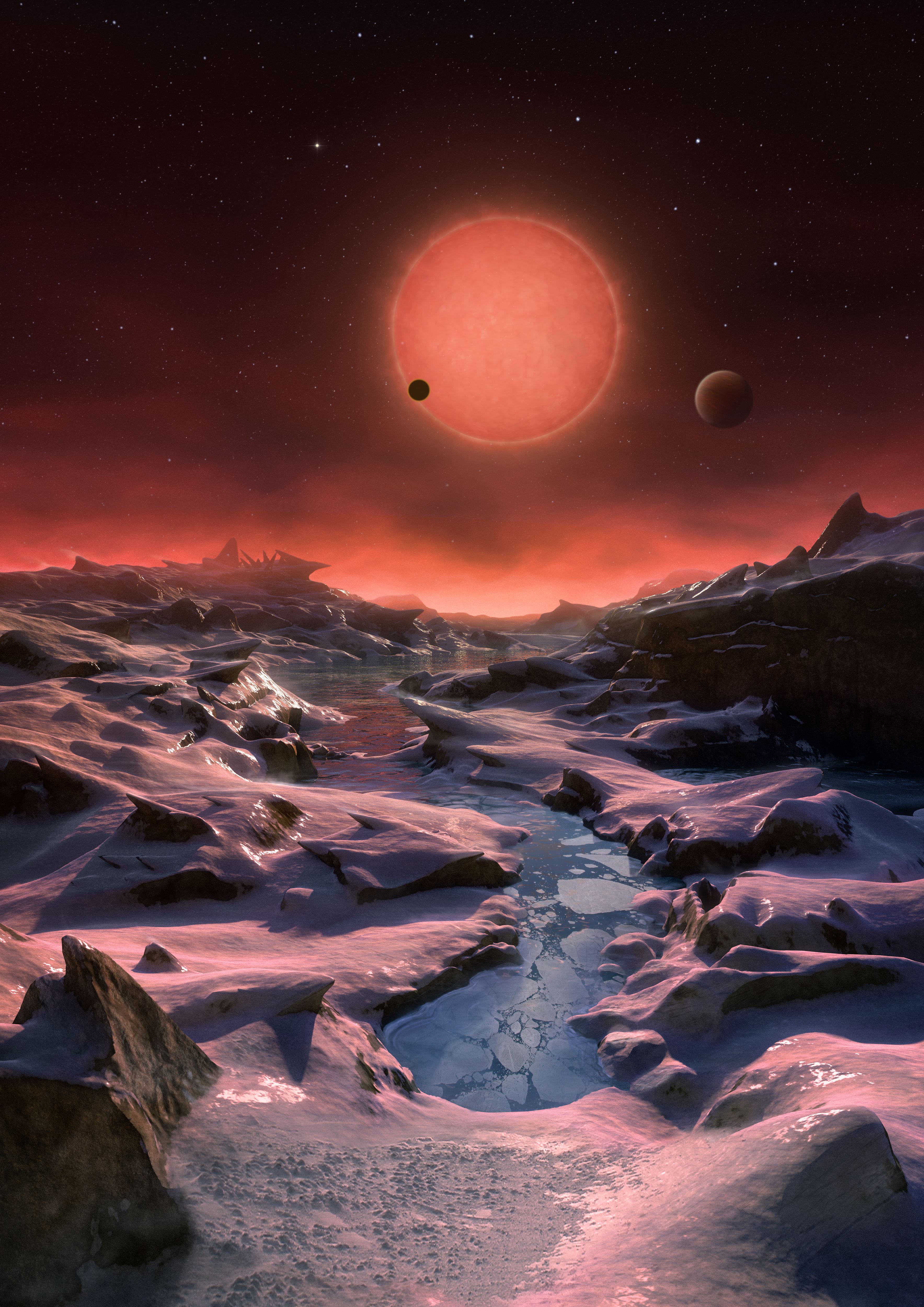
The second bit of exoplanet news is, well, not exactly practical, but certainly much more so that intergalactic exoplanets. TRAPPIST-1 is, after all, 100 million times closer to Earth that RX J1131-1231. If that name rings a bell, it should, I've written about it before. A seven planet system around a red dwarf, three of which are in the habitable zone? And at only 40 light-years away, TRAPPIST-1 is close, much closer than any of the other potentially habitable exoplanets we've found, which are almost all Kepler discoveries and are hundred or even thousands of light-years out. That makes it a very inviting place to study, and study it we have. TRAPPIST-1 (named for the Belgian beermakers, if you're curious), is likely now the most studied solar system outside our own, and the results we've gotten so far are very promising. We've found water, and lots of it. We've found these planets don't have thick hydrogen/helium atmospheres and are almost certainly terrestrial.

While nearly all the planets in the system are interesting, TRAPPIST-1e is particularly noteworthy. It's a bit smaller and a bit less massive than Earth, but it has a very similar density to Earth, meaning it most likely has an iron core, like Earth. And that means a magnetic field. It likely doesn't have a tremendously thick atmosphere or an enormous world-covering ocean. It receives nearly the same amount of light Earth does. Granted, 1e is tidally locked, but in every other way, it's exactly the sort of planet we've been looking for. I expect to hear a lot more about TRAPPIST-1e in the future.


Friday, February 24, 2017

Exoplanets Around TRAPPIST-1

Yeah, you've probably heard the news already. It's been everywhere. Recently, scientists announced the discovery of a seven planet system orbiting the red dwarf TRAPPIST-1, all of which are Earth sized and likely made of rock, and three of which are solidly in the habitable zone. What makes this system especially inviting for future study is the dimness of the star. TRAPPIST-1 is tiny and incredibly faint, the midday sky on the orbiting worlds would only be as bright as the sky at sunset on Earth. Most of the heat comes in infrared, and any plants on the surface would be black instead of green. There may very well be habitable planets, but they won't be like Earth.

Anyway, a dim star makes it much, much easier to study the orbiting planets. Planets glow, but not by much, and they pale in comparison to their stars normally. It's like trying to study a firefly floating next to a floodlight from a mile away. It's difficult. But here, instead of a floodlight, we have a 60 watt bulb. It makes life that much easier.

Anyway, I'm sure we'll be hearing more about the TRAPPIST-1 system in the future, especially when the James Webb Telescope goes up in 2018. But for now, we'll just have to imagine what standing on some of those worlds would be like.