Featured Post

Review: Southern Pines Golf Club (Part 1)

For our final golf course on this North Carolina getaway, we turn to Southern Pines, which would appear on a surface level to be the third m...

Showing posts with label gettysburg. Show all posts

Wednesday, September 18, 2024

Review: The Bridges Golf Club (Part 2)

It's time to check out the back nine at The Bridges, go here to see the front.

The tenth hole is 420 yards and pretty much feels like a longer version of the first hole. The drive is extremely wide open, and since the hole's got an extra 50 yards to it, the stream that crosses the fairway  a hundred yards short of the green isn't a concern. The lone greenside bunker front right is reasonably threatening though, and the green itself does have a fair amount of back-to-front tilt. Still, a little too much like a copy-paste of the first hole, in my opinion.

The tenth hole.

The tenth green.

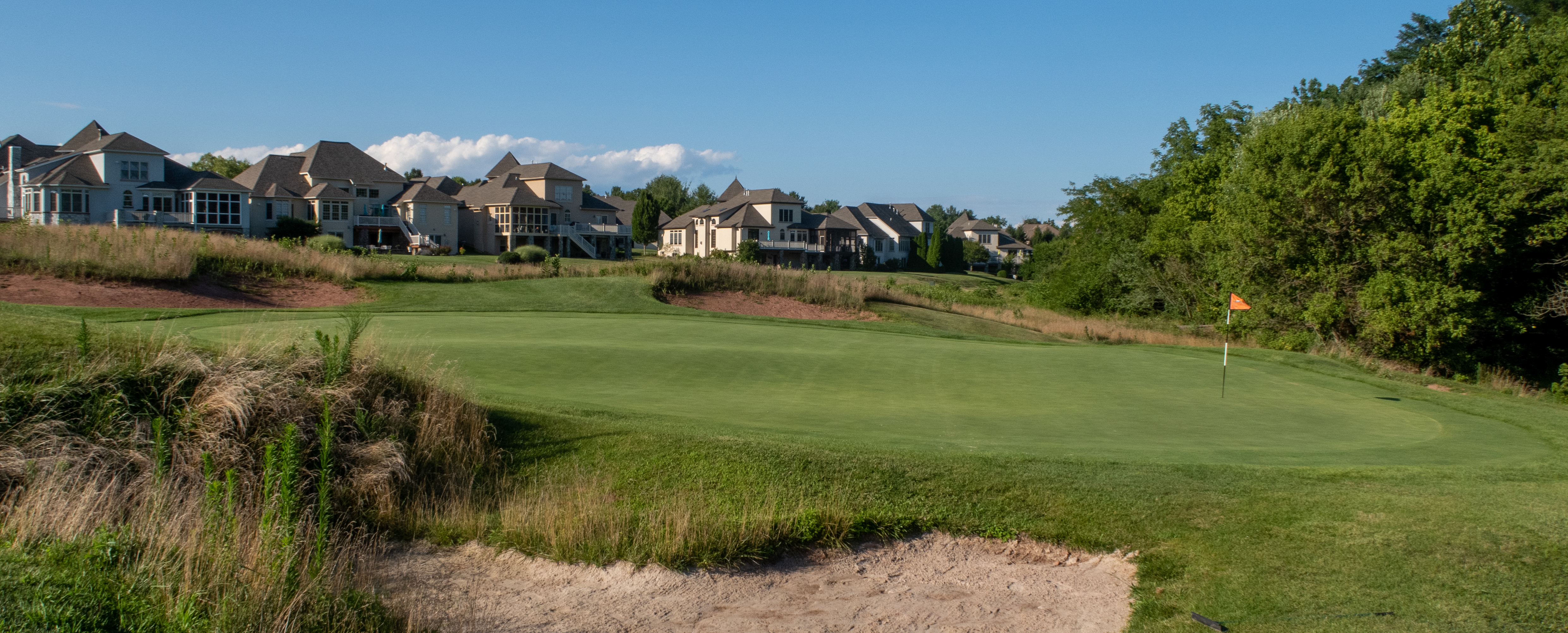
The eleventh hole, on the other hand, is actually a pretty solid and fun golf hole. It's a 180-yard par 3 with a narrow green carved out of a hillside. There are two bunkers right which function both as hazards and as a means of catching slightly wayward shots from bounding down into the trees further right. Also, this green's got some interesting contours and isn't just a basic back-to-front proposition. I do wish the hole was slightly shorter, as this would be an excellent candidate for a genuine short par 3, but I'll take what I can get.

The eleventh hole.

The eleventh green.

The twelfth hole is a fairly short par 4 at 350 yards, and while it may appear to be as wide open as most of the previous holes, there's actually something to pay attention to on the drive here. Two staggered bunkers eat into the fairway right where a driver would land, so if you want a short pitch into the green, you'll have to thread the needle between those bunkers. The green is open in front but is flanked by one large bunker left and two tiny little bunkers right. Also, there's a tree guarding the front-right corner that I imagine does an excellent job of interfering with approaches hit from right of the fairway.

The twelfth hole.

Approaching the twelfth green.

The twelfth green.

The thirteenth hole is a mid-length par 4 that plays uphill to a partially blind fairway, with a completely blind water hazard about 275 yards out essentially cutting the fairway in half. Everyone's favorite, blind water hazards. At least you can see it from the previous green, so you know it's coming, and the scorecard does give a distance to it. Theoretically, you could squeeze between the water and the trees left, but we're talking about a gap of like 15 yards. Not something you can depend on. A 3 wood is fine on the tee and should give you a short iron second shot. The green's pressed up against a boundary line with a single bunker left; the approach is open and right isn't a terrible miss.

The thirteenth hole.

Approaching the thirteenth green.

The thirteenth green.

The fourteenth hole is quite a short par 4 at 325 yards, but since it plays uphill the green really isn't within reach. Also, driver is a very bad play, since the margin for error is so tiny. Big trees overhang the right side, and a bunker and more trees cut in from the left; unless you've got a long fade at your disposal, this is definitely long iron time. That leaves a wedge into the green, which is on the narrower side, sloped pretty significantly from back to front, and protected by a large bunker to the right. Given it's length, this isn't the birdie opportunity you'd think it would be.

The fourteenth hole.

The fourteenth green.

The fifteenth hole is a 535-yard par 5 and is definitely the best hole on the course. The hole is mostly blind, with the fairway falling out of sight about 225 yards out. That's not a big carry, but with O.B. right and forest left, the landing area is relatively narrow, certainly narrower than most of the holes The Bridges presents. If you can carry past the top of the hill, you'll be rewarded with a massive kick forward, potentially bringing the green into reach with the second. If not, the second shot has to contend with a massive right-to-left sideslope that dominates the second half of the hole, as well as a bunker about 50 yards short that's perfectly placed to catch overly ambitious lay-ups. The green is pretty small, with a single bunker left. Not the most exciting end to a fun hole, but this isn't that sort of golf course.

The fifteenth hole.

Approaching the fifteenth green.

The fifteenth green.

The sixteenth hole is just over 200 yards but does play significantly downhill, making it play a bit shorter than the scorecard indicates. The green has a fair amount of slopes and breaks to it, and there are two bunkers left. There's also a pond back right lurking in the background, but you'd either have to significantly overclub and slice or virtually shank your tee shot to get to it. It looks more intimidating than it actually is.

The sixteenth hole.

The sixteenth green.

The seventeenth hole is a little bit awkward when you step onto the tee, as the tee's angled well away from the fairway, pointing more at the twelfth fairway than its own. Also, there are a couple of small trees about 30 yards away that come uncomfortably close to the line you want to take. Beyond that, this 370-yard par 4 is relatively straightforward. The fairway's pretty open, and the pond that does come in from the right is basically out of range unless you're a long hitter. The green is pretty big and has some significant undulation, so if you can't get your second shot close, three putting is a distinct possibility. 

The seventeenth hole.

Approaching the seventeenth green.

The seventeenth green.

The Bridges closes things out with a 540-yard 5 that plays parallel with the ninth, with the teeing grounds literally 20 feet apart from each other. I actually overheard a brief heated discussion when I was walking away from the eleventh green where one group accused another group of jumping in front of them, only to realize that they were the ones who were standing on the wrong tee. Anyway, the fairway negotiates the same rolling ground as the ninth, with a bunker guarding the corner of the dogleg. Carry that bunker, and you could go for the green in two. The green is pretty small though, and protected quite closely by two large bunkers, so a lay-up is likely the more prudent play. It's a decent way to finish out the round; not too easy, but birdie is a distinct possibility.

The eighteenth hole.

Approaching the eighteenth green.

The eighteenth green.

The Bridges is far from being the worst course in the world. It's also far from the best. Our amateur architects built a distinctly average golf course, with a couple fun, interesting holes and a couple weird, not-so-good holes. I really did enjoy the fifteenth. All in all, though, The Bridges doesn't really rise above the numerous pleasant yet forgettable layouts dotting the south-central Pennsylvania countryside. Well, except for the Links at Gettysburg, but moldy bread is more appealing than that place.

The price was fine, being sub $40, but there are cheaper options (namely Gettysburg National). Maintenance was also fine, and the course was in good shape, but at that point in mid-April, if you can't grow grass and have your golf course looking lush, you're kind of doing something wrong. In the end, there's nothing wrong with The Bridges, and it's a perfectly reasonable place to play if you're looking for a round, but there's no good reason for me to go back.

Wednesday, September 11, 2024

Review: The Bridges Golf Club (Part 1)

If you've driven down Route 30 between Gettysburg and York, Pennsylvania, then you know The Bridges. In a similar vein to Rich Valley nestling up right next to I-81, The Bridges sits right alongside Route 30, and is similarly alluring to golfers driving past. I can't exactly say I go past this course on a regular basis, but I've done it enough times that it honestly really bugged me that I'd never played it. The course is right there, right next to a major road, not very far away from where I live, but I just never committed. After a while, it felt like The Bridges and I were a couple of old acquaintances who only ever see each other at big social events who always say to each other "hey, we should totally hang out some day" with both sides knowing perfectly well they're never actually going to make those plans.

Well, score one for committing to a plan, because I finally got around to playing The Bridges. And that's about all I have for preamble, since there's really no background for this course. The people who own the course designed it, which I guess is kind of neat, building your own golf course, but unless your name is George Crump and you've enlisted a half-dozen architects to give you advice, amateur-built golf courses aren't usually a recipe for success. But who knows, maybe the Altland brothers cooked up something interesting? Let's find out.

The first hole starts things off in mild, if entirely unspectacular fashion. It's a 375-yard par 4, playing gently downhill until the fairway meets a small creek cutting across the hole a hundred yards short of the green. Longer hitters will probably want to use a long iron or fairway wood. That will leave a wedge into the green, which is about as bland as you could imagine. Gently sloped from back to front, pretty much circular, and with bunkers on both sides. It's very, very far from being the most inspired green complex of all time. Still, this hole presents a pretty decent chance of starting out with a birdie.

The first hole.

The first green.

I'd hesitate to call the second hole good, but at the very least it is more interesting than the first. At 340 yards, the hole's pretty short, but the fairway bends 90 degrees left about 225 yards out, which pretty effectively takes driver out of your hands. Being able to sling a hook around the trees is obviously very helpful, as it gets you closer to the green and gives you a much flatter stance. It's not a big deal, since the hole's not very long, but it's something. The green here is up on a hill behind three bunkers, and while it's more interesting than the first, we're not talking anything revolutionary. Just a small tier running through the middle. Hey, anything's better than nothing.

The second hole.

Approaching the second green.

The second green.

The third hole is just over 400 yards, and other than there being O.B. vaguely left, there's not much on the tee shot here. And that goes for the second shot as well; aside from a greenside bunker left, the approach is pretty simple and the green is basically flat. This is just kind of a bland, straightaway mid-length par 4 with very little to make it stand out.

The third hole.

Approaching the third green.

The third green.

The fourth hole is the first par 3 at The Bridges, playing 190 yards downhill to a fairly large green with sand on both sides. This green does have some internal contours to it, with the back of the green being particularly tilted. Nothing revolutionary or even all that exciting, but it's better than anything the first three holes present. 

The fourth hole.

The fourth green.

The fifth hole is a pretty short par 5 at just 475 yards, but it's not as reachable as you might think, as we're confronted with the second 90-degree dogleg in five holes. You've got maybe 225 yards before the fairway bends hard right, so if you play safely, the green is out of reach in two. However, if you can hit a big high slice, you can cut the corner and leave yourself with just a long iron second. Finally, a tee shot made for me. That said, even if you do play aggressive, this green isn't one you'll be hitting in two, not without some extraordinary precision. The green is 30-40 feet up with bunkers on either side and a grass bunker directly in front. The green's also pretty shallow, although it is sloped pretty sharply from back to front. If you can hit it, it'll probably stay on, but actually doing that from 200 yards out is a challenging proposition. 

The fifth hole.

Approaching the fifth green.

The fifth green.

The sixth hole is about the same length as the third hole at a little over 400 yards and plays similarly straight along a relatively open fairway, but this hole feels better because of the more interesting topography. The landing area is partially blind as it crests the top of a hill, and if you don't get far enough on the tee shot, the second shot is also blind. The green is on the small side and sloped pretty significantly from back to front. My second shot ended up about 40 feet right of the hole, and my birdie putt had more than 5 feet of right-to-left break to it. Also, because the green's been built up so much, missing long is pretty much instant death. Not a difficult hole, but there is at least a little thought required.

The sixth hole.

Approaching the sixth green.

The sixth green.

The seventh hole is a not very exciting longish par 3 playing 210 yards to a medium-sized green with a fairly large bunker right. The green itself is also not particularly exciting. This is a hole that's just kind of there.

The seventh hole.

The seventh green.

The eighth hole is 560 yards, making it the longest hole on the course. The safe play on the tee is out to the left, avoiding the trees in the corner of the dogleg, but that adds quite a bit of length onto an already pretty long hole. It also brings water into play on the second shot, as a pond lurks left of this fairway about 100-150 yards from the green. A more aggressive drive can take that water out of the equation. The green here is quite small and is protected by two bunkers, one of which absolutely screwed my third shot. My wedge was a little weak and to the right, and I figured it would end up in the right bunker. But oh no, to my great surprise the ball bounced about 30 yards up and away, sailing way over the green into a spot where getting close to the hole was virtually impossible. Turns out that out of all the bunkers on the course, this one lone bunker has a wooden lining along the top edge, and I hit the unlucky lottery. I won't claim to be great out of bunkers, but I could have gotten up and down for par from the bunker. I could not do so from where my golf ball ended up. It's probably not the worst break I've ever gotten, but it's definitely up there.

The eighth hole.

Approaching the eighth green.

The eighth green. You can see the wood lining my golf ball ricocheted off of on top of the right-side bunker. Why does that bunker need a wooden lip? Who knows? 

The ninth hole is the longest par 4 at The Bridges, playing 430 yards. The drive is extremely wide open, though the fairway does traverse some nice rolling topography as it bends left toward the green. A solid drive should leave just a short iron second. While the bunker front right looks intimidating, the green slopes pretty hard from back left to front right, which means the bunker is probably the best place to miss, especially if the flag is cut on the left side. Chips from the left side will definitely roll out more than you'd like.

The ninth hole.

Approaching the ninth green.

The ninth green.

That's it for this week, next week we'll take a look at the back nine.

Wednesday, January 31, 2024

Review: The Links at Gettysburg (Part 2)

It's time to take a look at the back nine at the Links at Gettysburg, go here to see the front.

The tenth hole is 390 yards, with the drive playing slightly uphill to a fairway guarded by a line of four bunkers right, along with O.B. in the form of houses just beyond. Houses which are very much in play if you slice, as I can attest. My drive stayed in bounds by a margin of inches, and it was quite literally in someone's yard. If you do hit the fairway, the second shot is to a wide, shallow green with a bunker behind and a pond short left, with fairway running down toward it. A golf ball probably wouldn't run the whole way down into the water if you came up short, but that's probably down to maintenance limitations. I bet, if they could, they would absolutely roll back into the pond.

The tenth hole.

Approaching the tenth green.

The tenth green.

The eleventh hole is not a long hole at 365 yards, but it's quite narrow, with the fairway squeezed between a pond left and forest right. Finding the fairway is very important, so you almost certainly do not want to use driver. The second shot is a wedge or short iron further down the hill to a green protected by sand left and right and a stream beyond. At least that's a natural water hazard, unlike the 10 ponds scattered across the back nine. No, that's not an exaggerated number. 

The eleventh hole.

Approaching the eleventh green.

The eleventh green.

The twelfth hole is 160 yards, and it's a hole every classic links has: an island par 3. Wait, no, not that. Literally no links course has a par 3 surrounded by water. Sure, you could say that the green here is large, the island is large, and there's plenty of space to not go in the water. And that's true. The water's only in play if you hit a really bad shot. In a lot of ways, that makes the problem even worse. Why bother with a silly island green if you're going to do everything to keep the water out of play? It's just there because they felt like having it, and that's a terrible reason. It's a bad idea badly executed. 

The twelfth hole. Some excellent branding in view as well.

The thirteenth hole and I have some real history. In my many years of playing junior golf tournaments, only once did I record a single-hole score in the double digits. Right here. I made an 11 here, thanks to hitting two tee shots in the water, hacking my fifth shot onto the fairway, then hooking the sixth into the water again. Also worth mentioning: I am 100% convinced they had us playing the full 7,000 yard course, because I will never forget the tee shot I had to hit that day. During this round, however, there was no tee back where we were in 2006. I was 14 years old trying to play a 455 yard par 4 with a narrow fairway squeezed between two ponds left and dense forest right. This hole was a little more doable in 2023 when it played 415 yards and could be managed with a driver and a wedge. Don't get me wrong, the hole's still terrible. But at least it was possible this time around.  

The thirteenth hole.

Approaching the thirteenth green.

The thirteenth green.

The fourteenth hole is basically a repeat of the previous hole, just longer. Pond left, trees right, narrow fairway. And it's like that for nearly 500 yards until finally opening up a little for the last 50 yards. The green is protected by three bunkers, two right, one left. It's an exercise in unfun plodding along, hit a careful drive, hit a careful second; at no point is there ever any real reward for aggressive, bold play. I guess the green's not terrible, but that hardly makes up for 530 yards of punishing boredom.

The fourteenth hole.

Approaching the fourteenth green.

The fourteenth green.

The fifteenth hole is 190 yards and big surprise, it's got a pond left and trees right. All you can really do with it is hit your mid iron carefully and hope you're accurate. In isolation, this hole is fine, it's not unreasonable by any stretch of the imagination. Not good, but fine. It's there, it's a par 3, which are about accuracy anyway. It has no place on a links-style course, but I could deal with it on other courses. But here, it's just the same thing we've seen multiple times in a row, and the water's gotten very, very old.

The fifteenth hole.

The sixteenth hole is, mercifully, open on the tee shot. A wide fairway and no ponds (unless you hit, like, the worst/shortest hook ever). No, the water on this hole is natural and comes into play on the second shot; a stream cuts in front of the green, separating it from the rest of the hole. The green is quite small and pretty heavily sloped, and also has five bunkers around the green. This would be a pretty solid green site for a short par 4, something in the 350-yard range. However, this is not a short par 4. It's 420 yards, and could play as long as 490. That's absolutely insane for a green of this size and accessibility. You have to play the aerial game here, and when you've got a mid iron in hand, you're just not going to hit this green in two very often, and the punishment for missing the green is steep. Deep bunkers, plenty of places to lose golf balls, and a hard green to putt on.

Oh, and a special thanks to the path across the stream here, which goes so far out of its way it adds like 150-200 yards to the walk. That was a lot of fun, taking 5 minutes to walk in literally the wrong direction to get to the green.

The sixteenth hole.

Approaching the sixteenth green.

The sixteenth green.

The seventeenth hole is a long par 4, playing 450 yards. Once again, there's a pond left, and while the right side is slightly more open than some of the previous holes, there's still long grass lurking. There's an advantage to playing down the left side, as it does give you a better angle into the green, but there's a couple problems with this. For one, the hole bends right, so playing to the outside of the dogleg makes a long hole even longer. Also, you can't see the water from the tee, so you're completely guessing on how far you can go before you end up getting wet. Blind water hazards are so much fun. The green is quite large and slightly elevated, and hidden behind a big bunker.

The seventeenth hole.

Approaching the seventeenth green.

The seventeenth green.

The eighteenth hole is a short par 5 at just 480 yards, which would lead you to believe it should be a solid birdie opportunity. But don't forget, this is the Links of Gettysburg, and this hole uses water as generously as other courses use bunkers. There's water all the way down the left side, and bunkers, tall grass, and housing right, which makes hitting driver extremely uncomfortable. And if you don't hit driver, that essentially takes the green out of play, since it's also got sand and water close by (not to mention those oh-so-stylish red wall cliffs). Of course, there's also no good place to lay up either, since water runs down the right side of the fairway from 200 yards out from the green to essentially greenside. Basically, what we've got here is a risk/reward par 5 with all risk and very little reward. And this is coming from someone who hit literally two perfect shots and made eagle. I could play this hole 100 times and I wouldn't come close to that again. I got so incredibly lucky, especially on the drive, since I forgot about the pond right, out past the corner of the dogleg. I could have hit just as solid a drive and been punished for it had I aimed 10 yards further right. So yeah, a terrible hole, but an appropriate way to finish, I suppose.

The eighteenth hole. That house to the right has to get hit with so many golf balls.

Approaching the eighteenth green. The red rock walls make their triumphant return.

The eighteenth green.

And now for the million dollar question: Is the Links at Gettysburg still the worst golf course I've ever played?

Yes. 

Don't get me wrong, I've played some pretty bad courses over the years. Greencastle, Maryland National, Heritage Hills, and the back nine at Glen Mills in particular stand out. Just like the Links at Gettysburg, those courses have significant routing and design issues. They stick holes where they shouldn't go. Holes are often way too narrow, giving the golfer no sense of freedom. The bad holes at Glen Mills especially stand out as being nearly as bad as the worst Gettysburg has to offer.

Crucially though, all of those courses have one thing going for them that this course does not: They respect their environment. What does that mean? It means they look like a golf course in this part of the country should. The Links at Gettysburg does not look like a golf course in the rolling hills of southern Pennsylvania. It looks like something you'd find in Florida or Myrtle Beach, what with the double-digit ponds scattered around. Pennsylvania doesn't look like this. The course is just wrong, it doesn't belong here. The place oozes insincerity.

Also, and this is something I forgot, the course is actively spiteful toward walkers. You can walk the course, and on paper it shouldn't be very difficult. There's some hills on the front, but the back is basically dead flat. The walks between greens and tees don't look too bad from above. On the ground, however, you realize that the paths take you on the most roundabout, convoluted routes imaginable, adding so many extra steps to the journey. The trek to get to the sixteenth green from the fairway is especially heinous. And there's little to no reason for it. They just assumed everyone would take a cart, and I have no patience for courses like this. Golf is meant to be a walking game, and the Links at Gettysburg spits in the face of that.

I could go on, but I think I've ranted enough. Avoid this course, no matter the cost. Like, even if someone offered me a free round here, I'd pass. Literally never again.