Featured Post
Review: Southern Pines Golf Club (Part 1)
For our final golf course on this North Carolina getaway, we turn to Southern Pines, which would appear on a surface level to be the third m...

Showing posts with label black hole. Show all posts
Showing posts with label black hole. Show all posts
Thursday, May 7, 2020
Closest Black Hole To Earth Discovered
In cosmic distances, the new black hole in the HR 6819 binary star system is right next door. In human distances ... not so much. So if you see a news headline announcing how there's a black hole lurking super close to Earth, be a little skeptical. It's 1,000 light years away. Like I said, close on a cosmic scale. There is absolutely nothing to worry about from this black hole. The potentially millions of undiscovered black holes lurking throughout the galaxy? You can worry a little about those.

Wednesday, January 8, 2020
The Best Of Science In 2019
There were some big events in the scientific fields in 2019, and Science News has compiled a top 10 list of the biggest. Some were more positive than others (new depression drug good, measles return not so good), but all are important. (Yes, even the Denisovans. Cavemen are very important.) I'm glad that the black hole image took the number 1 spot though, because that's a very big deal. That little orange and black doughnut was the culmination of years of work, and it's great to say that we've finally actually seen a black hole. We can only hope 2020 is equally as interesting when it comes to science.
Thursday, October 3, 2019
Is It Planet X ... Or A Black Hole?
Okay, so we're dealing with a theory stacked on top of another theory here today. Astronomers have been looking for an object far out in the solar system because, according to what they've observed of current Kuiper Belt objects, something is disrupting their orbits. That something could possibly be a ninth planet, similar to Uranus or Neptune. It might not even be there, the data is sparse.
But let's say there is something out there causing gravitational mischief. The only requirement for this object is that it weighs something like 10 Earth masses. It doesn't HAVE to be a planet.
So a pair of physicists have suggested that a tiny black hole, similar in physical size to a grapefruit, is causing those trans-Neptunian objects to go off course. Their evidence? A series of brief microlensing events observed by the Optical Gravitational Lensing Experiment. Planets don't cause microlensing events like the ones the experiment observed, but a small black hole would. And the mass causing the events was consistent with the mass of the theoretical ninth planet.
The physicists noted that their theory is a wild one, and that it probably isn't a black hole. Like I said, we don't even know if there is something in the outer solar system causing gravity problems. But it would definitely be cool if our solar system had picked up a little black hole over the years. Rest assured, it would be no threat. You'd have to be really close to get sucked in by a black hole that weighed only a few times more than the Earth. Just remember, if the sun was replaced by a black hole of equal mass, Earth's orbit wouldn't change. We'd freeze, but we wouldn't get sucked in. That's not how gravity works.
The physicists noted that their theory is a wild one, and that it probably isn't a black hole. Like I said, we don't even know if there is something in the outer solar system causing gravity problems. But it would definitely be cool if our solar system had picked up a little black hole over the years. Rest assured, it would be no threat. You'd have to be really close to get sucked in by a black hole that weighed only a few times more than the Earth. Just remember, if the sun was replaced by a black hole of equal mass, Earth's orbit wouldn't change. We'd freeze, but we wouldn't get sucked in. That's not how gravity works.
Wednesday, July 24, 2019
Dark Matter Stars May Have Seeded Supermassive Black Holes
We're getting very theoretical here, considering we're not even sure what dark matter is. Anyway, in the early universe, when all the matter was squished together a lot more tightly than it is today, stars that formed were often a little different. Oh sure, they were made of hydrogen, but they also contained a bit of dark matter in the form of Weakly Interacting Massive Particles.
These dark matter stars would have looked a lot different than the stars we know today. For one, they were gigantic, spanning up to 10 AU across. They could be millions of times heavier than the sun, and billions of times as bright.
The existence of these stars could solve a big mystery of the early universe. Galaxies seemed to form around supermassive black holes, but where did these black holes come from. A gigantic star would collapse into a gigantic black hole. It's almost a little too obvious.
These dark matter stars would have looked a lot different than the stars we know today. For one, they were gigantic, spanning up to 10 AU across. They could be millions of times heavier than the sun, and billions of times as bright.
The existence of these stars could solve a big mystery of the early universe. Galaxies seemed to form around supermassive black holes, but where did these black holes come from. A gigantic star would collapse into a gigantic black hole. It's almost a little too obvious.
Wednesday, May 8, 2019
Most of Earth's Heavy Elements Come From One Place
All of the matter in the universe heavier than hydrogen or helium was made after the Big Bang in stars. However, standard nuclear fusion can only produce elements as heavy as iron; once a star tries to start fusing iron, the fusion reaction requires more energy than it puts out, causing said star to go supernova. It's during the supernova that all the heavier elements are made, however, supernovae are not the only way heavy elements come into being. The collision of two neutron stars also produces heavy elements, and according to new research, such a collision was responsible for seeding our solar with a vast quantity (something like 1 quintillion tons) of heavy elements such as gold and uranium.
According to the scientists, the specific collision happened about 1,000 light years away from the stellar nebula that our solar system formed out of, and occurred about 80 million years before the sun was born. This conclusion was reached through analysis of ancient meteorites, and the elements leftover from radioactive decay within those meteorites. Those elements were consistent with what a neutron star collision would have produced, not a supernova.
While we should be grateful for that collision all those eons ago (specifically, the iodine produced is essential for life), if such an event happened at that proximity today, it would create a gamma ray burst that would essentially torch our atmosphere, causing a mass extinction. Well, if we were unlucky enough to be on the business end of one of the poles of the black hole that would be formed in the process. Fortunately, these things don't happen very often, so no need to worry.
Wednesday, April 10, 2019
For the First Time, We Have a Picture of a Black Hole
Normally I'd use this week's post for the first half of a golf course review, but not this week. For one, the review isn't close to being finished yet. Also, this news is probably way more interesting than some golf course in West Virginia.
This has been a long time coming. We have actual pictures of a black hole, the thing that's so dense not even light can escape. Yes, we took a picture of an an object that literally cannot emit light. And here it is.
It's strange how something can be exactly what you expect but still be compelling. I mean, of course that's what a black hole would look like, a black point surrounded by superheated gas blasting out all sorts of interesting radiation. But the possibilities for new science that this opens are enormous.
Anyway, the black hole we've photographed is the supermassive black hole at the center of M87, a massive elliptical galaxy. The black hole has a mass of 6.5 billion suns, so even though the galaxy lies 50 million light years away, it was a reasonable target. Easier than the Milky Way's own black hole, which is a mere 4 million solar masses.
The act of getting the pictures took years and the combined efforts of observatories all over the world. The pictures were so massive that they couldn't be sent over the internet, it was faster to store them and ship them around.
Once again, this is some sort of accomplishment. I really never thought we'd get a picture like that now. It's a black hole, after all, and yet, here we are. Astronomy is pretty cool sometimes.
This has been a long time coming. We have actual pictures of a black hole, the thing that's so dense not even light can escape. Yes, we took a picture of an an object that literally cannot emit light. And here it is.
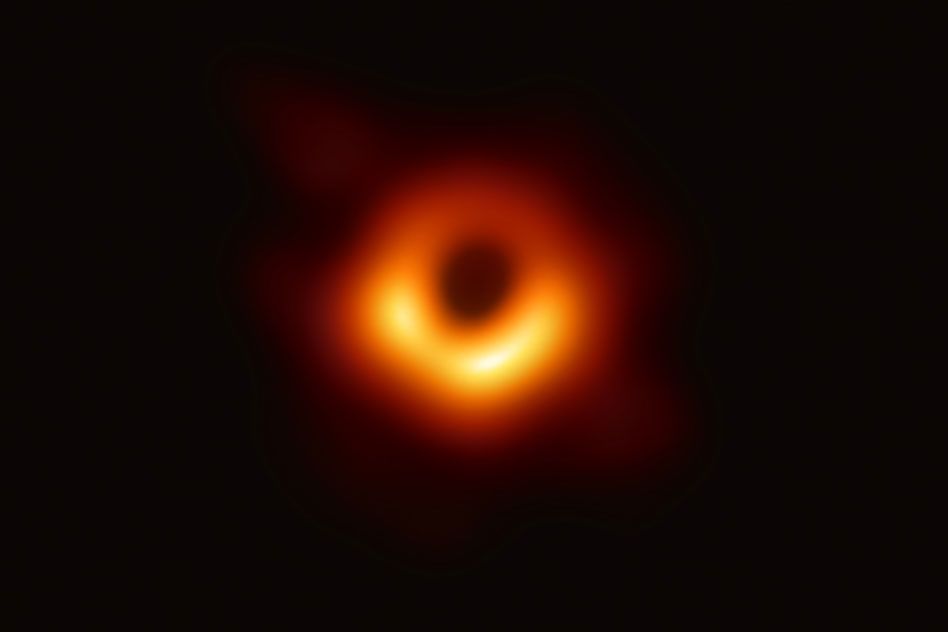 |
| Event Horizon Telescope |
Anyway, the black hole we've photographed is the supermassive black hole at the center of M87, a massive elliptical galaxy. The black hole has a mass of 6.5 billion suns, so even though the galaxy lies 50 million light years away, it was a reasonable target. Easier than the Milky Way's own black hole, which is a mere 4 million solar masses.
The act of getting the pictures took years and the combined efforts of observatories all over the world. The pictures were so massive that they couldn't be sent over the internet, it was faster to store them and ship them around.
Once again, this is some sort of accomplishment. I really never thought we'd get a picture like that now. It's a black hole, after all, and yet, here we are. Astronomy is pretty cool sometimes.
Thursday, February 11, 2016
Discovery of Gravitational Waves Announced
It really doesn't sound like very much, does it? The existence of gravitational waves, first theorized by Albert Einstein, is accepted by pretty much everyone. But for the past 100 years, we've never been able to detect them. We've tried, but gravity, as it turns out, is ridiculously weak.
Let's do a little comparison between gravity and the other 3 fundamental forces, just to demonstrate gravity's weakness. Imagine the force of gravity represented as a 1 kilogram object sitting on a table. A big bottle of water that holds 1 liter weighs a kilogram, if you need a visualization. It's not a problem to pick up, right? Everyone can pick up a bottle of water. That bottle represents gravity's comparative force. Now, let's replace gravity with a similarly sized bottle with the comparative weight of the weak nuclear force, the next weakest fundamental force. That bottle, previously 1 kilogram now weighs nearly as much as Earth and Venus combined. It would then turn into a black hole. As it turns out, the weak nuclear force is stronger than gravity by a factor of 1 * 1025. Try picking that up.
The story only gets worse with the other 2 forces. Let's move on to electromagnetism, which along with gravity is the fundamental force we all know. It's stronger than gravity by a factor of 1 * 1036. For reference, the Sun weighs about 2 * 1030 kg. Our bottle would weigh about as much as 500,000 Suns. This is nearly as heavy as Segue 2, a dwarf galaxy and Milky Way satellite which is (according to Wikipedia) the least massive galaxy known; but far, far more than the most massive stars, which weigh in at around 200-250 solar masses. Again, it would then become a black hole. The strong nuclear force is only 100 times stronger than electromagnetism, so our bottle now weighs 50 million solar masses. For comparison, the supermassive black hole at the center of the Milky Way is only about 4.5 million solar masses. At that mass, our bottle actually would not become a black hole...yes it would.
It would clearly be no easy task then to detect gravitational waves. But today, scientists with the Laser
Interferometer Gravitational-Wave Observatory announced that they had finally managed to do it. The project used a pair of detectors 2,000 miles apart to detect the waves, which compress a laser in one arm of a detector and stretch the laser of the other arm. 2 detectors are necessary to confirm the result, and to triangulate the location of the gravitational wave. It's an incredibly sensitive experiment, but it has to be. Even the largest gravitational waves, emanating from sources such as supernovas and black hole collisions, cause a change in laser length measured at the subatomic level.
On one hand, this isn't exactly the most exciting news. Gravitational waves have been observed indirectly before, and like I said before, very few doubted that they existed. But on the other hand, direct observation is a lot better than indirect. While we can't rule out an error in the experiment (and verifying this observation will be very difficult, since LIGO is the only detector powerful enough to detect gravitational waves), it seems that this announcement will likely be the real deal. It represents a powerful confirmation of general relativity, and now that we know how to detect gravitational waves, we can take the process further, learning much more about the universe. It really is a bigger deal than it sounds.
 |
| Perfect, now just stuff that in a water bottle |
The story only gets worse with the other 2 forces. Let's move on to electromagnetism, which along with gravity is the fundamental force we all know. It's stronger than gravity by a factor of 1 * 1036. For reference, the Sun weighs about 2 * 1030 kg. Our bottle would weigh about as much as 500,000 Suns. This is nearly as heavy as Segue 2, a dwarf galaxy and Milky Way satellite which is (according to Wikipedia) the least massive galaxy known; but far, far more than the most massive stars, which weigh in at around 200-250 solar masses. Again, it would then become a black hole. The strong nuclear force is only 100 times stronger than electromagnetism, so our bottle now weighs 50 million solar masses. For comparison, the supermassive black hole at the center of the Milky Way is only about 4.5 million solar masses. At that mass, our bottle actually would not become a black hole...yes it would.
 |
| Credit: LIGO |
On one hand, this isn't exactly the most exciting news. Gravitational waves have been observed indirectly before, and like I said before, very few doubted that they existed. But on the other hand, direct observation is a lot better than indirect. While we can't rule out an error in the experiment (and verifying this observation will be very difficult, since LIGO is the only detector powerful enough to detect gravitational waves), it seems that this announcement will likely be the real deal. It represents a powerful confirmation of general relativity, and now that we know how to detect gravitational waves, we can take the process further, learning much more about the universe. It really is a bigger deal than it sounds.
Sunday, August 17, 2014
Rare Type of Black Hole Found

Astronomers at the University of Maryland have found one of these rare, intermediate mass black holes. The black hole in question lies in M82, a galaxy 12 million light years away. M82 also happens to be the closest "starburst" galaxy, meaning it has an accelerated rate of star birth. While observing this galaxy in the past, scientists noted an unusually bright source of X-rays, imaginatively named M82 X-1. It was suspected that this object was an intermediate-mass black hole, but accurate estimates of its mass could not be obtained.
To get a more accurate mass estimate, the scientists measured individual x-ray particles from M82 X-1, finding a distinct pattern of light pulses which formed a 3:2 ratio. This ratio could be used to measure the mass of the black hole, which is pretty amazing, when you think about it. They found the black hole's mass to be 428 solar masses, give or take a 100. Doesn't sound very accurate, but it does make this black hole definitively heavier than any stellar mass black hole. Stars don't get that massive. So, now the challenge is figuring out how a black hole of 400 solar masses forms.
Subscribe to:
Posts (Atom)