Featured Post

Review: Southern Pines Golf Club (Part 1)

For our final golf course on this North Carolina getaway, we turn to Southern Pines, which would appear on a surface level to be the third m...

Showing posts with label links. Show all posts

Wednesday, November 25, 2020

Review: Highland Links

The United States has an absolute wealth of golf courses. Golf courses of all shapes and sizes. Golf courses on mountains, in dense forests, in swamps, and on beaches and coastlines. But there's one type of golf course that we don't have too many of: links courses. True links courses are incredibly rare in North America, and Bandon Dunes has a near-monopoly on U.S. links. But out on the end of Cape Cod, flush against the Atlantic on a set of mountainous dunes, is a little 9 hole golf course called Highland Links. 

The fifth green on the edge of the Atlantic.

It's an old course, one of the oldest in the country, dating all the way back to 1892, a time when golf had only been played consistently in the United States for a few years and there were less than 20 courses in existence. It has changed a couple times over that time, but what hasn't changed is its primitive, basic nature. This is not an incredibly elaborate course; all the strategy comes from the land and the elements. Let's take a look at it.

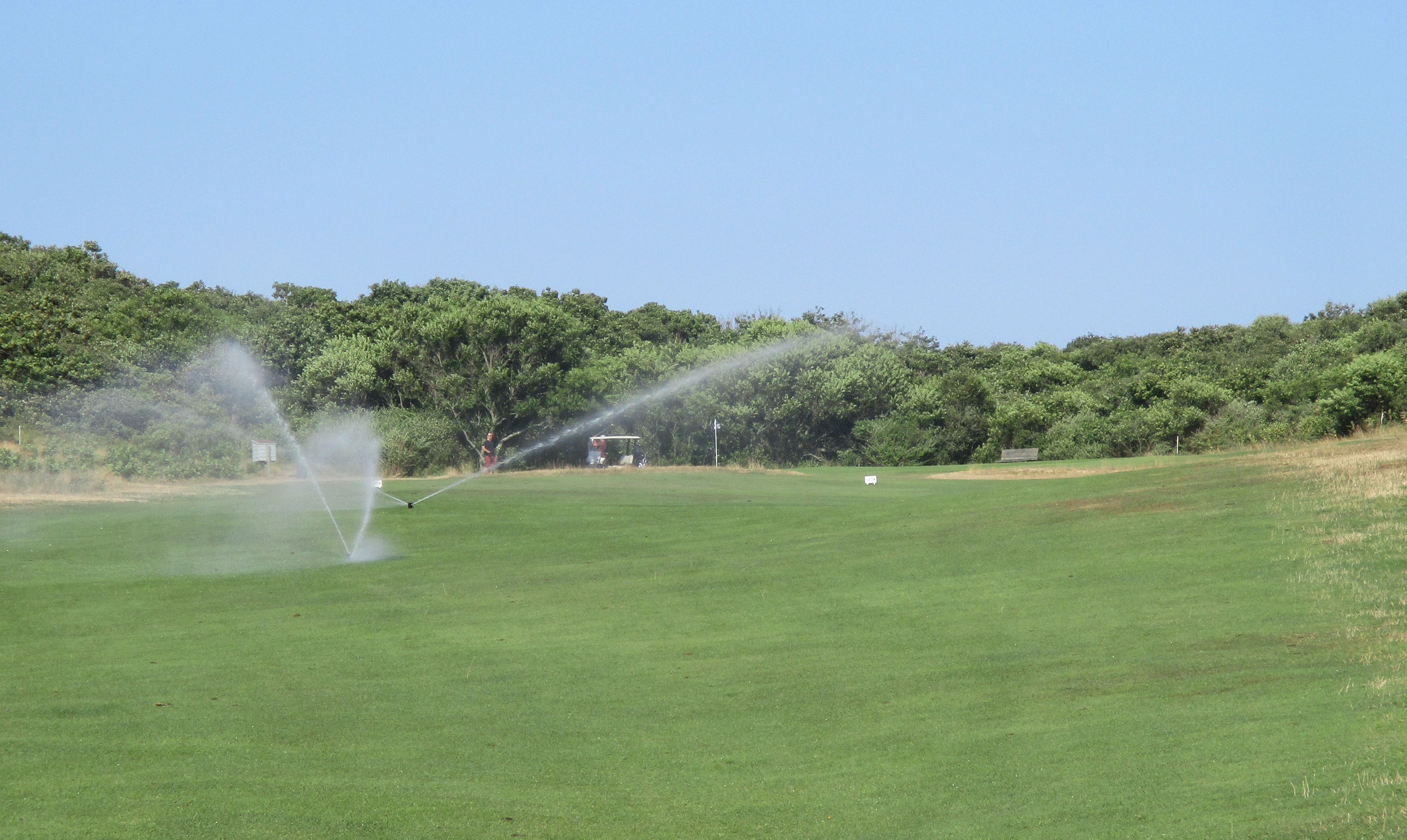
The first hole is about as short a par 4 as you'll ever see, playing all of 250 yards. It's just sitting there, so within reach, a green sitting up on a hill, so close to the tee. You have to go for it, you just have to. But be wary of the wind. Oh yes, a golf course like this is fully exposed to the elements. I imagine this hole is completely unreachable when the wind is smacking you right in the face as you step onto the tee. The safe play is a lay-up, followed by an uphill pitch, but honestly, who can resist? In addition to the wind, there's a pair of bunkers just short that your tee shot will need to be maneuvered around. With the green being fairly quiet, you've got an excellent chance to open with a birdie. 

The first hole.

The first green, with a glimpse of the Atlantic beyond.

The second hole is the sort of hole you don't see every day. On the surface, it's a 460 yard par 5, which doesn't sound like much, but when you get to the tee, the story gets a lot more complex. You start off from a high point and plunge down into a narrow valley covered in bushes and scrubby trees doing their best gorse impersonation. The fairway is angled about 45 degrees from the tee, so the more of the dogleg you cut off, the shorter the second shot. Now, the fairway isn't exactly wide, and in an ideal world, the fairway would be maybe 10-15 yards wider. But that hardly detracts from what is a beautiful and unique hole. The second shot is uphill, but since you're sheltered in the valley and the wind is much less of an issue, it's pretty easily reachable in two. There's a couple of bunkers that need to be carried, but otherwise, the green is fairly straightforward.

The second hole. The mini-castle is apparently a memorial to some entertainment figure of old.

The uphill approach to the second green.

The second green.

Looking back down the second hole.

The third hole, a 160 yard par 3, heads back up out of the valley that the second played through. It's a tough shot, despite the modest length and the lack of any bunkers. It's a big hill you have to go up, and if you're going straight into the wind, we're talking multiple extra clubs being necessary. The green has a decent amount of back to front slope, so missing long isn't recommended. Or short. Or right. That fescue rough really doesn't stop golf balls as well as you might think. It's thin and whispy, especially when the course is dry.

The third hole.

The third green.

The fourth hole is an uphill par 4, not too long at 380 yards, but when it plays straight into the wind, it becomes quite a big task. You want to carry the hill on the tee shot, which wouldn't ordinarily be a huge problem, but the wind makes it a lot tougher. If you do make the carry, you get a view of the green, which is reasonably undulating. 

The fourth hole.

Approaching the fourth green.

The fourth green.

The fifth hole plays parallel to the fourth and is basically the same length, but since it runs in the opposite direction, you'll be facing the opposite wind. That meant the hole was playing very downwind for us. The hole looks flat from the tee, but the same small valley that you have to carry on the fourth cuts across the fairway here. Drives will probably end up down at the bottom, meaning you'll have an uphill and semiblind (or completely blind) pitch to the green. There's a bunker behind the green, which I'm sure gets a fair amount of action considering the wind and the fact that green does fall away slightly at the back. Of course, all that pales when you consider the background. It's really interesting hitting your drive on this hole, watching the golf ball disappear against the vastness of the sky and ocean beyond. The green is perched in the perfect overlook as well. This isn't a marsh, or estuary, or bay, this is the Atlantic Ocean, and there isn't land for thousands of miles. It may not be a complicated hole, but that's probably for the best, since any fancy design would be wasted against such an enormous  backdrop.

The fifth hole.

Down in the gully, looking up at the fifth green.

The fifth green.

Next stop: Europe.

The sixth hole is the longest hole at Highland Links, but at 465 yards, it doesn't sound like much. Remember the wind though, which was at its strongest here, right alongside the cliffside. I imagine even a tour pro would have difficulty getting to the green in two in the wind we faced. For me, a mere mortal, I were lucky to reach the bottom of the valley with the drive, and then to get to the top of the hill in two. Doing that provided a relatively simple pitch into the green, which is guarded by bunkers right and long. 

The sixth hole. Naturally, the Highland Lighthouse was closed and under repair.

Approaching the sixth green.

The sixth green.

The seventh hole is a mid-length par 3, and unlike quite a few holes at Highland Links, the green here has a fair amount of slope, being tilted fairly significantly from back to front. Shots that don't quite make the green will run back down the little slope in front. There's a bunker behind the green that you'll also want to avoid.

The seventh hole.

The seventh green.

The eighth hole turns away from the ocean, and though it may seem modest in length at 350 yards, it plays into the wind and it isn't a very wide fairway. The hole is slightly uphill and doglegs slightly to the left. The right side of the fairway provides a better angle into the green, since there's a bunker left of the green. It was at this point that my brothers and I figured that we could keep shots under the breeze, so rather than throwing a wedge up and leaving it to the mercy of the wind, we hit run-up shots into the green, which worked a lot better. That's really how the course should be played.

The eighth hole.

Approaching the eighth green.

The eighth green.

The ninth hole is the shortest hole at Highland Links at just 135 yards. Plus it was playing downhill too. Doesn't sound like much, but it's more interesting than you might think. The green is small, with bunkers short right and long left. It's also split into two tiers. Rather than hitting and hoping with a high wedge, the play, at least for us, was to hit a punch shot out to the right and running the ball down the tier toward the flag. So while it's short, this is one of the best holes on the course, and a great way to finish the round.

The ninth hole.

I won't sit here and try to claim that Highland Links is someplace you need to see. In the end, we're talking about a 9 hole course that isn't even 2,800 yards from the back tees, and a fairly rudimentary course at that. It's $35 to play 9 holes, which is pretty expensive too. But we played 27 holes the day we came here, with this coming at the end of the day. We drove more than 2 hours in total to get here, and 2 hours to get back. None of us regretted that decision. While some people may be spoiled for choice when it comes to links courses, my brothers and I are not. That makes Highland Links something really unique.

Plus, it's not like we're talking about a bad golf course in a special place. Sometimes rudimentary and primitive is all that you need. The second, fifth, and last hole in particular would be noteworthy at nearly any golf course, with the second being one of the best holes we played over the entire week. So would I recommend Highland Links? I would, and I'd definitely play it again if I'm in the area.

Wednesday, July 22, 2020

Review: The Links at Hiawatha Landing (Part 2)

It's time to check out the back nine at Hiawatha Landing, go here if you haven't seen the front.

The tenth hole is a downhill mid-length par 4 with O.B. all along the left side. Most people will hit a draw in between the two fairway bunkers, likely ending up on the little plateau about 250-300 yards from the tee. Or you could play it like my brother, who hit his drive left, landing on the cart path and ultimately going way over 300 yards. Risky, but probably not worth it. The green is guarded by two bunkers to the right. Overall, a nice, fairly simple way to start off the back nine.

The tenth hole.

The tenth green.
The eleventh hole is a fairly long par 4, playing 430 yards. The hole is bunkerless, but it doglegs left around a cluster of trees that you'll want to avoid. There's plenty of room to the right though. The second shot is semiblind to an elevated green secluded in a little amphitheater. It has a fairly significant amount of slope to it, so missing long isn't a great idea.

The eleventh hole.

The eleventh green is semiblind.
The twelfth hole is by far the longest hole at Hiawatha Landing, stretching to 600 yards from the back tees. This is a big hole by every definition of the word. Off of the tee, the fairway is pretty wide, but there are fairway bunkers on both sides that you'll want to avoid. Then you have a choice. If you're not in a great position, you'll probably have to follow the fairway, leaving yourself quite a long third shot. But if you've hit a decent drive, you can carry as much of the big native area sitting between the fairway and the green as you want. The green is nearly reachable in two if you're pretty long. There's a bunker in front if you're coming from that direction, or on the right if you've laid up. The hole looks intimidating, but it's easier than it looks.

The very long and expansive twelfth hole.

Approaching the twelfth green.

The twelfth green.
The thirteenth hole is a slightly uphill par 3 playing 180 yards over a couple of bunkers. The green is extremely shallow but very wide. And speaking from experience here, if you hit onto the wrong side of the green (such as hitting the left corner when the hole is cut on the right) you will be left with a putt that you will either have to aim off of the green to get to the hole or chip. And yes, I did manage to make a par, which was probably the best two putt I've ever managed. So I'm inclined to like this hole.

The thirteenth hole.

The thirteenth green. You can sort of see my ball way in the distance, many many feet away from the hole.
The fourteenth hole is a nice and short par 4 playing downhill. When we played it, it was downwind, so a well-struck drive could get quite close to the green. Normally though, a driver might not be the best play, since there's a small pond left and a bunker right, both pretty much right where a slightly wayward drive would end up. The green is long, narrow, angled 45 degrees from the fairway, and from our experience, it is completely impossible to make a putt on it. It doesn't look particularly nasty, but apparently it's the toughest green on the course.

The fourteenth hole.

Approaching the fourteenth green.

The fourteenth green.
The fifteenth hole is a long and uphill par 4, playing every inch of its 450 yards. The tee shot is pretty wide open, as the single fairway bunker is too close to the tee to make much of a difference. The second shot is much more interesting, as the green is guarded by four bunkers, all of which are on the left side. The chipping area right of the green does provide some difficulty if you bail out that way. It's a long hole, but not a particularly difficult one.

The fifteenth hole.

Approaching the fifteenth green.

The fifteenth green.
The sixteenth hole is probably the best hole at Hiawatha Landing despite being the longest par 4 on the course, stretching up to 465 yards. That's pretty long, but the hole doglegs sharply to the left, so you can absolutely cut off some of that dogleg to get a much shorter look at the hole. Of course, you have to avoid a cluster of big fairway bunkers to do this, but you can leave yourself a very short second shot if you do it right. And you might want to, because approaching the green from the right side is an intimidating prospect. There's a few bunkers in front and to the right, and the green is sort of elevated on a small plateau.

The sixteenth hole.

The sixteenth green.

The seventeenth hole is a par 3 that's a little over 200 yards, and naturally, as all modern courses must apparently do, water has to come into play. In this case, a pond lurks to the left, and a bunker protects the green to the right. I'm not entirely sure what the two fairway bunkers are accomplishing on a par 3, but yet, there they are. Other than that, it's a fairly standard difficult par 3.

The seventeen hole.
The eighteenth hole is a par 5, and on the scorecard it's listed as being 520 yards (and is almost that wide). But it's only that long if you take the extremely long route around the lake, playing so that no shot carries any water. But if you're willing to take on some risk, you can shorten the hole by a lot. And I do mean a lot. I hit a drive that was maybe 270, 280 yards over the right corner of the pond and had just under 200 yards into the green. But if you can hit it 300 yards, you can really get aggressive and have just a wedge for the second shot. Sure, there's plenty of water to worry about, but a wedge into a par 5 is a pretty tempting proposition. The green is pretty shallow and pretty tilted from back to front so it's not the easiest two putt in the world, but still, this is a great opportunity to finish with a birdie or even an eagle.

A panoramic view of the last hole.

Most people will go down this way.
Approaching the eighteenth green.


The eighteenth green.
All in all, I couldn't help being a little disappointed in the Links at Hiawatha Landing. Don't get me wrong, it wasn't a bad course and there were some interesting holes, but I was hoping for a little bit more. I was especially disappointed in the front nine. Sure, it was neat playing along the river, but the ponds sitting in the middle of the front nine really kind of ruined it. It made several holes, particularly the seventh, way too narrow. I don't like having water on both sides of the fairway, doing that is unnecessarily penal in my opinion.

It's a shame that the front nine isn't more like the back, since the back is by far the superior of the two. There's less water and there's actual elevation change, both of which automatically make things more interesting. I know there probably wasn't much the architect could do in terms of elevation change on the front nine, since it is routed on a flood plain, but throwing ponds down was not a good solution.

In terms of value, Hiawatha Landing isn't too bad. It was 30 dollars per person on a Sunday afternoon, which is pretty decent, especially seeing as it's a newer golf course. But still, if you're looking for value in the Southern Tier, Mark Twain is by far the better option. Two people could play for 30 dollars, and I like that course better. It was nice to play this course once, but I probably wouldn't go back.

Wednesday, July 15, 2020

Review: The Links at Hiawatha Landing (Part 1)

When I went to Binghamton back in October last year to play some golf, I had two courses in mind. Mark Twain and the Links at Hiawatha Landing. Obviously I chose Mark Twain, but when I went up to New York again in early May this year for golf purposes, the Links at Hiawatha Landing got its turn. It's remarkable that courses in New York only closed for a couple weeks considering how bad the pandemic was there.

The course is right next to the Susquehanna River, with all the advantages and disadvantages you'd expect (Advantage: natural hazard; disadvantage: floods easily). I'd heard good things about the course, but the prospect of playing a course right on the river was appealing too. And since we played in early May and this is New York we're talking about, the trees were still basically bare so you could actually occasionally see the river. We got lucky with the weather too (75 and sunny), seeing as not even a week later Binghamton (that's where Hiawatha Landing is) had a few nights below freezing and one day where the high was a whole 35 degrees. In May. Anyway, onto the golf.

The first hole starts things off in a generally benign fashion. It's a mid-length par 4 that plays very slightly downhill. I mean very slightly. The front nine is on the river's flood plain, so it's basically completely flat. Aggressive drives will go over the dogleg and the cluster of fairway bunkers at the corner, leaving a fairly short second shot. But there's a ton of room to miss on either side, this course is pretty wide open in general. That may change later in the year, I'm not sure how thick or how prevalent the native areas get at Hiawatha Landing. The green is protected by a bunker short and left, and the surface is medium sized with a fair amount of contour. So long as you avoid the fairway bunkers, it's not a tough opening hole.

The first hole.

Approaching the first green.

The first green.
The second hole is on the longer side of par 4s, potentially stretching nearly 440 yards depending on tee placement. There's a thick forest right, but it's not all that close to the fairway, and the pond in the distance is also pretty much out of reach. There is a bunker in prime driving position that does pinch into the fairway, and that's the primary hazard on the drive. The pond is more in play on the second shot, bordering the green left and long. To the right there's a chipping area, the first of multiple at Hiawatha Landing. The green is angled right to left, so it's better approached from the right side.

The second hole.

Water lurks left of the second green.

The second green.
The third hole is a pretty simple par 3. It's 180 yards and a single bunker guards the front-left portion of the green. It's a small green, and it's a pretty shallow target. Nothing too special about this hole.

The third hole.

The third green.
The fourth hole is a fairly long 425 yard par doglegging slightly left with O.B. right. There's a fairway bunker at the corner of the dogleg that you'll also want to avoid. As such, a slight draw will be the best shot to hit off of the tee. The second shot is a bit tricky, as there are bunkers short on both sides and the Susquehanna lurks just beyond the green. When the hole is in the back it's quite tough getting shots all the way back there, since you definitely don't want to go long.

The fourth hole. That's not an actual water hazard in the left corner, just a leftover from heavy rain a couple days earlier.

Approaching the fourth green.

The fourth green, with the Susquehanna River in the background.
The fifth hole is the start of a less than stellar 3 hole stretch. I'm not entirely sure why there's a pair of ponds on the front nine when the river provides plenty of watery danger, but that's the design choice they made. The hole is 380 yards and doglegs around the pond to the right, and a pair of bunkers protects the left side. If you've hit the fairway, you're looking at a wedge or short iron to a very narrow green guarded closely by water. Missing left of long isn't great either, since that very slender green slopes down toward the water.

The fifth hole.

Approaching the fifth green

The fifth green isn't an inviting target.

The fifth green from the sixth tee.
The sixth hole is 225 yards, the longest par 3 at Hiawatha Landing. And as you'd expect, it's not easy. There's the pond right, the river lurking left, and the green is all of 15 yards wide, if that. And it's not long either. I guess you can say that the hole is certainly committed to being difficult, since there's not a whole lot of room to miss.

The sixth hole.

The very narrow sixth green.
The seventh hole is the first par 5 at Hiawatha Landing, and in my opinion is the hardest hole on the course. The hole runs alongside the Susquehanna, which is fine, but for most of the hole there's also a pond against the left side. And I'm not a big fan of having water on both sides of a hole. I mean, there's a decent amount of space in between, but still, it's a poor design choice. The hole is 525 yards, so if you've hit a good drive, the green is reachable, but that second shot has to carry the pond to get there. For most people, this is a three shot hole, which is fine, but I wish there was significantly less water involved. In my opinion, the pond just doesn't add anything of value.

The seventh hole, with the river to the right and a pond left.

Approaching the seventh green. I wouldn't recommend trying to get home in two.

The seventh green.

The eighth hole, a moderately long 430 yard par 4, also plays right along the river, but since there's no pond on the left side, there's room to breathe, and to think. A bunker protects the front-left section of the green, which is angled 45 degrees right to left. So the closer you get to the river on the drive, the better angle you'll have into the green. I'm never happy to lose a golf ball in the moment, and it's weird to say, but I put my drive into the river, so now I can say that I've hit a golf ball into the Susquehanna, and I'm oddly proud of that.

The eighth hole.

The best angle to approach the green is from the right side, flirting with the river.

The eighth green.
The ninth hole is a 510 yard par 5, playing slightly uphill. This is a big wide hole, and you can hit your drive almost anywhere. Just watch out for the two fairway bunkers left. If you're going for the green in two, which is completely possible, the second shot has to clear a cluster of five bunkers just short of the green. I'm not sure they're all necessary and maintenance would probably be cheaper if they were consolidated into one slightly bigger bunker, but that's the choice they've made. If you're not going for the green, there's a fairway bunker on the left side slightly less than 100 yards from the hole that you'll want to watch out for.

The ninth hole.

There are plenty of bunkers around the ninth green.

Approaching the ninth green.

The ninth green.
That's it for this week, next week we'll take a look at the back nine.