And sure, golf courses ultimately only uses about 2% of Arizona's total water, but that bumps up to 9% of municipality water. Considering how niche a hobby golf is, it's no wonder no golf course wanted to get interviewed for that article unless they've done a good job. Golf may not be the biggest drain of the West's valuable water resources, but it's very visible and an easy scapegoat. So please, Arizona golf courses, don't ruin the sport for the rest of us. Use your water responsibly.
Featured Post
Review: Leatherstocking Golf Course (Part 1)
Most people who visit Cooperstown, New York, are going to see the National Baseball Hall of Fame. It is the obvious reason to visit the town...

Showing posts with label water. Show all posts
Showing posts with label water. Show all posts
Wednesday, August 3, 2022
Arizona Golf Courses Continue To Use Too Much Water
Here's a controversial statement: Golf really doesn't belong in the desert. Of course, people don't really either, but let's just stick with golf for the moment. Golf courses use a lot of water, and when the desert regions of the United States are going through a multiyear drought of epic proportions, it's really not a good look to hear that Arizona golf courses have consistently failed to bring down their water usage over the past 20 years.

Wednesday, August 8, 2018
Underground Lake Discovered on Mars
So, this was really big news a couple weeks ago, and I was going to write about it last week. But then I found the German beer bottle fiasco and thought it was too good to pass up writing about. Hey, that Martian lake's lasted this long, it can wait a couple weeks.
Anyway, we've found a lake. Filled with liquid water. On Mars. It's a mile underneath the southern ice cap, so we won't be visiting it any time soon, but still, liquid water. A significant body of liquid water on Mars, roughly analogous to Lake Vostok in Antarctica. The Red Planet seems to be sending us mixed signals here, on the one hand, we've confirmed that Mars simply doesn't have enough carbon dioxide left to be terraformed, but on the other hand, we've got this. A lake, about 12 miles across and at minimum 3 feet deep. That's a decent amount of water, and considering what we know, if there's liquid water, there's a good chance there's life.
This is still science we're talking about here, and the discovery still needs to be confirmed. But if it is a lake, it seems like it could be an excellent warm-up for when we explore Europa and Enceladus. Mars is much closer, after all, and I think it's likely we'll get there sometime this century. The water isn't that far underneath the surface, and if there is life floating around in this lake, surely that would boost the odds of life existing under the ice of those moons. All we need to do first is get to Mars. No problem, right?
Anyway, we've found a lake. Filled with liquid water. On Mars. It's a mile underneath the southern ice cap, so we won't be visiting it any time soon, but still, liquid water. A significant body of liquid water on Mars, roughly analogous to Lake Vostok in Antarctica. The Red Planet seems to be sending us mixed signals here, on the one hand, we've confirmed that Mars simply doesn't have enough carbon dioxide left to be terraformed, but on the other hand, we've got this. A lake, about 12 miles across and at minimum 3 feet deep. That's a decent amount of water, and considering what we know, if there's liquid water, there's a good chance there's life.
This is still science we're talking about here, and the discovery still needs to be confirmed. But if it is a lake, it seems like it could be an excellent warm-up for when we explore Europa and Enceladus. Mars is much closer, after all, and I think it's likely we'll get there sometime this century. The water isn't that far underneath the surface, and if there is life floating around in this lake, surely that would boost the odds of life existing under the ice of those moons. All we need to do first is get to Mars. No problem, right?
Wednesday, November 16, 2016
Does Pluto Have a Subsurface Ocean?
As it turns out, apparently you can't go five feet in the outer solar system without hitting a subsurface ocean. Europa's got one, Enceladus has one, and Titan, Ganymede, and Callisto probably have them. That's not even mentioning the list of objects that may have them, according to models of radioactive decay. Here's a list of those.
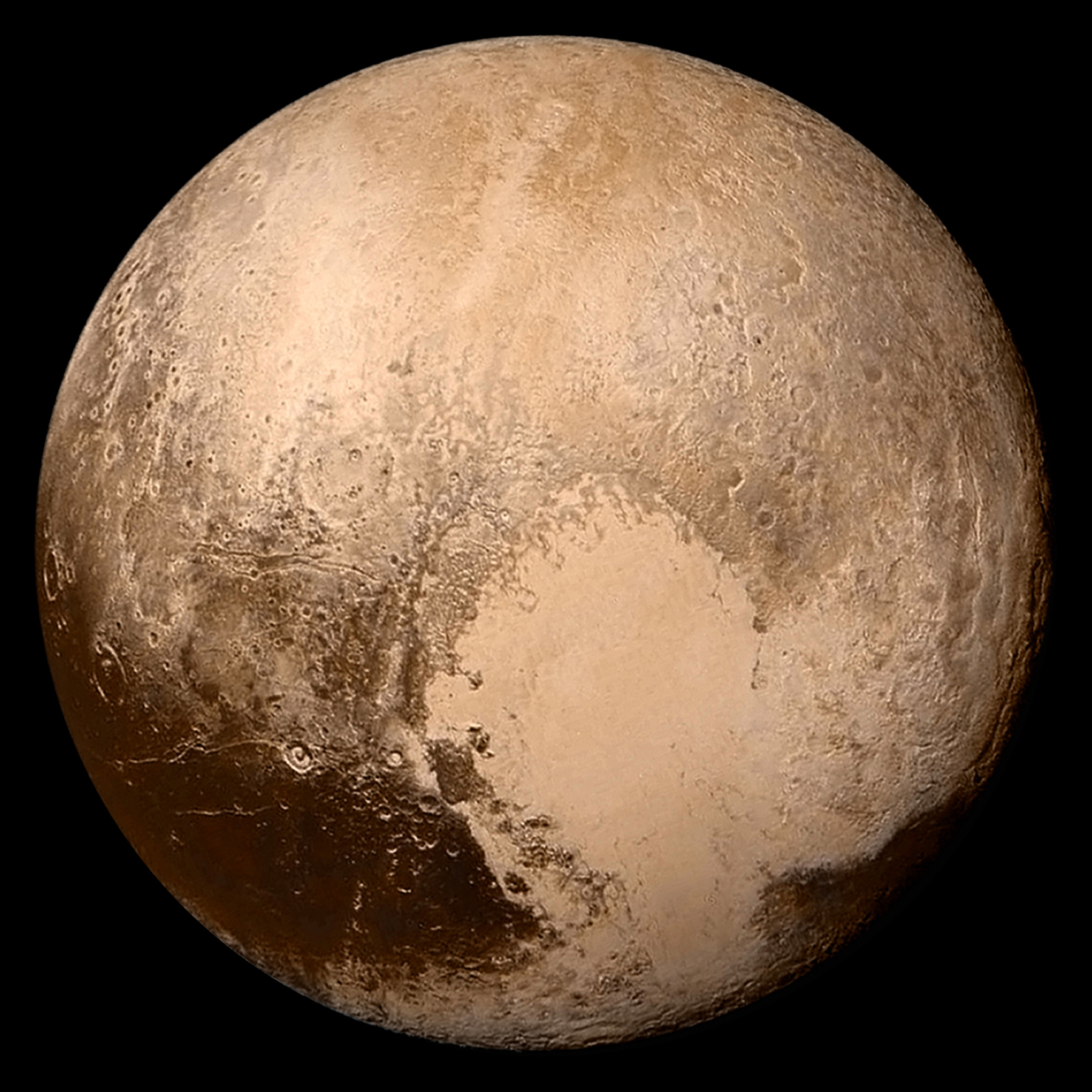 If you're observant (or read the title of this post), you'll notice Pluto on there. I've written about Pluto on several occasions now, as data from New Horizons slowly filtered through. The data return is done, but we still have a lot of things to learn from it. Like this, for example. Based on research of Sputnik Planitia, otherwise known as Pluto's "heart", it is very likely that Pluto possesses a subsurface ocean.
It is believed Sputnik Planitia was once a vast impact basin filled with a layer of nitrogen ice about 6 miles thick. That's fine, but what's interesting is that Sputnik Planitia is oriented almost directly opposite to Charon, the smaller partner in the Pluto-Charon double planet system. This position on Pluto's tidal axis is probably not a coincidence. After the impact, the basin filled up with nitrogen ice. This happened slowly, but as this gigantic mass of ice formed, it changed the shape of the planet, causing the basin to slowly wander towards its current, more natural position on the tidal axis. And as it moved, a series of faults and fractures would have appeared across the surface. And Pluto has these faults and fractures.
Where does the subsurface ocean come in? The sort of movement that Sputnik Planitia has undergone would be impossible without a subsurface, the model depends on it, and observations seem to back up the model. The model predicts faults and fractures, and there are faults and fractures.
Further proof comes from a second study. Those scientists calculated the odds of Sputnik Planitia forming in it's current spot at about 5%, and so also believe the feature has moved over time. They found that the impact which formed the basin would have weakened the crust, bringing the subsurface ocean close to the surface. This along with the accumulation of nitrogen ice would essentially roll the (dwarf) planet around. Without the liquid water, the ice of Sputnik Planitia would have to be several times thicker than currently believed, and that doesn't match up with our observations.
So there we have it. Pluto: likely possessor of a subsurface ocean. It's still not a planet though.
It is believed Sputnik Planitia was once a vast impact basin filled with a layer of nitrogen ice about 6 miles thick. That's fine, but what's interesting is that Sputnik Planitia is oriented almost directly opposite to Charon, the smaller partner in the Pluto-Charon double planet system. This position on Pluto's tidal axis is probably not a coincidence. After the impact, the basin filled up with nitrogen ice. This happened slowly, but as this gigantic mass of ice formed, it changed the shape of the planet, causing the basin to slowly wander towards its current, more natural position on the tidal axis. And as it moved, a series of faults and fractures would have appeared across the surface. And Pluto has these faults and fractures.
Where does the subsurface ocean come in? The sort of movement that Sputnik Planitia has undergone would be impossible without a subsurface, the model depends on it, and observations seem to back up the model. The model predicts faults and fractures, and there are faults and fractures.
Further proof comes from a second study. Those scientists calculated the odds of Sputnik Planitia forming in it's current spot at about 5%, and so also believe the feature has moved over time. They found that the impact which formed the basin would have weakened the crust, bringing the subsurface ocean close to the surface. This along with the accumulation of nitrogen ice would essentially roll the (dwarf) planet around. Without the liquid water, the ice of Sputnik Planitia would have to be several times thicker than currently believed, and that doesn't match up with our observations.
So there we have it. Pluto: likely possessor of a subsurface ocean. It's still not a planet though.
Friday, September 16, 2016
How Recently Did Mars Have Liquid Water?
Science is very hard. You think you know something, you think you've got things all figured out, but then you get some more information, and that previous assumption just goes flying out the window. Case in point: last year, I wrote about how the MAVEN space probe had studied the Martian atmosphere and determined that the pleasant Mars with a substantial atmosphere and abundant liquid water was gone nearly 4 billion years ago, and for most of Mars' history, it's looked pretty much the same as it does now. It was simple, it was elegant, and while it wasn't really good news, it fit the data we had.
You can probably see where this is going. As it turns out, there are valleys and basins on the Martian surface that were formed by liquid water, but formed a billion years after the Martian atmosphere was lost to space, and the planet's surface became too cold to host liquid water. We're not talking about an insignificant amount of water either, there was enough water in one of these lakes to fill Lake Erie and Ontario with water to spare. The valleys running into these basins are not as complex as the older river valleys, indicating a slower flow. This probably indicates the lakes were filled not with rain, but with runoff from fallen snow.
This is obviously a bit of great news. If water could stay liquid on the Martian surface 2 billion years ago, that means that it was potentially habitable for the same amount of time. That is a much longer timeframe then we previously thought. 500 million years is not a huge amount of time for life to evolve, but 2 billion years is a lot more generous. Of course, it also raises into question the findings of MAVEN. Was the atmosphere gone by that point? Where did all the snow come from? Mars just got a lot more interesting.
You can probably see where this is going. As it turns out, there are valleys and basins on the Martian surface that were formed by liquid water, but formed a billion years after the Martian atmosphere was lost to space, and the planet's surface became too cold to host liquid water. We're not talking about an insignificant amount of water either, there was enough water in one of these lakes to fill Lake Erie and Ontario with water to spare. The valleys running into these basins are not as complex as the older river valleys, indicating a slower flow. This probably indicates the lakes were filled not with rain, but with runoff from fallen snow.
This is obviously a bit of great news. If water could stay liquid on the Martian surface 2 billion years ago, that means that it was potentially habitable for the same amount of time. That is a much longer timeframe then we previously thought. 500 million years is not a huge amount of time for life to evolve, but 2 billion years is a lot more generous. Of course, it also raises into question the findings of MAVEN. Was the atmosphere gone by that point? Where did all the snow come from? Mars just got a lot more interesting.
Tuesday, August 2, 2016
Martian Gullies Not Water-Based

But this is science, and in science, the story never ends. Someone dug deeper, did more research, and concluded that the gullies formed through the constant freezing and thawing of carbon dioxide frost, not liquid water. Using spectroscopy from the HiRISE space probe, scientists discovered no evidence that the gullies had deposited any sort of clay or other mineral associated with running water, and that any clay associated with the gullies were ancient and had been exposed during the formation of the gullies. I take this as a reminder that science is never easy, and that even if the answer seems obvious, you should always check to make sure.
Tuesday, February 16, 2016
To Find Life on Mars, Follow the...Salt?

This sounds very counter-intuitive, but it does make a certain amount of sense, considering how microbial life has adapted to the driest conditions here on Earth. In these hyperarid regions, life survives by going underground, living underneath salty crusts that absorb water directly from the air. There is a possibility that as Mars dried up and microbes huddled together in the last bits of liquid brine just below the surface, they evolved in a similar fashion to Earth microbes in a similar situation, subsisting on the small amount of water in the Martian atmosphere. The researchers also suggest that these environments probably dried up for the last time recently, and perhaps some still exist. It's not the most dignified way for life to get by, but to go for so long in such a hostile place would be impressive nonetheless.
Monday, September 28, 2015
Liquid Water on Mars
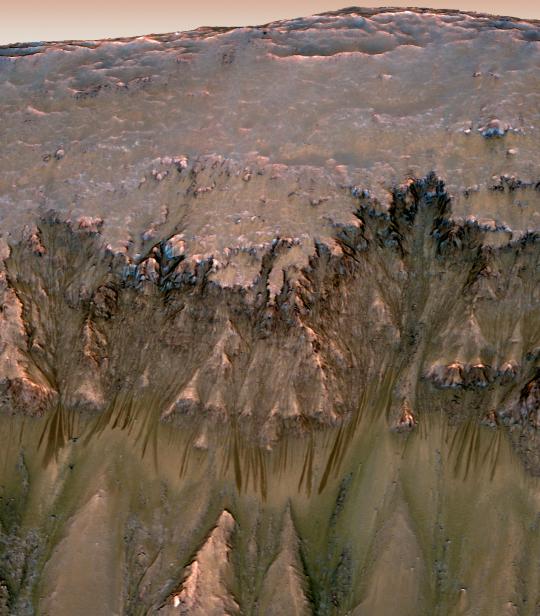
As you may have guessed, today NASA announced that the evidence had been gathered, and they could definitively say that the RSL were in fact formed by liquid water. Now, I don't want to overstate the importance of this discovery. The water is filled with a kind of salt called perchlorate, which lowers the freezing point of the water to well below zero. That's good for liquid water, not good for life, as we know of no organism that could live in such an environment. In addition, we're not talking about some big gushing stream running down a crater, but what basically amounts to damp soil. There's not a lot of water available. However, finding any amount of liquid water is fantastic news. Just because life as we know it could not survive there doesn't mean it's completely inhospitable, and any manned missions to Mars could certainly use it. I think it's absolutely incredible that for so long, we assumed that liquid water could only exist on Earth, but we've found it on Europa, on Enceladus, and now, on Mars. That's 4 different planetary systems that we can find liquid water, spread out across a billion miles of space. At this point, I would be more surprised if life did not exist elsewhere in the Solar System then if it did, because with every discovery of liquid water, the odds of finding life improve.
Monday, August 5, 2013
A Year of Curiosity
The Curiosity rover has been on Mars for a year now. While the rover captured the public's eye with its exciting landing, I've been waiting for a while, watching the science roll in. This article provides a good summary of everything that the probe has accomplished in the past year:
http://www.wired.com/wiredscience/2013/08/curiosity-year-discoveries/?pid=9781&viewall=true
The confirmation that Mars had fresh liquid water at its surface is the most exciting piece of news. The implications should be obvious, where there is water, life usually follows. Unfortunately, Curiosity isn't equipped to look for ancient or current life, so we'll have to wait for the next rover to find the answer to those questions. However, the prospects for current life on Mars do not look good, as Curiosity was unable to detect any methane in the Martian atmosphere. Methane had previously been detected, and since methane almost always comes from an organic source, modern life on Mars seemed likely. This result doesn't mean there isn't currently life on Mars, but the odds are against it. The rover is still going strong, and hopefully the future will prove to be as productive as the past year for Curiosity.
http://www.wired.com/wiredscience/2013/08/curiosity-year-discoveries/?pid=9781&viewall=true
The confirmation that Mars had fresh liquid water at its surface is the most exciting piece of news. The implications should be obvious, where there is water, life usually follows. Unfortunately, Curiosity isn't equipped to look for ancient or current life, so we'll have to wait for the next rover to find the answer to those questions. However, the prospects for current life on Mars do not look good, as Curiosity was unable to detect any methane in the Martian atmosphere. Methane had previously been detected, and since methane almost always comes from an organic source, modern life on Mars seemed likely. This result doesn't mean there isn't currently life on Mars, but the odds are against it. The rover is still going strong, and hopefully the future will prove to be as productive as the past year for Curiosity.
Subscribe to:
Posts (Atom)